AI learning tracks by role
Start with the work you do, or with no technical background at all. Each track puts explainers, definitions and conversations in an order chosen for that starting point, with a reason for every step.
- 7 tracks
- 73 steps
- 34 explainers
Pick your starting point
-
Curious about AI, no technical background
You can explain what an AI assistant is doing, check what it tells you and decide what to share with it.
Start the Curious about AI, no technical background track What’s inside: Curious about AI, no technical background
-
Business leaders and executives
You can question an AI proposal, define evidence of value and set boundaries before expanding its use.
Start the Business leaders and executives track What’s inside: Business leaders and executives
-
Product managers
You can scope an AI feature, specify how to judge it and measure whether it improves the user’s work.
Start the Product managers track What’s inside: Product managers
-
Software engineers new to AI
You can explain an AI application’s components, test its behavior and review the code used to build it.
Start the Software engineers new to AI track What’s inside: Software engineers new to AI
-
Developers working with AI coding agents
You can brief a coding agent, define the checks it must pass and review its work without reading every line.
Start the Developers working with AI coding agents track What’s inside: Developers working with AI coding agents
-
Engineers taking AI to production
You can define release checks, trace failures and bound the cost and authority of a production agent.
Start the Engineers taking AI to production track What’s inside: Engineers taking AI to production
-
Security, governance and compliance
You can review an agent’s access and oversight, identify needed audit evidence and scope adversarial testing.
Start the Security, governance and compliance track What’s inside: Security, governance and compliance
These routes draw from all five levels of the AI, decoded pathway. Use a track for a particular job or follow the levels to build depth across the subject.
New to the show? Start hereTrack 1 of 7
Curious about AI, no technical background
For anyone who uses or keeps hearing about AI and wants to understand it, without a technical background or a full course.
After this track: You can explain what an AI assistant is doing, check what it tells you and decide what to share with it.
- 11 steps
- 34 min reading
- 1 episode

- AI vocabulary in plain English: 14 terms Glossary
- How do large language models actually work? Explainer
- Why do LLMs hallucinate? Explainer
- How do you check whether an AI answer is supported? Explainer
- How do you decide what information an AI assistant may receive? Explainer
- How do you give an AI assistant a useful brief? Explainer
- What makes an AI agent different from an LLM? Explainer
- Can an AI agent actually run your workday? Explainer
- Is using AI bad for the environment? Explainer
- Is AI taking software engineering jobs? Explainer
- I Built an AI Coworker That Runs 90% of My Day | Sterling Chin, Postman Episode
Track 2 of 7
Business leaders and executives
For leaders making AI decisions in clinical, financial, operations and other business teams.
After this track: You can question an AI proposal, define evidence of value and set boundaries before expanding its use.
- 11 steps
- 41 min reading

- AI vocabulary in plain English: 14 terms Glossary
- Why do LLMs hallucinate? Explainer
- What is a token in AI, and why does it decide what AI costs? Explainer
- Why do most enterprise AI projects fail to show ROI? Explainer
- How do you measure whether AI is actually paying off? Explainer
- What are AI evals, and what should leaders know about them? Explainer
- How do you govern AI agents in an enterprise? Explainer
- What does it actually take to ship AI in a regulated industry? Explainer
- How do you decide what information an AI assistant may receive? Explainer
- What makes an AI agent different from an LLM? Explainer
- How much autonomy should you give an AI agent? Explainer
Track 3 of 7
Product managers
For product managers defining AI features, acceptance criteria and the work people keep.
After this track: You can scope an AI feature, specify how to judge it and measure whether it improves the user’s work.
- 10 steps
- 36 min reading
- 2 episodes
- How do you give an AI assistant a useful brief? Explainer
- What is context in an AI agent? Explainer
- Should you use prompting, RAG, or fine-tuning to customize an AI model? Explainer
- What are AI evals, and what should leaders know about them? Explainer
- What is LLM-as-a-judge, and when can you trust it? Explainer
- How much autonomy should you give an AI agent? Explainer
- What's the difference between human in the loop and human on the loop? Explainer
- How do you measure whether AI is actually paying off? Explainer
- AI Codes: Product Engineers Decide What to Build | Laurie Voss, Arize Episode
- 250,000 Lines of Code/Week: Inside an AMD VP's Agent-First Workflow | Anush Elangovan Episode
Track 4 of 7
Software engineers new to AI
For software engineers adding language models and agents to their existing engineering skills.
After this track: You can explain an AI application’s components, test its behavior and review the code used to build it.
- 12 steps
- 41 min reading
- 1 episode
- How do large language models actually work? Explainer
- What is a token in AI, and why does it decide what AI costs? Explainer
- Context Window Glossary
- How do you give an AI assistant a useful brief? Explainer
- What is RAG, and why do AI systems use it? Explainer
- Embeddings Glossary
- Vector Database Glossary
- Should you use MCP or build a custom integration to connect AI to your tools? Explainer
- Do you still need an AI agent framework? Explainer
- How do you test an AI system when the output isn't deterministic? Explainer
- 250,000 Lines of Code/Week: Inside an AMD VP's Agent-First Workflow | Anush Elangovan Episode
- Who reviews the code when AI writes most of it? Explainer
Track 5 of 7
Developers working with AI coding agents
For developers who hand real work to coding agents and need to trust what comes back.
After this track: You can brief a coding agent, define the checks it must pass and review its work without reading every line.
- 10 steps
- 22 min reading
- 3 episodes
- How do you give an AI assistant a useful brief? Explainer
- How does reinforcement learning improve AI coding models? Explainer
- How do you test an AI system when the output isn't deterministic? Explainer
- Who reviews the code when AI writes most of it? Explainer
- My Robot Army: How I review AI code External article
- Reward Hacking Glossary
- 250,000 Lines of Code/Week: Inside an AMD VP's Agent-First Workflow | Anush Elangovan Episode
- Can AI modernize legacy code and old applications? Explainer
- Your Best AI Engineer Might Have the Worst Metrics | Sonar CTO Andrea Malagodi Episode
- AI Codes: Product Engineers Decide What to Build | Laurie Voss, Arize Episode
Track 6 of 7
Engineers taking AI to production
For engineers and architects responsible for operating AI systems beyond a working demo.
After this track: You can define release checks, trace failures and bound the cost and authority of a production agent.
- 10 steps
- 35 min reading
- 2 episodes
- How do you evaluate an AI agent? Explainer
- What's the difference between AI observability, evaluation, and benchmarking? Explainer
- What are AI agent guardrails, and how do you set them? Explainer
- How do you cut the cost of running an AI agent? Explainer
- Latency Glossary
- Why do multi-agent systems fail, and how do you make them reliable? Explainer
- What are the types of AI agent memory? Explainer
- How do you give an AI agent an identity and permissions? Explainer
- Architecting Reliable Agentic AI | Cisco’s Giovanna Carofiglio on the AGNTCY Collective Episode
- The AI Agent Trust Gap: Bridging Risk to Reliability | Elastic’s Philipp Krenn Episode
Track 7 of 7
Security, governance and compliance
For security, risk and compliance teams reviewing AI data access, actions and accountability.
After this track: You can review an agent’s access and oversight, identify needed audit evidence and scope adversarial testing.
- 9 steps
- 23 min reading
- AI Security Topic guide
- Prompt Injection Glossary
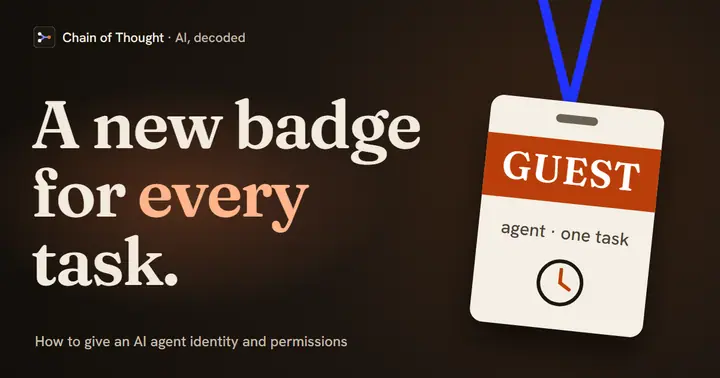
- How do you give an AI agent an identity and permissions? Explainer
- Data Sovereignty Glossary
- How do you decide what information an AI assistant may receive? Explainer
- How do you govern AI agents in an enterprise? Explainer
- Audit Trail Glossary
- AI Red Teaming Glossary
- Microsoft: planning red teaming for LLMs and their applications External docs
The newsletter
New episodes and Conor’s essays, in your inbox
New episodes and Conor’s essays on what they add up to. 1,300+ subscribers. Up to once a week, no spam, unsubscribe anytime.