In detail
Pilots are easy; production is where ROI lives
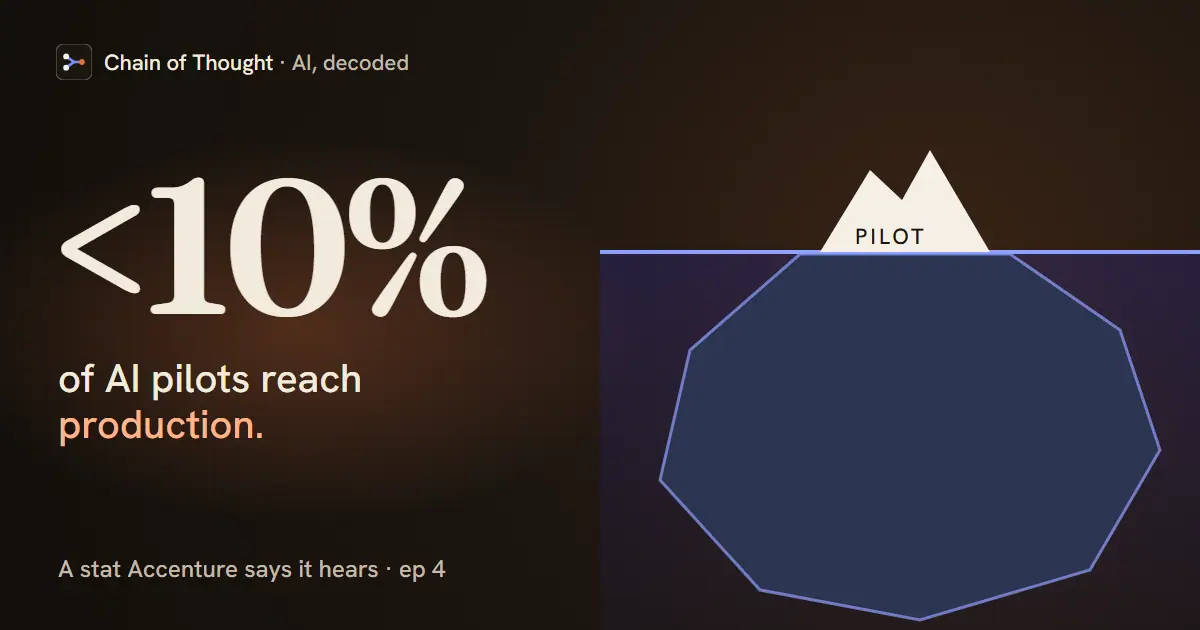
A proof of concept proves the model can do the task once, in clean conditions. Returns mostly appear at scale, in production, running against real data and real users. The distance between those two is where most projects end — the pilot succeeds, the rollout never happens, and the spreadsheet shows cost with no offsetting return.
Accenture’s Jay Subrahmonia said in episode 4 at 33:00 that “we also hear stats” putting production deployment at less than 10% of proofs of concept, partly because the governance, testing and monitoring needed to make that shift are missing; he does not name the source of the statistic. In July 2024, Gartner predicted that at least 30% of generative AI projects would be abandoned after proof of concept by the end of 2025, citing poor data quality, inadequate risk controls, escalating costs or unclear business value.
The costs nobody budgets
The line item that kills ROI is everything after the model works: wiring it into legacy systems, cleaning the data it depends on, building evaluation so you can trust it, clearing governance and compliance, and paying to run and monitor it indefinitely. These are large, ongoing, and easy to leave out of the original business case — so the project looks cheaper going in than it is. Kyndryl Global Head of Strategy Kris Lovejoy says in episode 62 at 6:59 that critical infrastructure customers often run mainframes, newer systems and multiple clouds, with data scattered across them. A pilot does not settle the data integrity, security and reliability work required to operate across that mix.
Vague metrics guarantee invisible returns
Many projects can’t show ROI because they never defined it. “Make support more efficient” isn’t measurable; “cut average handle time by 20% against this quarter’s baseline” is. Without a baseline and a target set before you start, even a project that works can’t prove it did. In episode 76 at 4:33, Sonar CTO Andrea Malagodi found one engineer with more than 500 pull requests and a low AI cost per pull request, while another had high spend and few pull requests. Looking into their work showed they were solving different problems, so the cost metric alone could not establish whose work was more valuable. (5:02)
What the successful ones do differently
They pick a problem with a clear, measurable value, budget for the whole lifecycle rather than the pilot, and decide up front how they’ll measure success. The model is rarely the hard part. The operating discipline around it is.
Picking the problem can be the hard step. OutSystems co-founder Rodrigo Coutinho said in episode 19 at 36:22 that many of the company’s customers know AI matters but have not found the use cases where it pays off, partly because of a “wrong perception that these technologies fix everything” (37:14). His conclusion at 37:40 is that “the biggest challenge is not the technological” but ideation: working out with the business where the technology is strong. The episode aired in season two, which Galileo sponsored while Conor worked there; Galileo CTO Atindriyo Sanyal co-hosted (0:30).
Adoption also needs an owner. Claire Vo, then chief product and technology officer at LaunchDarkly and founder of ChatPRD, said in episode 36 at 6:05, published in August 2025, that large companies adopting AI in a meaningful way are operationally mature: their engineering practices already protect quality and velocity, which makes it easy to add agentic engineers or AI IDEs, because the same practices apply as when you add engineers or tools (6:33). Along with risk tolerance and that maturity, she names centralized focus and accountability. At LaunchDarkly, she says, the shift that made the biggest difference in engineering adoption was making one of its most senior engineering leaders the AI czar (7:22). She is describing engineering adoption, a precondition for returns, not measured ROI. The episode aired in season two, which Galileo sponsored while Conor worked there; Conor points listeners to the RunGalileo YouTube channel at 42:24.
Disclosure: In episode 4, Conor introduces himself as Galileo’s head of developer awareness, with Galileo CEO Vikram Chatterji co-hosting (0:00). Episode 76 credits Svix, Walrus Memory and Inngest as Season 4 presenting sponsors (Svix read at 14:55, Walrus Memory at 16:01, Inngest at 34:17) and carries a G2i episode sponsorship (read at 33:36).
Hear it from the guest
“We also hear stats that say … while there are a lot of POC that have been done only less than 10 percent have actually been put into production and partly … it's because of not having the right sort of governance and the, testing and the monitoring in place to be able to make that shift.”
“But I feel like a lot of people skip over the hard part. It's less fun. It's less exciting. It's less sexy.”
“95% of all AI work today done by enterprises remain as proof of concepts. They don't move into production.”
“The use cases where a customer is not aligned on what good looks like.”
“They want to build something shiny and adopting some cool tech, right, but not necessarily solving a business problem.”
“Most critical infrastructure industries are not cloud first. They may have some mainframe mid-range. They have your X-series. They've got cloud infrastructure. They probably have multiple clouds. They've got a truly hybrid environment. Some of it is very old. We say it's vintage.”
“I get to a reasonable understanding of the cost of PR. And we did that. And what I observed in the numbers, which I have to say, I mean, it made me incredibly curious immediately. was I had on the one side Individual at the one extreme that had an enormously high PR count, over 500.”
“The biggest challenge is not the technological. It's actually this ideation process and coming up with great use cases where they can benefit from the technology.”
“They're operationally mature in a way that their engineering practices already protect for quality, already protect for velocity”
Quotes lightly edited to remove filler words.
From the conversation
This explainer is drawn from these episodes — each carries its full transcript.
-
 Why Most Enterprise AI Projects Fail to Show ROI | HP, ServiceNow & Accenture
-
 The Enterprise AI Deployment Playbook | ServiceTitan, Indeed & Twilio
-
 Your Key to AI Success is Hiding in Plain Sight | Cohesity's Greg Statton
-
 Why Enterprises Need a Different Approach to AI Agents | Lyzr’s Siva Surendira
-
 The State of AI: Open-Source Models & Enterprise Trust | May Habib
-
 From Demo to Defensibility: How to Build an AI Business that Lasts | Aurimas Griciūnas
-
 The First Fully Autonomous AI Attack is Coming | Kris Lovejoy, Kyndryl
-
 Your Best AI Engineer Might Have the Worst Metrics | Sonar CTO Andrea Malagodi
-
 Low-Code AI: From Requirements to Apps in Minutes | OutSystems' Rodrigo Coutinho
-
 How AI Velocity is Rewriting the Rules for Engineering Leaders | ChatPRD's Claire Vo
Concepts in this explainer
AI Pilot (Proof of Concept)AI BubbleCost per PRData QualityGenerative AI