
Atindriyo Sanyal, known as Atin, is the co-founder and CTO of Galileo and a recurring co-host of Chain of Thought in the show’s first season. He co-hosted conversations on evaluation-driven development, the fallout from DeepSeek’s R1 model, and why a trust layer is becoming the bottleneck for shipping AI.
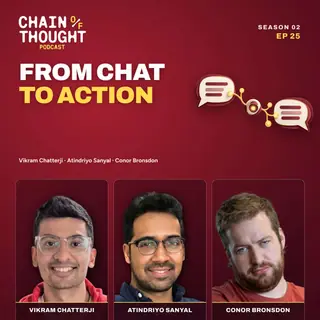
Latest episode with Atindriyo Sanyal · EP 25
The 2025 AI Shift: From Chat to Task Completion & Reliable Action | Galileo Founders
Vikram Chatterji & Atindriyo Sanyal ·
Episodes
-
-
EP 11 · AI Agents
How DeepSeek Changed the AI Race Overnight
-
-

EP 6 · Open Source AI
The Enterprise AI Deployment Playbook | ServiceTitan, Indeed & Twilio
What the conversations cover
These notes summarize the episodes featuring Atindriyo Sanyal, including other speakers in panel conversations. Follow a source link to read the discussion in context.
EP 25 The 2025 AI Shift: From Chat to Task Completion & Reliable Action | Galileo Founders
- Vikram Chatterji frames 2025’s defining shift as generative AI moving from chat completion toward task completion and action. He argues this elevates the enterprise conversation beyond building chatbots to automating tasks, with the goal of higher ROI on OpEx and CapEx — though he concedes “agents” is “an overblown term.” Episode takeaways
- Vikram describes a “gold rush” among middleware providers racing to build orchestration and frameworks — citing OpenAI’s Agents SDK, Anthropic’s MCP, and Google’s A2A. He’s blunt that some “don’t mean anything” and are “shallow libraries,” but reads the collective effort as the system falling into place to make task-completion apps real. Episode takeaways
- Atin Sanyal pitches evaluation agents as composable functions that sit where the developer works — for example an eval agent installed as a tool inside Cursor that automatically fixes potential issues. He argues eval is expanding into a broader AI reliability story rather than the point-in-time activity it used to be, with MCP servers standardizing communication around the LLM. Episode takeaways
EP 11 How DeepSeek Changed the AI Race Overnight
- Atin argued R1 was no secret sauce: DeepSeek leaned on the standard methodologies already used to train the larger OpenAI and Anthropic models, pushing distillation and reinforcement learning hard enough to train a very large model at “like 95% less cost.” The novelty, he said, was efficiency — not some technique no one had seen before. A very large base model still sat underneath it all (the V3 base, trained on 15 trillion tokens). Episode takeaways
- On the cost curve, Atin predicted that within “twelve to eighteen months, someone should be able to train a similar model just on their laptop.” He pointed to cheaper models already built on top of DeepSeek — including, by his own double hedge, a Berkeley student project he “already heard” about that “what I heard was $500” — as the start of a pattern of ever-cheaper foundation models. Episode takeaways
- Atin pushed back on the hype that R1 was “some kind of all knowing all encompassing thing.” He framed it as a reasoning experiment: reinforcement learning plus auto-generated chain-of-thought data to produce high-quality reasoning models — which, by design, left it “not that great at some non reasoning based tasks.” Episode takeaways
EP 9 AI in 2025: Agents & The Rise of Evaluation-Driven Development | Galileo's Yash Sheth & Atindriyo Sanyal
- Atin Sanyal’s hot take: “in the next three to five years, every piece of software that is built on this planet will have some sort of AI baked into it.” He argues AI software development is “back to square zero” — “there’s no eval tooling,” and people are using “caveman tools” to “just look at vibe checks and eyeballs.” Conor pushes back that it’ll take longer and will owe Atin a meal if that five-year claim is proven right. Episode takeaways
- Yash Sheth’s one-word theme for 2025: “automation.” He argues the real ROI comes not from making software more conversational but from automating workflows across industries — LLMs that make API calls, execute code, and process multi-modal data (images, audio). Episode takeaways
- Atin notes that “25 percent of Google’s code is now code gen automated,” but says under a magnifying glass most of it is boilerplate — “a couple of for loops” and basic things. His excitement for 2025 is moving past boilerplate toward “better code understanding” that grasps the context around the code. Episode takeaways
EP 6 The Enterprise AI Deployment Playbook | ServiceTitan, Indeed & Twilio
- Mehmet (ServiceTitan): “Second Chance Leads” reassesses conversations a CSR marked as a non-lead — if the system decides the call should have booked a job, it triggers a callback within about five minutes. Mehmet calls it a direct ROI generator because it recovers a lead that was already missed. Episode takeaways
- Mehmet (ServiceTitan): for an actual virtual assistant, the LLM cost was “about at least half” of the operational overhead (hedged — “I don’t know the exact numbers” — and inclusive of all compute). On model-to-task fit, GPT-3.5 works great for summarization or sentiment detection, while GPT-4.0 is reserved for reasoning-heavy work like virtual assistants. Episode takeaways
- Mehmet (ServiceTitan): large context “defeats RAG in pretty much all” contextual Q&A, but you pay for it on every request. Emerging self-route / staggered approaches first ask the LLM whether it can answer from the RAG window, and only fall back to large context when it says it cannot. Episode takeaways
Positions and best quotes
What Atindriyo Sanyal argued on the show, as verbatim transcript excerpts. Each one links to the moment it was said.
EP 9 AI in 2025: Agents & The Rise of Evaluation-Driven Development | Galileo's Yash Sheth & Atindriyo Sanyal
-
I think from my perspective, lot of focus will be on getting LLMs to actually do work and take action, as opposed to just showing some generation that looks smart, which is where agents come in. A lot of the foundational models are also focusing towards multi modality, so that will, that's the other thing that'll sort of pick up. And it'll be interesting to see a hybrid system where … the LLMs are taken to the next level. They start actually achieving goals for users and, not only taking language as input, but also images and audio.
Transcript at
EP 6 The Enterprise AI Deployment Playbook | ServiceTitan, Indeed & Twilio
-
I know, Vinnie, I know Twilio is of course doing agentic stuff, but also leveraging multimodal. Like, I'm curious to know if, sort of challenges have you seen in the early going as you've been building out these applications, maybe if you could focus maybe on evals, that would be interesting.
Transcript at
Quotes are verbatim, with ellipses marking omitted words. Automatically selected quotes may have filler words removed.
In their words
I think I'd love to give my two cents on this one because it's an interesting question. I know creativity versus determinism was this one of the first questions that was asked when ChatGPT happened and LLMs were upon us.
 Atindriyo Sanyal The 2025 AI Shift: From Chat to Task Completion & Reliable Action | Galileo Founders · 29:10
Some of the other things that we realized as some of these agentic systems matured that number one there's no one size fits all there's no one metric that can tell you agent quality it really depends on the different components that you have in your agentic system just to be more concrete say you have an agent which is like a financial chatbot advisor, just to take that example. Say you have some, a rag system in there that does vector store lookups.
Atindriyo Sanyal How DeepSeek Changed the AI Race Overnight · 21:28 Transcript excerpts; ellipses mark omitted words. Some automatically selected quotes have filler words removed.
Related episodes
-
EP 42 · AI Agents
Architecting AI Agents: The Shift from Models to Systems | Aishwarya Srinivasan
Aishwarya Srinivasan, Fireworks AI
-
EP 81 · AI Agents
Agents Are Overtaking Humans in Search: Why Search Must Be Rebuilt
Saahil Jain, You.com
-
EP 80 · AI Agents
How Cisco Secures Personal AI Assistants for 90,000 Employees | DJ Sampath
DJ Sampath, Cisco
-
EP 31 · AI Agents
Architecting Reliable Agentic AI | Cisco’s Giovanna Carofiglio on the AGNTCY Collective
Giovanna Carofiglio, Cisco
Related guests






Explained on AI, decoded
- Can switching to an open model actually cut your AI costs?
- Can AI modernize legacy code and old applications?
- How do you test an AI system when the output isn't deterministic?
- How do you evaluate an AI agent?
- What makes an AI agent different from an LLM?
- How do AI voice agents work?
- How do you measure whether AI is actually paying off?
- Should you evaluate AI with an LLM-as-a-judge or with human review?
- When should you use a reasoning model instead of a standard LLM?
- How do you cut the cost of running an AI agent?
- What are AI agent guardrails, and how do you set them?
- Why do most enterprise AI projects fail to show ROI?
- Why do multi-agent systems fail, and how do you make them reliable?