Vinnie Giarrusso
Principal Software Engineer at Twilio
- 2 episodes on Chain of Thought
- 5 topics covered
- 2 full transcripts
- Dec 2024 first on the show

Vinnie Giarrusso is a principal software engineer at Twilio. He appeared on Chain of Thought first as part of an enterprise deployment panel and then for a Season 1 closing conversation on AI assistants as "async junior digital employees," arguing that AI can free people for more meaningful human connection rather than replace it.
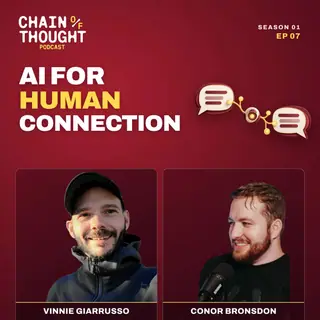
Latest episode with Vinnie Giarrusso · EP 7
Beyond Chatbots: How Twilio Uses AI to Strengthen Human Connection | Vinnie Giarrusso
Vinnie Giarrusso, Twilio ·
Episodes
-
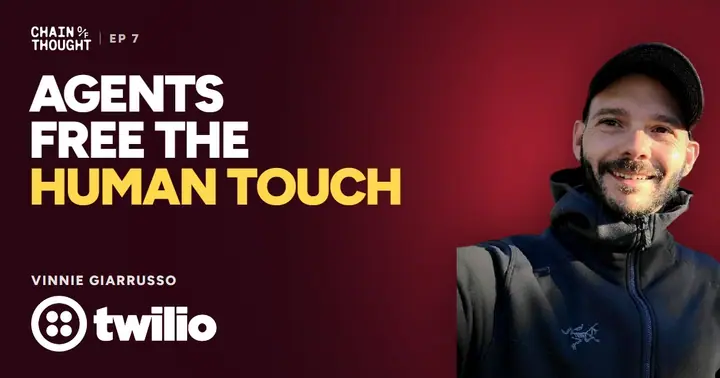
EP 7 · AI Evaluation & Reliability
Beyond Chatbots: How Twilio Uses AI to Strengthen Human Connection | Vinnie Giarrusso
-
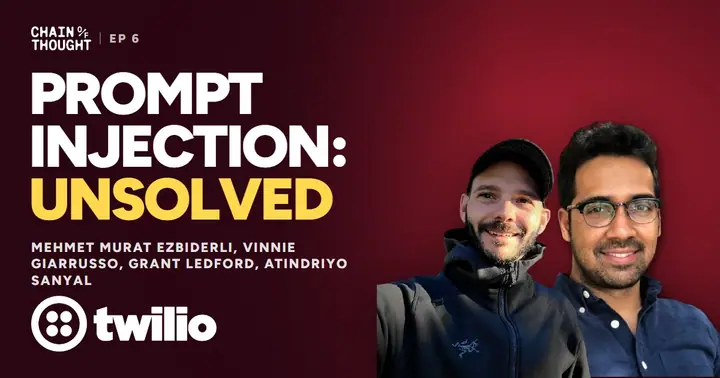
EP 6 · Open Source AI
The Enterprise AI Deployment Playbook | ServiceTitan, Indeed & Twilio
What the conversations cover
These notes summarize the episodes featuring Vinnie Giarrusso, including other speakers in panel conversations. Follow a source link to read the discussion in context.
EP 7 Beyond Chatbots: How Twilio Uses AI to Strengthen Human Connection | Vinnie Giarrusso
- Twilio deliberately calls them “AI assistants,” not agents — the framing is that, especially early on, these systems play a “side by side” role with humans, augmenting people with “superhuman powers” and they can interact with humans who may be tasked with accepting or rejecting the assistant’s actions. Episode takeaways
- The product is a low-code autonomous agent platform: developers get tools, knowledge sources (document upload and web-page crawling), managed memory, and an API layer for deployment and invocation — with Twilio’s native channels (SMS, voice, WhatsApp, conversations) integrated so an assistant can actually reach customers. Episode takeaways
- RAG retrieval is one of the biggest failure modes at scale — it is easy to stand up a pipeline from the LangChain docs, but once you dump 10, 15, or 20 knowledge sources in, the assistant may pick the wrong source or return weak top-K chunks; context-aware retrieval (informed by Anthropic’s contextual research) has been “a game changer,” though Vinnie declined to give hard numbers on the accuracy lift. Episode takeaways
EP 6 The Enterprise AI Deployment Playbook | ServiceTitan, Indeed & Twilio
- Mehmet (ServiceTitan): “Second Chance Leads” reassesses conversations a CSR marked as a non-lead — if the system decides the call should have booked a job, it triggers a callback within about five minutes. Mehmet calls it a direct ROI generator because it recovers a lead that was already missed. Episode takeaways
- Mehmet (ServiceTitan): for an actual virtual assistant, the LLM cost was “about at least half” of the operational overhead (hedged — “I don’t know the exact numbers” — and inclusive of all compute). On model-to-task fit, GPT-3.5 works great for summarization or sentiment detection, while GPT-4.0 is reserved for reasoning-heavy work like virtual assistants. Episode takeaways
- Mehmet (ServiceTitan): large context “defeats RAG in pretty much all” contextual Q&A, but you pay for it on every request. Emerging self-route / staggered approaches first ask the LLM whether it can answer from the RAG window, and only fall back to large context when it says it cannot. Episode takeaways
In their words
Ah, thank you so much. … we feel the same way. And, it's been such a great ride with you guys and, really looking forward to seeing what we can build together.
 Vinnie Giarrusso Beyond Chatbots: How Twilio Uses AI to Strengthen Human Connection | Vinnie Giarrusso ·
Transcript excerpts; ellipses mark omitted words. Some automatically selected quotes have filler words removed.
Related episodes
-
EP 81 · AI Agents
Agents Are Overtaking Humans in Search: Why Search Must Be Rebuilt
Saahil Jain, You.com
-
EP 42 · AI Agents
Architecting AI Agents: The Shift from Models to Systems | Aishwarya Srinivasan
Aishwarya Srinivasan, Fireworks AI
-
EP 31 · AI Agents
Architecting Reliable Agentic AI | Cisco’s Giovanna Carofiglio on the AGNTCY Collective
Giovanna Carofiglio, Cisco
-
EP 17 · RAG & Retrieval
Inside IBM's watsonx: Building Enterprise AI That Ships | Dr. Maryam Ashoori
Maryam Ashoori, IBM
Related guests






Explained on AI, decoded
- How do AI voice agents work?
- What's the difference between human in the loop and human on the loop?
- How do you evaluate a RAG system?
- Can switching to an open model actually cut your AI costs?
- How do you measure whether AI is actually paying off?
- How do you cut the cost of running an AI agent?
- How do you test an AI system when the output isn't deterministic?
- Why do most enterprise AI projects fail to show ROI?