
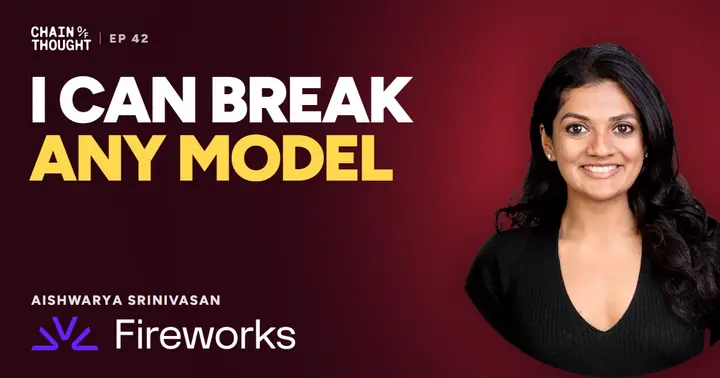
At the time of the conversation, Aishwarya Srinivasan was Head of AI Developer Relations at Fireworks AI, with a large following for her AI content on LinkedIn. On Chain of Thought she argued that most agents are built backwards, starting from models instead of system architecture, and walked through the move from prompt engineering to context engineering.

Latest episode with Aishwarya Srinivasan · EP 42
Architecting AI Agents: The Shift from Models to Systems | Aishwarya Srinivasan
Aishwarya Srinivasan, Fireworks AI ·
Episodes
What the conversations cover
These notes summarize the episodes featuring Aishwarya Srinivasan, including other speakers in panel conversations. Follow a source link to read the discussion in context.
EP 42 Architecting AI Agents: The Shift from Models to Systems | Aishwarya Srinivasan
- One of the biggest prototype-to-production gaps is treating LLMs as tools versus building tools with LLMs inside them. As Aishwarya Srinivasan puts it, the “magic box” wrapper era of 2022–2023 is over — production agents are “way more of a software engineering challenge rather than just a model building challenge,” orchestrating small, mid, and large models, memory, and tool calls as one system. Episode takeaways
- “How much autonomy is right autonomy” has no universal answer — it depends entirely on the user journey, the points of risk, and the level of compliance you’re building under. The job is identifying exactly where a human-in-the-loop or a deterministic checkpoint belongs, not picking a global setting. Episode takeaways
- Quantify every step. Srinivasan’s core reliability principle is to make each step of the system measurable and logged — for a coding copilot, that means separate quantification for writing code, reviewing it, writing unit tests, and merging to main. Without checkpoints and traces, when something breaks you can’t reverse-engineer what broke, why, or how to stop it recurring. Episode takeaways
In their words
I think vision is definitely one of the areas where it is harder for the open source models, at least the ones that are out there compared to the proprietary models which are available in the market. Apart from that, yes, there are some level of performance gap that comes with how open source model look like on the benchmarks that we have publicly available.
 Aishwarya Srinivasan Architecting AI Agents: The Shift from Models to Systems | Aishwarya Srinivasan · 33:59
Transcript excerpts; ellipses mark omitted words. Some automatically selected quotes have filler words removed.
Related episodes
-
-

EP 80 · AI Agents
How Cisco Secures Personal AI Assistants for 90,000 Employees | DJ Sampath
DJ Sampath, Cisco
-
EP 61 · AI Agents
The AI Framework Era Is Over: Why Context Is the Moat | Jerry Liu of LlamaIndex
Jerry Liu, LlamaIndex
-
EP 31 · AI Agents
Architecting Reliable Agentic AI | Cisco’s Giovanna Carofiglio on the AGNTCY Collective
Giovanna Carofiglio, Cisco