AI AgentsAI Evaluation & ReliabilityEnterprise AI
Asking Your Team to Automate Their Jobs With AI | Cloudera's Shayde Christian
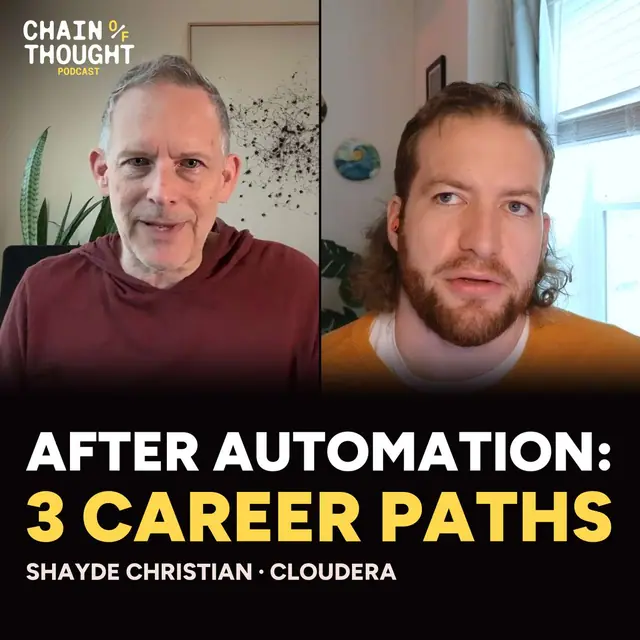
with Shayde Christian, Cloudera
Prefer to listen?


Show notes
Shayde Christian's team at Cloudera has built AI agents that can open a sales opportunity in the CRM and send a customer a 30% discount on training. He still isn't authorized to switch them on in production. Cloudera runs as conservatively as the regulated customers it serves, and the business owners want more proof of reliability and accuracy first. The AI tool his team does lean on every day is, in his words, barely AI.
Shayde Christian is Chief Data and Analytics Officer at Cloudera. He walks Conor through how support-case data became a signal for which customers need training, how Cloudera uses a public model to vectorize questions and private agents to execute or generate SQL, and why he developed new career paths before asking his data team to automate their own jobs.
We cover:
- How three non-break-fix support cases a quarter on a product like NiFi flag a customer who needs training, and Shayde's Bellagio fountain idea of dashboards that disappear once a decision is automated
- Getting customer success managers up to speed on a new account in an hour or two instead of a week, and covering eight or nine accounts instead of two to four
- How the query tool uses a public model to vectorize the question and agents to run existing SQL and Python; when no match is found, the agent can generate SQL, with a disclosure and feedback check
- 200 power users for $2,000 a month, and why Shayde's advice is to ask whether you need AI, not just where to run it
- Why data governance is still hard, and the table renaming, synonym columns and metadata work it took for AI to understand business meaning
- Cloudera's new Mistral partnership: why Shayde says "Mistral reigns" in Europe and the Middle East, the sovereign AI stack with NVIDIA and Dell, and a proof of concept for agents that act across a company's SaaS systems
- Three career paths for a data team whose work is being automated: AI engineer, "parachutist" and "insight assassin"
- The human skills that matter more as AI takes routine work, and his advice to new graduates: automate your last job
Connect with Shayde Christian:
LinkedIn
Cloudera
Links from the episode:
Cloudera and Mistral partnership announcement
MotionBench
Connect with Chain of Thought host Conor Bronsdon:
Newsletter
X / @ConorBronsdon
LinkedIn
YouTube
Thanks to CoralBricks for sponsoring this episode. CoralBricks serves open models through one API, fast and at low cost: DeepSeek V4.1 Flash streams at over 300 tokens a second. Get $5 in credits on signup, plus another $5 on your first purchase
Thanks to WisdomAI for sponsoring this episode. In WisdomAI's latest benchmark, Claude Code alone topped out at 73% accuracy; WisdomAI closed the gap, delivering accurate answers 3x faster at about a third of the cost. Get "The Blueprint for Trusted AI Analytics"
Transcript
101 segmentsShayde Christian 0:00 I knew I was going to ask my entire team to automate their jobs. I knew how popular that would be. I knew, um just how great I would be viewed by my team. They were going to love me. the more we automate data and analytics, the more valuable we're going to be to the business, ironically. So I came up with three career paths. One is AI engineer. I got a guy named Laszlo in Budapest. He's done this. He used to be just a data architect. He says just a data architect.
Shayde Christian 0:26 And now he's a full-stack AI engineer. He couldn't be happier. Automate your last job. What are the things that you did? Generate synthetic fake data. guide AI through the actions of what that job was?
Conor Bronsdon 0:43 You can give everybody in a company a dashboard and still leave them waiting for someone to make a decision. Adding AI to that dashboard raises a harder question. When do you trust it enough? to take the next step for you. Welcome to Chain of Thought. I am Conor Bronsdon, your host. Joining me today is Shayde Christian, Chief Data and Analytics Officer at Cloudera, where his team is building the systems that we'll be talking through today. You've described Customer support information that can tell someone they need training in professional services. Are there particular areas where you're seeing the most customer signal or interest. Uh in this new analytics era.
Shayde Christian 1:21 Yeah, it's an interesting question. I think that the most um Actionable signals can be buried very deep in the data. I can give you an illustration of one that we uncovered and how it's working for us. I think your audience should first understand kind of what we do, Cloudera Cell's data platforms. We have a very complex 60 micro service, full service data platform. And it's complex because our Customers who are the most recognizable brands and largest companies are trying to solve the world's most complex data problems with them.
Shayde Christian 1:56 And because of that, we have a big support group, an organization that supports them. And so we take a lot of case data from our customers and diagnostic bundles and things of that nature. And so typically our professional service and training team would shadow, as is usual, the GTM team, the go-to-market team. And they will go out together and uh determine whether there are professional services or training needs for our customers to help them with these complex products. But the truth is the secret to who really needs professional services and training for our customers is buried in the case data.
Shayde Christian 2:31 If a customer opens three cases per quarter on NiFi, for instance, one of our components, and we solve them as non break fix NBF, it means that there's nothing wrong with the software. we had helped the customer understand how to use it with their other systems and components. And so if you look at these signals, We can then provide and do in a single pane of glass called shared customer intelligence. We provide this information, these signals about which customers are struggling with which products and may need professional services and training. And we offer that in this single pane of glass for humans in the loop to react to.
Conor Bronsdon 3:08 (Sponsor read: Sponsor thank-you) Before we dive in, I want to say a quick thank -you to our presenting sponsors for Chain of Thought, Ingest for long -running agents, and Walrus Memory, providing portable agent memory. Plus, this episode's other sponsors, CoralBricks .ai, providing lightning -fast open model inference, and WisdomAI, the enterprise agent analytics platform.
Conor Bronsdon 3:28 So great, we've got a single pane of glass for humans to look at. How are agents leveraging that data on the back end? And how are you? uh enabling not just human coworkers, but the growing group of digital coworkers that we have uh built around them.
Shayde Christian 3:46 Well, first we're utilizing multiple layers, our AI intelligence layers actually communicating with the cases and actually crunching uh the data, getting the sentiment. So there's a lot of agentic AI working to Understand and produce the signal. The single pane of glass, it becomes then a human affair. What we do have the capability is going beyond that. In fact, we've programmed Agents Conor to Create an opportunity in our CRM so that the CRM then alerts our PST organization that they have an opportunity for this customer utilizing this technology.
Shayde Christian 4:25 We also have the capability to communicate with our customers via that CRM agentically, which says, hey, Here's a uh um A coupon for 30% off of Ni-Fi training, and we can automatically send that to the customer. The challenge for us is that. Like the regulated customers that we have. We're pretty conservative and so the business owners who own these applications are still looking for a lot of assurity in terms of reliability and capability and accuracy before they're allowing our AI agents to be released into production.
Conor Bronsdon 5:03 Interesting. Can you Unpack a bit more what kind of signals your enterprise customers who have these concerns are looking for to. uh enable new AI capabilities and what are the blockers holding them back?
Shayde Christian 5:17 it's the data privacy and protections that are are culture at Cloudera. um has because we want to mimic the highly regulated Environments that our customers are held within. And so, just by our nature, we're very conservative. Number two, Well, you have to make sure that these AI agents are getting you right. Are you sending the coupon to the right customer? Are you opening the correct opportunity? Is it in the correct amount? Does it really describe what really needs to happen? Is it clear for the professional services organization to understand what's happening?
Shayde Christian 5:53 We have a really good track record currently of passing those tests, but we're still kind of in that cultural feel about what are we going to allow agents to do in production.
Conor Bronsdon 6:04 I want to talk more about the data architecture. behind this because I know there are crucial decisions being made around you know, what goes to a non-deterministic system versus a deterministic workflow. Mm. I'd love to understand a bit more first about this shared customer intelligence view you've created and what was happening to customer signals, whether that's case notes, account history, anything else you were pulling in. beforehand and then how you're now showcasing it. Today
Shayde Christian 6:31 Right, so these signals were generally not available, right, because you don't have the professional services group or the go-to-market community or the marketing team ferreting through case. Volume, right? It's just typically unavailable. And so we work the same way we've always worked. We get these ideas from our business customers. Hey, can't we look at case data, et cetera, et cetera. And so we go and stick our technology on it, particularly generative AI in this case. And so previously these signals weren't being provided. Now in terms of the signaling, the way that we use shared customer intelligence as a single pane of glass, I mean, have you been to the Bellagio?
Shayde Christian 7:09 Have you seen the fountain where it creates shapes and then the shapes disappear? This is kind of our image about what we're trying to do. My personal philosophy is that I created a great career based on dashboarding and data and analytics, right? We trust them, we love them. The great part about them when they started and through their evolution is that They pulled together data and insights from places you couldn't see together. And so they've been a marvelous evolution of what I call in decision intelligence.
Shayde Christian 7:39 But even when you look at dashboards, my current feeling, Conor, is that they're just another system. They're just one piece of data, one piece of the puzzle that needs to be put together for, for instance, professional services or a go-to-market account team to make a decision. And so we're trying to get away from. dashboarding and data and SQL and Python coding as a way to find the puzzle pieces. And we're trying to surface intelligence with dashboarding to me just being another system. And so here's where the fountain idea fits in, right?
Shayde Christian 8:13 This single pane of glass, you might say, well, it's just another dashboard, it's just another system. What are you talking about? Yes, but it's intended to be the Bellagio fountain. It's intended to surface these signals temporarily, provide them to our business team. uh for them to determine what agents can accomplish. Or, what automation can accomplish, or where in the workflow this automation can happen. And as soon as they make those decisions, and we Automate those tasks, then the fountain comes down, the shape comes down, and there's nothing anymore. And there's just actions being taken on behalf of the business.
Conor Bronsdon 8:49 So I think this is a really important point around how we need to enable business users within an enterprise. And the types of data that we need to pull out for them, and the fact that a lot of that has been hidden at times in the past or hard to access. Mm-hmm. I'd say be like you mentioned specific tools here, like Uh having to learn a lot of SQL, et cetera. Like, frankly, Not to say it's not useful to know SQL today, but a coding agent can write your SQL for you.
Conor Bronsdon 9:16 If there's something you need a query for, you can describe it in plain language. It can go execute that for you. So it's enabled many business users who were less technical to take on data tasks that they wouldn't otherwise. But I think there's still a big opportunity for engineers here. And a lot of my audience are developers, they're high technical. but they may or may not be thinking about how can I enable the business side of our organization. What would you say to engineers who are hearing this and saying, okay, that's great, there's more data being exposed, we want to enable people at the org, but that's not really necessarily a priority for me.
Conor Bronsdon 9:51 There's got to be an incentive, I would assume, for them to help support these kind of systems and build off of this data. because of what it could enable for them in the business and their own careers.
Shayde Christian 10:02 So what is in it for your engineers is, first of all, that it seems threatening, but it's not threatening, that the business can now self-serve on, for instance, Dashboarding, right? Dashboarding can now be accomplished. My team has accomplished it through natural language. And if we really want to be valuable to the business, You could do two things at Cloudera. You could speak SQL or Python, you could learn the data, you could learn a visualization tool, and you're still going to spend hours and weeks to create something valuable for you to look at.
Shayde Christian 10:34 Or you could. You can't do that in your natural language because you have to wait in my team's queue for weeks and months. We have a tool that enables people to create their own dashboards just using natural language, and it takes them minutes and hours. So the first thing for the engineers in my group was Not that this was the cause and effect, it was really in the reverse. But let's get rid of the problem solving and visualizations. Let's get rid of the I'm Constantly perpetuating new visualizations for the business and enable them to do that so I can get onto higher value work, which is AI engineering.
Conor Bronsdon 11:10 As folks are uh enabled to spend more time at a different abstraction layer and Kind of push off this work that has previously taken up a lot of hours. We're seeing very interesting opportunities to put teams on work that is higher value for their skill set. And I know one of the areas that you have seen advances through your work has been around enabling faster onboarding. and the ability to take on more accounts simply because of what technology is enabling for Cloudera.
Shayde Christian 11:39 Absolutely. So, one of our business customers is this support organization that I talk about. I talked it from a PST perspective before, but we support that support organization. And we also. support the customer service managers. And the challenge with our customer service managers is that our Again. Tools are very complex. Our customers have very, very complex Atlas environments. And so it would normally take a week to get up to speed on a new account. And they can only take on two to four accounts depending on how complex the accounts were.
Shayde Christian 12:13 That's how intense the customer service is in our neck of the woods. And so what we've done is we've used AI to look at the sentiment on all of our case tickets, summarization of all of our cases. And now it takes only an hour or two to get up to speed, which means uh You know, that's 95% savings and effort and time. And now our CSMs can support up to eight or nine customers at a time. That's 267% improvement. I mean, that's real tangible value. And not only that, Conor, but we've enabled the top five knowledge base articles and the top five past solved cases.
Shayde Christian 12:54 And now the meantime to repair for tickets is decreasing because we're giving them the intelligence they truly need to solve the case. Um And net promoter score is increasing with that customer community as well.
Conor Bronsdon 13:08 So this is really interesting. You have through these technological adaptions. improves the ability for multiple parts of the organization to take action. You know, we haven't touched on a few parts of the org. I mean, obviously, things like recruiting, hiring, et cetera, are very important as well, ops. What are you seeing for folks who are non- technical business user side of things. Outside of even like the data analytics team, are they seeing major gains from the internal systems you've built?
Shayde Christian 13:37 Some are seeing major gains. I think that there's three levels of business value that you can really drive with AI depending on your level of commitment, your tech feasibility. And your risk tolerance. One is these individual productivity efficiency gains. You're wiring up a foundational model. You're allowing people to affect their jobs, which is great. We've seen a lot of productivity efficiency. There, those are table stakes. You're not going to change the game necessarily with those use cases. The second level is what I'm referring to and guiding you through in my illustrations, which is workflow automation.
Shayde Christian 14:09 It's not just one person's productivity, it's looking at how does CSMs operate? What is the decision intelligence they need? Let's automate their workflow and give them all the puzzle pieces at the moment they need decision. And then the third type of use case is really a game-changing use case. And one that we have that's very effective is this automated data uh dashboarding capability. We call it natural language querying tool. And with that, we are seeing again minutes and hours of dashboarding capability. It has revolutionized the amount of Capacity that my team has to develop these AI applications.
Shayde Christian 14:45 And so, yes, sometimes massive, sometimes very effective and very productive over time, and some. Like initial productivity and efficiency gains are the immediate uh business impacts of AI.
Conor Bronsdon 14:57 (Sponsor read: Walrus Memory) Season four of Chain of Thought is presented by Walrus Memory, the portable memory layer for AI agents. Your agent has learned your code base and how you work. Now you want to use that context in another tool. Exporting a file gives you a snapshot, but what happens when the context changes? Walrus Memory is a portable memory layer that lets your agent store context for later use across tools. Python and TypeScript SDKs plus the name of MCPSupport let you connect it to your Thank -you Walrus Memory CoralBricks Inngest WisdomAI
Conor Bronsdon 15:46 And a lot of what enables these gains is getting the underlying information architecture correct. Because if you're feeding the wrong context and data into AI tools, it's simply going to go off in their own direction. As smart as frontier models can be, and as smart as we can build these systems. They're still reliant just like a human is on what's the information that I am being provided. Uh and I know that there are efforts that you've taken to ensure that there's extreme trustworthiness behind not just the self-service.
Conor Bronsdon 16:18 aspect of what you're developing. But also understanding the limits of any accuracy and privacy claims. Can you walk me through? What happens when Say an employee types a question in and is looking for an answer. Like, what's happening with the model? Where is information coming from? Uh what stays outside of it?
Shayde Christian 16:35 you've backed into a very strong problem statement right i think that most Everybody in my role and in the units that I um Manage came up with the idea years ago. Well, let's put this GPT-like interface over our enterprise repository, make it searchable, and bam, natural language speakers are able to generate insights instantaneously. I think we've all had that ambition. Um I know of customers and a competitor who did it the what seemed to be the logical way. Well, let's put that chat GPT-like interface on top of the enterprise repository.
Shayde Christian 17:12 Here's the problem. It knows no context of your business data. You're asking it to look at a wide swath, a broad data estate and come up with answers. And it's not capable of doing those things. It hallucinates wildly. And customers and competitors I've read have put dozens or hundreds of data engineers to try to figure out these solution nations and make it work. We used a very different approach. I assigned seven data engineers to this problem. And um We said to ourselves, how do we achieve this data privacy?
Shayde Christian 17:46 I cannot allow a public model to look at my private data. We're self-regulated in that way. That really makes it difficult for me to get a GPT-like interface over our enterprise repository. So data protections and privacy is critically important, but so is accuracy and reliability. We've taken a look at what people have done in the industry and how wildly inaccurate it is. And so what we've done is we've created a solution that's barely AI. How did we come up with it? We were backed into a corner.
Shayde Christian 18:17 How do we do this? Um and we sat around and said, Wait a minute, we've been producing SQL and Python code for the last dozen years that comes up with the exact answers to these questions. Is this really an AI problem? Right. How do we achieve data privacy? How do we give Total accuracy and reliability in the responses because our senior executives and all the way down to individual contributors are making key decisions for the company based on this data. We want it to be accurate higher than the accuracy and reliability rates even of the great foundational models today.
Shayde Christian 18:50 So what we've done is we've created the interface. Conor says I want to know about ARR, which is our golden metric, which is annualized recurring revenue, right? And we do use a foundational public model to vectorize the question. That's it. Translate the question into a vector array. We have that model, compare it to business and technical metadata that we have over time heavily involved. And this really gets to the answer that you're asking about, Conor, because It's not good enough that I have data in a table and I understand the schema.
Shayde Christian 19:23 And I have great business glossary and data catalog information. I can tell you how to compute ARR, I can tell you where to go and what table, how to compute it, what it means to the business, et cetera. But AI still doesn't speak that language as much as it speaks natural language. I'm talking about generative AI. And so we've really worked. worked on that business and technical metadata and the AI says okay. I understand. the questions being asked and I understand Where? On-premise in the private environment with Shades AI agents that are behind the wall.
Shayde Christian 19:56 air gapped. What they need to do to call the right SQL and Python code to get the correct answer. Those agents take the instruction, they generate the answer from a SQL and Python, they give it to the user around AI, because AI is not allowed to see the data. They give it in text tab. They give you A. Um. Visualization, which you can then pin to a dashboard. That's how the dynamic dashboarding and automation of dashboards comes in. They give you the SQL, they give you the lineage, and they say have a nice day.
Conor Bronsdon 20:24 Interesting. You're using this Frontier model to vectorize. It's querying. I presume I rag database to pull this information out. And then You have a very intriguing approach to privatization here to ensure that. Data is not being exposed. And I know that's been a huge concern for a lot of other organizations. As they've tried to leverage frontier models, I mean, we've seen examples. Like, let alone small things. There was the conversation about Grok essentially stealing customers' code to use for training data. a couple months ago. And it's not the only example we've seen of data leaking by any means, but there are major privacy concerns when it comes to enabling AI at a major enterprise.
Conor Bronsdon 21:12 I'm curious if you have advice to other leaders who are listening and Thinking about improving their own approaches to private AI and leveraging it within their tech stacks.
Shayde Christian 21:25 I do. I want to say where my advice comes from because it's heavily informed, right? So because my Company develops data platforms, data analytics, and AI solutions, and that's what we sell. And because my team is the data analytics and AI team, we are customer number one. We utilize our products and we are to be the best in reference example for what our customer should follow. Half of my job is beating the street. Talking to prospects, customers, helping people, and supposedly advising them on how to do this.
Shayde Christian 21:58 But the truth is that I deal with some of the most advanced companies in the world, and they teach me as much or more than I teach them. So, this is the advice coming from. The top telcos in the world, the top banks and the top healthcare institutions, financial services, the largest companies in the world are who our customers are. And what we're all doing together is we're privatizing AI, which is two things that you saw in the NLQ. It is Taking AI, the foundational models, a lighter version of it, embedding it into our on-premise air-gapped systems so that we can share data with those models, because we're not going to share them with the public models.
Shayde Christian 22:36 Where you AI is critically important. These things now with the Cloudera AI inferencing engine are getting very capable from a performance perspective. And so we're able to. Allow AI to see an enormity of our data estate from a compute and storage perspective. The second thing you ask yourself, my advice based on our customers, is. If UAI, not just where UAI, but if UAI. With NLQ, it's barely an AI solution. I have 200 power users, Conor, on this application only. But my team uses it day in and day out as their primary development tool.
Shayde Christian 23:16 and talk about winning the token war. This application with that user community costs us $2,000 a month. That's it. It's barely AI, right? You're building on the foundations of everything you've done before. You're allowing the accuracy and reliability to be in the code base that you've already established for decades. and you're using AI where it makes the most sense in a private environment. and you're discerning high discernment. about if you're even employing it. Because as you mentioned at the top of this call, You raised a question in your head about what's deterministic, really? What's predictive? Like that's an important part. of if you ai.
Conor Bronsdon 23:55 This brings to mind a couple of questions for me. One, uh, When you were building the system, I'm curious, did you use AI enabled Engineering to do this, or as you were coding parts of it, or was your team using an internal or external tool for the coding side.
Shayde Christian 24:13 Yeah, we do. We've used a bevy of them. You know, GitHub Copilot, we're heavy into Claude Code right now. My BI team uses Cursor quite a bit. But again, it doesn't have access to the data, largely speaking, right? So we have these data privatization masking techniques that we use to get the assistance from the coding agents and be Become much more effective and efficient coders while keeping our data private. And it has achieved. Um In some cases, 75% or greater efficiency in coding. We absolutely use those tools.
Conor Bronsdon 24:51 Yeah, I think that's very fascinating to see how rapidly AI has taken over coding in particular because it's a somewhat solved domain as far as Hey, we have a clear. Win condition, I suppose you could call it, of what we're trying to do with this code, and we know what good looks like. We have so many examples of it. And it seems like an obvious area to continue to invest, but To your point. there are still privacy concerns that come with that as I think is a key theme for this whole conversation.
Conor Bronsdon 25:19 Beyond that, another I'm sure challenge that you faced around this was Ensuring that the glossary and metadata information that your systems are pulling from for these answers. is accurate, is up to date. How are you managing context? Because I know For a lot of teams, That context and data management can be a challenge that will unwind the value of these systems. Even if they do incredible engineering to backstop the system, if the data inputs that are going in are wrong, they're still a problem.
Shayde Christian 25:49 It's funny, I advise our marketing and sales units when I'm not at a conference that, oh, I'm going to be talking to some, what could I talk about? Your peers. And I go into a little bit, but I always say there's always two forever topics with CDAOs. What is your data strategy? Everybody wants to know everybody's data strategy as if that's. Uh we can even define it. And the second thing is data governance. Excuse my French, but no matter how long we've been at data governance, we all still suck at it.
Shayde Christian 26:18 How can we put so much enormous resources and fight the systems that be for budget and concentrate on this so much and we still suck at it? The good news for AI. is that what you've done over the last decade or two for data governance really applies to AI governance. What you've done for data readiness really helps you get AI data ready. That's the really good news. Um the bad news is that AI doesn't really understand naturally the ways in which we've described and the way in which we've governed data.
Shayde Christian 26:50 Yes, our business glossaries are plain English. Yes, we've got easy to understand technical Um Calculations, but it really needs a lot more help because of the amount of data they can understand and reason with at a particular time. So, what we've done on top of it, Conor. is we've provided a lot of different naming conventions. we renamed uh our tables, like 'cause even though it's p underscore finance, you should understand it's the finance uh table. Even though the column is error, it should know it's really annual recurring revenue and it should know it's revenue and it's point in time revenue.
Shayde Christian 27:28 And here's it's it needs to understand a lot more detail. So that's that. We also included different columns for synonyms. We've also physicalized many data sets. Whereas you get a lot of benefit from your data governance and AI And data Readiness programs, you have to take that next step to make AI understand the. Business meaning, not just where to go, what to calculate, the business meaning, because it's all about that prompt that's coming. and how to equate And semantically match what's going on in the technology with what the user wants is. a struggle.
Conor Bronsdon 28:09 (Sponsor read: CoralBricks) This episode is also brought to you by CoralBricks. CoralBricks serves open models through one API at the lowest prices and the fastest speeds. DeepSeek v4 .1 Flash streams at over 300 tokens a second. Plus, CoralBricks also just put out MotionBench, a benchmark that asks a simple question. Can a model animate? I've personally contributed to the open -source MotionBench and was impressed that DeepSeek Thank -you Walrus Memory CoralBricks Inngest WisdomAI
Conor Bronsdon 29:04 How are you evaluating the success of the system? Do you have regular evals you're running? What were you doing for testing, etc.?
Shayde Christian 29:11 Yes, I mentioned before that even though I think we're knocking out of the park with shared customer intelligence, I'm still not authorized to take these actions with agents in production. And that we measure just how accurate it is. We look at the logs. We see what it didn't do right if it didn't and why it didn't do it right. We correct And modify the solution. With NOQ, it's very easy. You've got a thumbs up or thumbs down. And because it gives you the SQL and the lineage, we can see exactly where it's gone wrong if it creates a SQL and an amendment to what I told you before.
Shayde Christian 29:42 Yes, the agent. The public model is vectorizing and sending instructions to an AI agent, but when it can't find a match, it's Authorized to generate its own SQL and give it a try. And then we disclaim when that answer comes that this is AI answering the question and not CDAP, our enterprise repository. So we have all this data that we're getting back. Human feedback, as well as the logs we keep and the accuracy and reliability, we're able to make changes based on that feedback.
Conor Bronsdon 30:12 And as you think about this next stage, Shayde, where you are going to begin enabling more agentic actions potentially on top of this data or based off it. What are the first steps you expect to enable And what are the I guess blockers that are still in place there? Is it simply a, hey, we're at 94% accuracy, we need to get to 99.9%? Uh is it? Something to do with the privacy side. What's kind of the next step you're building towards?
Shayde Christian 30:42 Well This threshold calibration is very touchy. What it means is that uh the controls you can place on public models and embedded models, especially the foundational models that are extremely beneficial, are very sensitive. And so do you say, All right, if I'm ninety-nine percent of the prompt or if I'm ninety-four percent to the prompt, these threshold calibrations are very touchy. Right. And so what we're learning is that we have to even do a better job of creating a semantic layer. The technical and business metadata was very important.
Shayde Christian 31:15 We made a lot of strides in that area. It's not like we tried to get out of creating a true semantic layer. We're building toward it. but you have to continue to evolve, just like data governance. data readiness. It's hard work that you have to keep. going through. So the immediate Um next steps for us are accuracy and reliability in the hands of the AI engineers based on the feedback from the users. In the long term, though, Conor, what we're looking at is pretty advanced concepts around enterprises code and the business self-serving, not just on dashboarding, but on business.
Shayde Christian 31:53 Workflow automation, and that's terribly exciting for us. We just signed a deal with Ms. Straw. and Mistral Cloudera and A huge SaaS provider are now currently working on a way for Cloudera to bring the data context through Mistraw Advanced Reasoning and take agentic action in multiple SaaS systems across your enterprise. And so where we're headed is essentially allowing the business. To use natural language in their CRM or ERP systems to say, I don't think this workflow is requiring us to do too much analysis, requiring too much data entry. Work with me on proposing where. hour business workflows can be automated to save us very valuable time.
Conor Bronsdon 32:46 I think in the US at least we hear a lot about OpenAI, we hear a lot about Anthropic, and you know, we get meta and SpaceX a bit. There's a lot less conversation about Mistral and the value they're providing. Can you tell me more about how Cloudera and Mistral are going to be working together?
Shayde Christian 33:01 Yes, you hear less about open AI and less about Anthropic in Europe. In the EMEA region, Europe and the Middle East. Uh mistral reigns. They are much more capable of working with the regulations and the Impositions imposed by regulators and data sovereignty. They've got these things solved more effectively. And so with our European and Middle Eastern customers. they're pretty steeped in mistral and more mistrusting of the foundational models that come out of America or China. And so we're we now have a huge data sovereignty play, which starts with infra, which is why we're with NVIDIA and Dell as partners.
Shayde Christian 33:47 It continues with our data platform and then it goes to AI sovereignty, which is part NVIDIA, part Mistral, and part Cloudera. And so we're trying to make that stack data sovereign. So They have the advantage in those capabilities, Mistral.
Conor Bronsdon 34:02 Very interesting. As you think about The Next. stage of development here. Are there particular capabilities you're looking to build or to partner with Frontier Labs on? to continue to extend the approach that you're taking today.
Shayde Christian 34:23 Yes, I mentioned that POC that we're doing, I think that would be revolutionary in what this concept that we're trying to prove with our partners is Great. You have CRMs and you have .ai companies who are giving you the power To leverage AI in a slice, a vertical of the business. Mm-hmm. Even the largest SaaS providers only have 20% or 10% of the data is state available to those agents. Cloudera has 30 exabytes under management. That's more than any other hyperscaler. we want to work with those SaaS companies and Mistral.
Shayde Christian 35:06 And we want to leverage in what we're proving out based on that case solver tool that I mentioned earlier. We're proving that SaaS companies with their agentic capabilities are significantly more effective if they can leverage the data estate and the AI capabilities that my team's developing. And so. That's Enormously powerful if SaaS companies are using foundational models and the entire data estate. to take the right actions across the business.
Conor Bronsdon 35:38 (Sponsor read: Inngest) Season 4 of Chain of Thought is presented by Ingest. Long -running agents need endurance. They must endure waiting for users and weather tool failures. They must take each new jump in model intelligence in stride. Ingest makes long -running agents durable, observable, and improvable over time. Check out their generous free tier and a sleek local dev server for testing your workflows. link in the description or visit ingest .link slash cot dash pod to get started build for the long run with ingest
Conor Bronsdon 36:18 (Sponsor read: WisdomAI) Any frontier model can query your data. But can you trust its answers? This episode's sponsors, WisdomAI, put that to the test in their latest benchmark study. Alone, Claude Code topped out at 73 % accuracy. WisdomAI closed the gap, delivering accurate answers 3x faster at a third of the cost. I sat down with Kapil Chhabra, WisdomAI's co -founder and CPO for episode 75, and he explained the analytics architecture that makes these kind of results possible. Check it out for a full deep dive, plus get the blueprint for trusted AI analytics at wisdom .ai slash benchmark so you can deliver accurate answers on Cloud, Chat2PT, or wherever your business gets their insights. Download your copy at wisdom .ai slash benchmark.
Conor Bronsdon 37:10 So as you think about These new leverage points. Um It certainly is changing the roles. and the responsibilities of different team members. as we're able to extend ourselves in certain domains with AI. it means that, as we mentioned earlier, the level of abstraction you may be working at may be changing. or maybe your focus areas for roles changing. How are you adjusting the responsibilities? uh of your team or your partners to work with your data systems and ensure that you're continuing to deliver not just analytics value, but you're moving towards these next stages.
Shayde Christian 37:46 How am I doing it? clumsily I can say. Um What happened to me was I was not a late adopter of generative AI, but I was not on the hype train for the first six months. And then Oh, wow, like this is real. When you start experimenting with it and you understand it's real. Um My processor got overloaded seeing the future of data analytics being automated. Yeah. And I kept it to myself. I talked to my CIO about it. I kept it to myself and started really thinking about it And I think this is a very important distinction for any data leaders or tech leaders listening.
Shayde Christian 38:23 When you realize that this technology is going to change everything you and your team do, it is a leadership. Decision and a leadership Commitment. to understand it. to plan around it. and to shift your strategy and the safety of your people. toward it. And so we started working with it. I knew I was going to ask my entire team to automate their jobs. I knew how popular that would be. I knew, um just how great I would be viewed by my team. They were going to love me.
Shayde Christian 38:55 But before I did it, I came up with the three Um Career paths that I was going to pitch them because I did realize that the more we automate data and analytics, the more valuable we're going to be to the business, ironically. So I came up with three career paths. One is AI engineer. I got a guy named Laszlo in Budapest. He's done this. He used to be just a data architect. He says just a data architect. And now he's a full-stack AI engineer. He couldn't be happier.
Shayde Christian 39:22 I invented the second career path of parachutist. I had a data engineer in Costa Rica who was adept. And he said, you know what, I don't want to vibe code in front of customers. I want to keep my mind firing in a Python library all day. Great. Where do you want to work? How can we get you there? What can we do? And we actually helped him offboard into someplace that he wanted to go. And we weren't happy to see him go, but we were happy to be part of his decision and help him through his decision.
Shayde Christian 39:51 And the third in Costa Rica I have an amazing data analyst. who is really understanding the business. And data analyst through NOQ is really automated. In a high percentage of the job is automated, but we've put her in the business. She sits with in the forecast calls in the QBR. This is a little hypothetical, I'm exaggerating a little bit, but. In the QBR, she can sit there with her multiplicity of machine learning algorithms. And she can listen to the CRO talk about where he's going to go and what accounts they're going to go in and she can raise her hand and say, you know.
Shayde Christian 40:25 My propensity to buy model doesn't show that. By the way, this company went with a competitor six weeks ago, and I think these are the accounts you should go to. And then that moment she becomes an insight assassin. Striking at the very moment when the true analysis is needed, with true insights that are available to her through the Bellagio Fountain. in certain panes of glass. And on that one day, Should she be able to do that? She would justify her salary for a year, which I could have harvested if I wanted to lay people off, right?
Shayde Christian 41:01 So. It's a leadership act to understand where you're going. Create these career paths and get your people the knowledge and understanding they need and the talent and skill. to get where they need to go because my team are far more valuable to the business now than when they started.
Conor Bronsdon 41:17 And I can imagine though that The transformation process is challenging for some folks. Some people are very excited by it, some people are resistant. How are you managing that change process with your team in particular to make sure that they feel comfortable? in this transition. And how are you enabling them to feel excited about it?
Shayde Christian 41:37 Well, I think that's what I meant with clumsily. it's a leadership act to plan for your people. And I didn't promise anyone I was never going to lay anybody off or that the world wasn't going to change for everybody. But what I did say, and I've expressed my belief many times in their capability and how they are going to be more effective. Look at natural language querying, right? It automates my data analytics and data analyst role and now the business can do it. So why would you need the data analyst?
Shayde Christian 42:05 Because they know the data. Better than anybody. They know where to find it. They're better with AI than the business. And if they get their proximity to the business and understand it as an insight assassin. They're gonna do better for the business than the business can do for themselves, period, right? So I was very open and honest. I was very transparent about where I thought I was going. I was very acknowledging how unfair it was that I was asking them to um Automate their roles. And to be honest, I have one team who still doesn't believe me, and this is two and a half years later.
Shayde Christian 42:38 They're all still here, though. And doing well. And so there's a campaign you have to have. There's a trust that you and your people have to have together. And it's not always there. And it's been difficult, Conor. It's been one of the most difficult transitions. I go back to thinking about how human value has been changed. Based on AI. And I have these cool graphics in a speech that I do, and it shows that roughly 60%, 65% of what humans do today or did yesterday for human value is: well, we execute tasks, we analyze.
Shayde Christian 43:13 We coordinate, we adhere to processes, which means more data entry. We do research, we generate content, and we perform coding tasks, right? These are all very important human values, or so it seems. But AI is changing all of that. Those 65% will decrease significantly over time. and the human values that will Uh be more important in the age of AI are empathy. and judgment. Mm-hmm. Insight synthesis. I give you all these fountains. You have to synthesize these insights, and now you're deciding more than you are thinking and providing data to decide.
Shayde Christian 43:55 System design thinking, therefore, becomes very important. as does working with AI, that's model monitoring, AI orchestration, and AI governance. And so yesterday's human values are changing to today's human values. And when we think about how people adjust. Yes, it involves adjusting to the role. But it also involves really adjusting within yourself. what qualities and attributes you have that are going to come to the fore.
Conor Bronsdon 44:24 This is a really poignant question because I think it's easy for us all to get caught up in elements of this execution that is so much of our work and fail to. Spend the time learning and growing that we need to, or at least not be as intentional as we perhaps should be. How would you recommend that folks think through this expanded responsibilities and capacity that we have with these new tools. that are enabling us with AI.
Shayde Christian 44:53 I don't think it's difficult. I think just like um I keep saying how clumsy I've been at change management. Change manage it is so important and the primary Um Adjustment to be made is to mindset. And so the first thing is to adjust your mindset and it's not that hard. You'll notice that I mentioned as yesterday's human values Process adherence. Coding So wait, speaking machine is a human value? How did that ever become a human value? That's a machine value. And so if you really look at this.
Shayde Christian 45:33 There's opportunity to get rid of tasks you never really wanted. Or Tasks that are unnatural to us that we've had to learn anyway. So, the first thing is really about changing your mindset. The second thing to realize is that, well, do we really need to examine and improve these skills and attributes within ourselves. Some of us may be more empathetic than others, but that's a core human capability. Judgment? decision ownership. We already have that. This isn't just about coders, it's about the business too. Does the business make deals?
Shayde Christian 46:10 Do they have to know where to spend their time? Yes, they're just doing more of it day to day than they used to. So do we need to give them a insight synthesis class decision? Ownership workshops. No, we don't. They already have judgment today. They're just going to be relying on it more. Sure. Even when we as techs and when the business gets involved in AI monitoring, AI orchestration, AI governance, there is a learning curve to be done there. But really, you've already struggled to make your systems behave today.
Shayde Christian 46:41 It's a behavior that you already know. and we're just going to give you differences in how this technology behaves. I don't I think there's a monumental shift in terms of mindset. But once that mindset shift is made, The reliance on who you need to be in the future. will be relatively natural.
Conor Bronsdon 47:01 And As we all navigate this future, Shayde, I think we're all very appreciative of the advice you've shared with us today and the story that you've gathered for us of Cloudera's transformation and the impact that it has had already in the business. I'm excited to hear more from your Insight Assassins. the coming months and years and uh to see how Engineering roles continue to evolve within Cloudera. and within the data and analytics teams. Do you have any closing thoughts for our audience that you'd like to share?
Shayde Christian 47:34 Yes, I think there's a way that we can Perform, conduct, and leverage AI safely. Today we talked about it in terms of a business. and setting up environments and sandboxes and air gapped capabilities to do it. But I do want to encourage your audience, given recent news, that. Humans are still in charge. Governments are the new way in which the French Revolution takes place now. It's violence-free, but it is governments who will act on our behalf to keep AI safe across the world and safe within this country.
Shayde Christian 48:12 And so I try not to overreact to the news items this week and last week, and I still have my faith in my fellow humans, and I can see a pathway where This is all going to be good and we're all going to thrive in the age of AI.
Conor Bronsdon 48:26 And one final question if you don't mind. As we think about this transition, Folks who have senior level skills, who have deep knowledge. Are often excelling. They're able to be positioned for this next steps. They have leverage points. But many folks who are just entering the workforce or are more junior are finding themselves sometimes struggling or simply experiencing a lot more fear. What advice would you give to those folks who are getting started and maybe taking on their first month at a new job? looking to enter an industry.
Shayde Christian 49:00 I actually provide this um advice on probably a biweekly basis. There are uh many people who have enabled my career and now their children are fresh out of school and unemployed and I am Returning favors by educating those folks and mock interviewing them and guiding them through what they should do. And I think the advice that I've given that's resonating the most is. Claude Code would be great, but if you can just do Cursor, if you can just do chat GPT, whatever your capability is technically.
Shayde Christian 49:33 Automate your last job. What are the things that you did? Generate synthetic fake data. guide AI through the actions of what that job was? Mm-hmm. Take on in this time in your life. Um These projects wherein you can understand and work with AI, because when you finally get to my desk. and I'm interviewing you for a position and you say to me, Oh, I did these twenty-seven. Uh projects myself. Oh, tell me about those. Oh, I automated my last job. I did an app that does this.
Shayde Christian 50:06 I had AI do this. That's going to be extremely compelling to me that you came, even though it's not on-the-job experience, and you understand how AI is changing the world and you are using it to make your world better. That's the number one. piece of advice.
Conor Bronsdon 50:23 I've talked to a couple of Mm-hmm. early stage developers who are in college right now and are worried about what they should be doing and I've been telling them, Look, build in public. you know, go contribute to an open source project. you know, rebuild something interesting like People want builders. They want people who are eager to learn. And There is more opportunity to do that today than ever before. And while there are challenges you're going to have to navigate, there is. so much opportunity to just go out and make an impact if you Have the Hutzpah.
Conor Bronsdon 50:52 and uh want to spend the time on it. So Um Shayde, really appreciate you taking the time to walk us all through your approach and perspective. And listeners, make sure that you drop a comment on YouTube, on Spotify, wherever you're listening. We'd love to hear from you. We'd love to know what else we should have asked, Shayde. We can probably get him back or drop him a couple more of our email if we need to. Shayde, thank you so much. Really appreciate you taking the time.
Shayde Christian 51:17 Thank you, Conor.
Conor Bronsdon 51:18 Awesome.