Picture a support team that wants an assistant to answer refund questions. An AI engineer picks a model, writes the system prompt, connects the help-center articles through retrieval-augmented generation, gives the assistant a tool to look up orders, and builds an evaluation set to check that answers stay correct as the prompt or model changes. Nobody on that team trains a model.
The title spread in 2023, when Latent Space argued that foundation models had moved a lot of applied AI from research teams to software engineers working through an API. A machine learning engineer usually trains, tunes and deploys models on an organization’s own data; an AI engineer usually starts from someone else’s model. The line moves both ways: AI engineers fine-tune and host open models, and ML engineers build on APIs.
The show explores which skills the role requires. In episode 37 at 18:23, Galileo co-founder Atindriyo Sanyal says the main skill a software engineer needs to become an AI engineer is data literacy: telling good data from bad. Hamel Husain adds at 17:21 that the work quickly arrives at the skills of an ML engineer or data scientist, even without training models, and predicts at 20:29 that the role may split into sub-disciplines. Episode 37 was sponsored by Galileo; Sanyal is introduced as its CTO and the show’s co-host at 0:35.
In episode 38 at 39:09, Aurimas Griciūnas rejects the idea that AI engineering is just data engineering: data engineering pipes data to where it needs to live, while AI engineering builds agentic systems on top of it (39:41). The episode was sponsored by Galileo, which Conor plugs at 28:13.
Titles vary between companies, so read a job description for the actual work. A useful test is whether the role is judged on model quality (closer to ML engineering) or on whether a product built with models works for its users (closer to AI engineering). See also product engineer and LLMOps.
Hear it from the guest
“For the software engineer to become the AI engineer or … to be efficient in the modern era is really just the skill of understanding data”
“AI engineering is about building those agentic system designs on top of the data that you have”
Quotes lightly edited to remove filler words.
Sources
- Latent Space: The Rise of the AI Engineer (2023) — The essay that popularized the title: tasks that once needed a research team now need API docs, and AI engineers work on the product side of the API line while ML researchers and engineers build foundation models; it notes the line is permeable; checked October 24, 2026.
- Google Cloud: MLOps, continuous delivery and automation pipelines in machine learning — Describes the older split, in which data scientists and ML researchers develop models and engineers build production services around them; checked October 24, 2026.
Go deeper
From the conversation
-
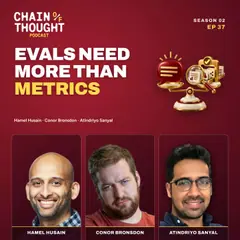 Mindset Over Metrics: How to Approach AI Engineering | Hamel Husain
-
 From Demo to Defensibility: How to Build an AI Business that Lasts | Aurimas Griciūnas
-
 Agent Memory: The Last Battleground in the AI Stack | Richmond Alake, Oracle
-
 I Built an AI Coworker That Runs 90% of My Day | Sterling Chin, Postman
-
 Explaining Eval Engineering | Galileo's Vikram Chatterji
-
 Architecting AI Agents: The Shift from Models to Systems | Aishwarya Srinivasan
-
 The 2025 AI Shift: From Chat to Task Completion & Reliable Action | Galileo Founders
-
 Using AI to Modernize Your Legacy Applications | MongoDB’s Rachelle Palmer