The term has broader meanings in AI research. On this site, it usually refers to an LLM-based action loop: a model chooses a tool, the application executes it, and the result informs the next decision. The model and the complete agent system are different objects.
A predefined pipeline can use multiple model calls without giving the model control of the next step. Agentic workflows can mix predefined paths and model decisions, so labels alone are insufficient to identify the architecture.
Example: a code agent reads a repository, makes a patch, runs tests, and responds to failures. Its success depends on the available context, tools, execution environment, and verification, as well as the model.
Autonomy is scoped. Deciding how to investigate a bug does not imply permission to deploy the fix. Our autonomy guide helps define those boundaries, and the evaluation guide explains what to check across a run.
See AI vocabulary in plain English for this term alongside the other language of models, data, agents, and infrastructure.
Sources
- Anthropic: Building effective agents — Makes the architectural distinction between predefined workflows and model-directed agents.
Go deeper
- What makes an AI agent different from an LLM? AI, decoded · 4 Things That Turn a Model Into an Agent
- How do you give an AI agent an identity and permissions? AI, decoded · Agent Identity and Permissions: The Layer Nobody Built
- How much autonomy should you give an AI agent? AI, decoded · How Much Autonomy Should an AI Agent Have?
From the conversation
-
 How Block Deployed AI Agents to 12,000 Employees in 8 Weeks w/ MCP | Angie Jones
-
 AI, Open Source & Developer Safety | Block’s Rizel Scarlett
-
 The Agent Bubble Debate | Spot AI's Kelly Vaughn
-
 The AI Framework Era Is Over: Why Context Is the Moat | Jerry Liu of LlamaIndex
-
 The Emerging AI Agent Stack | CrewAI’s João Moura
-
 Genspark's Bet: AI Agents Become the Users of Software | Wen Sang
-
 The AI Agent Trust Gap: Bridging Risk to Reliability | Elastic’s Philipp Krenn
-
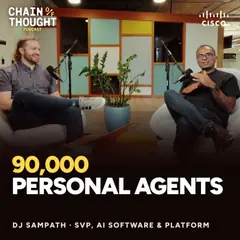 How Cisco Secures Personal AI Assistants for 90,000 Employees | DJ Sampath