AI AgentsOpen Source AIMCP (Model Context Protocol)
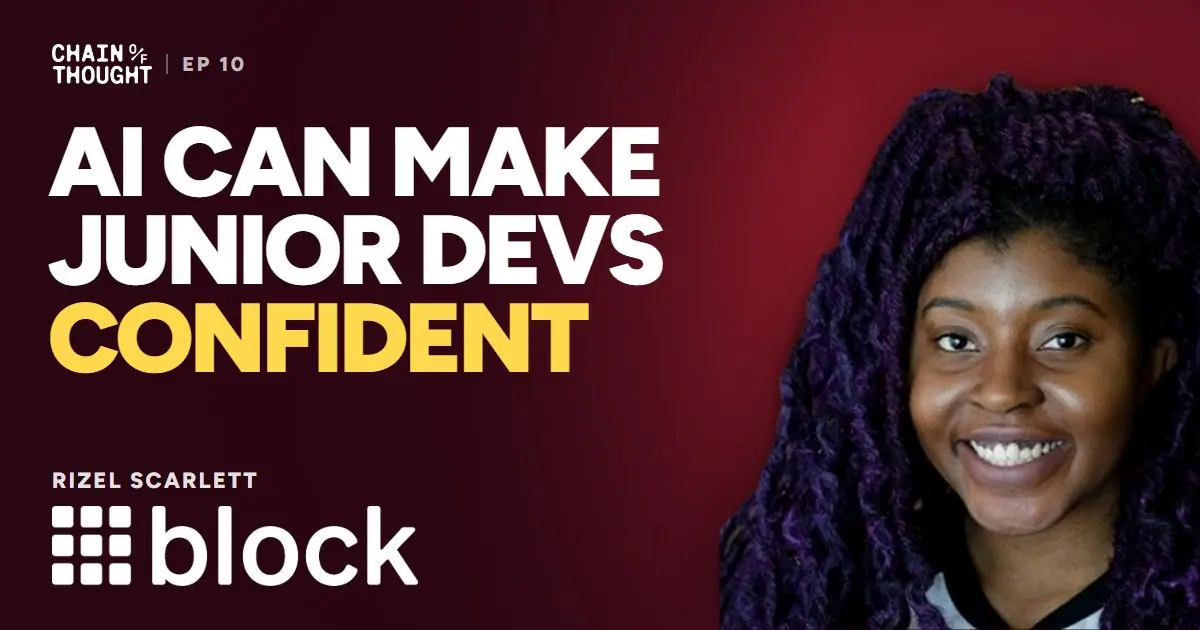
AI, Open Source & Developer Safety | Block’s Rizel Scarlett
with Rizel Scarlett, Block
Prefer to listen?
Key takeaways
- AI as psychological safety for juniors: Rizel reframes the fear that AI is going to replace junior developers — “if I had this when I was a junior developer, this would have made me so much more confident.” As a young Black woman engineer she was scared to ask questions and “come across as stupid”; AI lets you go back and forth and gain confidence, working “like a peer programmer.”
- What Goose is: Block’s open-source, on-machine developer agent. It has a Rust back end and an Electron front end, and you can drive it through the terminal or the Electron app. It is extensible — you can wire it up to your file system and other tools — and it leverages Model Context Protocol servers. Block collaborated with Anthropic on building out MCPs.
- Goose was built first for Block employees — starting with migrations. As Rizel put it, the goal was “to automate and make sure employees are not doing work about work” so the team “can just get straight to the impact,” before the project was opened up to the broader community.
- Productivity is more than coding faster: developers are also parents and open-source maintainers. “We’re not just these people that are heads down at their computer coding all the time.” The main benefit is helping people keep context as they constantly switch back and forth, and show up as their best self across all their responsibilities.
- Open source gave Rizel influence that closed tools did not. With GitHub Copilot she “couldn’t have as much influence as I wanted to,” even as a developer advocate; at Block she can push her own code to improve the tool — and so can community members, who bring in their own tools and MCP connections instead of filing requests.
- Responsible use means reviewing AI output, not rubber-stamping it: “don’t just check-in AI code, review what it’s giving you.” Rizel argues for a dedicated “how to code with AI” training alongside the usual security and harassment onboarding — keep writing and manually testing your code, and learn “how hallucinations work and how to kind of reduce them.”
Show notes
As DeepSeek so aptly demonstrated, AI doesn’t need to be closed source to be successful.
This week, Rizel Scarlett, a Staff Developer Advocate at Block, joins Conor Bronsdon to discuss the intersections between AI, open source, and developer advocacy. Rizel shares her journey into the world of AI, her passion for empowering developers, and her work on Block's new AI initiative, Goose, an on-machine developer agent designed to automate engineering tasks and enhance productivity.
Conor and Rizel also explore how AI can enable psychological safety, especially for junior developers. Building on this theme of community, they also dive into topics such as responsible AI development, ethical considerations in AI, and the impact of community involvement when building open source developer tools.
Rizel Scarlett : LinkedIn · Rizel's website
Connect with Chain of Thought host Conor Bronsdon:
Show Notes
Transcript
93 segmentsRizel Scarlett 0:00 I don't think AI needs to be closed source all the time. Also, another thing with open source that I always like is that it's almost it's authentic marketing. I was gonna say free marketing, but that doesn't sound rich. It's so free. We can be honest here. It's okay. It's authentic and free marketing where you have people just excited people that are just contributors and they're excited about it. They're talking about it at conferences
Rizel Scarlett 0:25 because they're getting that chance to feel like they're part of the project. I think that's another benefit, and I'm hoping to see more open source AI.
Conor Bronsdon 0:41 Welcome back to Chain of Thought, everyone. I'm your host, Conor Bronsdon. Today, we're joined by Roselle Scarlett, a staff developer advocate at Block, where she works on AI and open source. When she's not advocating for developers, Roselle is an advisor at gCodeHouse, an organization aimed at teaching women of color and non binary people of color to code. Roselle, welcome to the show.
Rizel Scarlett 1:00 Hi. Thanks for having me. I'm super excited since I am a workaholic and on parental leave, but I'm like, I still wanna talk on a podcast or or do something. So thanks for having me. Oh, it's it's my delight. I'm excited. I'm hoping we get a guest star appearance later.
Conor Bronsdon 1:16 Congratulations, by the way, on your new family member. That's very exciting. Thank you. But yeah, great to have you here. Thanks for making time. Thanks. And I know Block has some big announcements around AI coming up, so let's dive into your work there. Yeah. Can you tell us a bit about your role at Block and how you got involved with the AI projects there? Yeah. So, like you mentioned, I'm a staff developer advocate at Block, and I mainly focus on their open source initiatives. So, we actually recently,
Rizel Scarlett 1:43 I think probably today, the time I'm recording this is when we announced that like, Block is like getting into open source, or we're focusing some of our tooling on open source, and one of that is our AI initiatives. And how I got involved, I'm gonna say, like, I don't know if this is gonna sound weird, but I think I'm, like, destined to be an AI. Because hear me out. I used to work at GitHub,
Rizel Scarlett 2:06 and, like, GitHub had a lot of different products, and I was a junior developer advocate. They're, like, you know, you can, like, try out whatever you want. They just really wanted me to, like, increase my skill set. So I was like trying out GitHub actions or like advocating for those tools. And then GitHub Copilot came out. I felt like I was killing it at that. But then I was like, I want to try out like other technologies beyond coding with AI. I want to see like what else is out there. So I had gone to
Rizel Scarlett 2:33 Block's subsidiary TBD, and I focused on like Web5. It sounds weird, but I was just like, I want to see what emerging technologies are there. I ended up, the company pivoted away from TBD, like Block pivoted away, and they put me back in AI. So I think I'm just like dead skinned for it. That's how I got involved. And think like using AI to code is really exciting and empowering.
Rizel Scarlett 2:59 I know some people are not into it, but I think it's cool.
Conor Bronsdon 3:03 I I do love that AI coding technology has enabled so many more people to build software and to build software faster for many folks who've been doing it for a long time. Yeah. It's an exciting time for sure. And I also think there are some
Rizel Scarlett 3:19 exciting things happening on AI initiatives at Block, as you mentioned. Yeah. Can you tell us a bit more about what's happening there? Yeah. So, we're coming out with an AI agent called Goose, or we started building one. And by the time that this podcast is out, it should be out as well to the broader public. We have this open source AI agent called Block, and basically,
Rizel Scarlett 3:41 it's an on machine developer agent enabling you to like automate engineering tasks. So I've used it for a lot of things like prototyping UI tools. Like I've used it to just even get a better understanding of different open source projects. I've there's there's like a lot with it. Just because it's an agent, there's so much cool things you can do, and there's like a lot of extensibility around it as well. Can you give us a bit of an overview of what
Conor Bronsdon 4:10 Goose is and what its capabilities are as an AI agent?
Rizel Scarlett 4:14 Yeah. Like I said, it's on machine developer agent. You have a we have two different ways that you can leverage it, either through the terminal or you can use it through like an electron app. It has a rust back end, the front end is electron like I just mentioned. And you can really use it for any engineering task really, because there's so much extensibility since it's open source. You can basically say, hey, I want you be able to connect
Rizel Scarlett 4:40 Goose with like my file system or with this or with that. And you'll be able to set up tools for that. It also leverages model context protocol servers. So we collaborated, one of our open source initiatives as well with AI is we collaborated with Anthropic on building out MCPs. So that's incorporated with it as well. It sounds like vague, I guess, with my description.
Rizel Scarlett 5:08 It can what it can really do a lot. Like, anything you can imagine you in terms of engineering task, I think you can help it, or you can get it to do that. I've used it to take screenshots and then, like, hey. I wanna develop a site that looks similar to the screenshot that's here. Like, there's just so much.
Conor Bronsdon 5:25 I don't think it sounds vague. I think it sounds versatile. And to me, that's where I really see the opportunity with AI agents is. Right now, a lot of the early agents we've seen have been semi task specific, where it's like, hey, we're building on robotic process automation, adding some intelligence, but maybe we don't trust them to go out and do all these different broad tasks. So it's really exciting to see companies like Block and other projects out there release agents that have this opportunity to be more versatile to do more. But that's to me the exciting part.
Rizel Scarlett 5:56 Yeah. Yeah. I think there's a lot of exciting parts for me as well. I like I always said, like enabling other developers to do things. And then the other day I've been thinking about this, think before I jumped on this podcast with you, when we were planning, I talked about psychological safety for developers, and I know I'm jumping ahead. But I also thought about not just
Rizel Scarlett 6:18 junior developers, but when we talk about developer productivity, I always thought, oh, like, just helping a developer code faster. But, I feel like developers do so many different things. They're not just, like, We're not just these people that are heads down at their computer coding all the time. Some of them like me, now I'm a parent. Some people are open source maintainers. Some people are doing different things. So, when I think of developer productivity,
Rizel Scarlett 6:42 it's not necessarily coding faster, but just enabling them to maybe like keep the context when they're constantly switching back and forth and just helping them to still show up at like as a software engineer, but also at whatever other responsibilities they have as their best self. So I think that's also an exciting part of AI and AI agents to me. Absolutely.
Conor Bronsdon 7:04 And I'd love to talk more about how AI is approaching the open source community and blocks initiatives around this. But I let's jump ahead because I think you mentioned this really interesting concept about how you view AI coding tools as contributing to psychological safety, especially for Janu and your developers. Can you elaborate on this concept and how AI can empower developers to feel more confident in their work?
Rizel Scarlett 7:31 Yes. I love to. This is one of my favorite topics because a lot of times people are like, oh, AI is gonna, like, replace junior developers or put them out of a job. But I'm like, if I had this when I was a junior developer, this would have made me so much more confident. I think when you're a junior developer, you're a little bit scared to ask questions. You're
Rizel Scarlett 7:52 sometimes you ask a question, you don't even understand the answer. Or even sometimes people like, just Google it. And then I think for me, there's like this added fear or added complexity as a, like, as a minority, because I'm like a black woman. And when I first became a software engineer, was super young and like a black girl there, and I'm like, oh my gosh, I don't wanna ask questions. I don't wanna come across as stupid. But with AI tools, can kind of go back and forth, ask for help. You can gain more confidence in, oh, wait, I didn't even know this method existed.
Rizel Scarlett 8:27 You can ask like ChatGPT or Copilot or whatever tool you're using, oh, why did you choose this? Why does this exist? Whatever the case is. So I think that's how it kind of gives them more confidence. It kind of works as like a peer programmer, and you can kinda show up at in your team stronger and more confident. I love that. And,
Conor Bronsdon 8:48 I'll say for folks who are listening right now, now would be a great time to check out this rest of this episode on YouTube because we do have a guest star appearance. So hop onto our YouTube at Galileo. You can search Chain of Thought podcast on YouTube if you want to check this out and see the full visual spectacle. But let's keep talking about psychological safety here, because with the rise of AI, there are so many considerations for teams,
Conor Bronsdon 9:13 and it feels like teams need to rethink this concept of building psychological safety through learning. Are there new dimensions you think developers and and engineering teams need to consider compared to traditional software development environments now that AI is being inserted into them? That's a really good question.
Rizel Scarlett 9:32 I think so.
Conor Bronsdon 9:34 I think and when you say dimensions, can you expand on that? Sure. So as you mentioned, there's a lot of folks are now going to AI first, first for search, whether that's an internal search or external, they're maybe, maybe they're onboarding to a new team and they're saying, Hey, here, ingest all this documentation and just these concepts. And now I'm gonna like have an interrogative conversation
Conor Bronsdon 9:56 with this AI versus let me just go read all these docs. Let me kind of go back and forth. Do you think teams need to consider, like, an AI first approach to how they onboard,
Rizel Scarlett 10:08 how they enable folks? Yes, definitely. I think so. Because, like you said, people are gonna go to that anyways. So I think thinking about, like, okay, first, security, I know companies are really concerned about like, oh, how are docs being used with AI? But then also, kind of giving like a short training to developers on how to use AI to be able to onboard into their products. I know sometimes people get frustrated while using AI to code, because they don't there's there's a bit of a learning curve there sometimes. I remember when GitHub Copilot first came out, people were like, it's not coding for me. And they're like, you have to type, like, and it's it was more of like a tab completion back then. I think they expected it to be more like an agent. So just Yeah. Giving them a overview. Like, when once you have your teams, it's not just here's the documentation.
Rizel Scarlett 10:57 It's here's our AI tools. Here's how you can use it to onboard. I even used it for TBD myself. When I when I joined TBD, I was like, don't know what Web five is. I'm joining. I kinda skipped from being a mid level developer advocate all the way to staff. I'm like, I don't wanna act like I don't know anything. But if they had like a a GPT extension, and I would just go back and forth when someone would ask me a question, maybe some terminology that's specific to the to the the
Rizel Scarlett 11:26 ecosystem, I would be like, hey, what does this mean? Or I'd be like, hey, how does the data get stored in here? Is it like, does this happen? And it would tell me no or yes or whatever, because the data, the GPT extension was trained on, like, our documentation. So I was like, oh, it was saving me so much. And I also had to answer a lot of questions in Discord from community members. So that helped me be like, okay. I this is my second day here, but here's what the GPTF snatches at. Yeah. Oh, yeah. I I do love it for, as you're onboarding,
Conor Bronsdon 11:58 actually figuring out where things are and understanding, what you need to do to kind of have this public facing role. And obviously you've had experience at both GitHub and Block with AI You've seen them influence team dynamics and collaboration. Have you seen any particularly notable shifts that have been driven
Rizel Scarlett 12:18 by AI tools in how communication patterns or knowledge sharing is occurring, particularly for technical teams. At Block, a lot of what we do, we have all of these internal AI tools. So I'm used to like, you join a company, you just search through the documentation on like, when, to figure out like about parental leave or insurance or whatever. But we have like a lot of internal AI tools where you can just ask the questions
Rizel Scarlett 12:43 to these different AI tools and it'll tell you. So that's like one shift I've seen in like communication patterns and knowledge sharing. And that's really the main one. Think we'll start to, at least for me, I think we'll start to see a bit more as people use MCP or model context protocol a little bit. But those are the main ones I've seen. Have you I'm curious.
Conor Bronsdon 13:06 You know, I was just thinking about this, and I'm certainly seeing it, like, the the mid management level of, like, oh, I am now enabling my team differently when they're onboarding. I'm now trying to share information in different ways. I'm trying to plan for my team members to add this context into whatever, you know, model they wanna leverage and do this. And then at the enterprise level, I do see exactly kind of what you're mentioning here. It's like, okay, how can we enable certain processes to just be simpler?
Conor Bronsdon 13:36 Yeah. But I think we're just scratching the surface here potentially, and it's something I wanna have more conversations with on this podcast with folks who are kind of deep in the organizational design piece, because there is this massive potential for us to all have async junior digital employees, these AI agents that are functioning for us, async senior employees, in some cases, that are digital
Conor Bronsdon 13:59 agents. And I think we need to reimagine how our organizational dynamics function, because if we don't consider that, we have already gone through this major remote work transformation driven by COVID, or accelerated by COVID at least. And I don't think we've fully reckoned with how that has reshaped work, especially as we've had this like wave of return to offices movement the last year or two. So there's this tension that's happening here. There's still a ton of communication happening for most companies in Slack or Teams, these kind of digital workspaces.
Conor Bronsdon 14:31 And now we're adding this whole kind of subclass of additional, I mean, you can think of them maybe right now as contractors often, I think increasingly more important employees who are coding, who are running processes for you. And while we're seeing some major enterprises make decisions like cutting headcount in certain areas to kind of reassess, and we're also seeing plenty of employees get enabled by these same tools,
Conor Bronsdon 14:59 Yeah, no. It seems like there hasn't been a kind of clear organizational plan that has taken root as like, here's how you manage a bunch of AI agents at your company. And I think in the next year, we're gonna see that. Yeah. And I think we're gonna see a few different models of that.
Rizel Scarlett 15:16 Yeah. I'm really curious to how that's gonna play out. And now that you say that all, it makes me realize or remember, like, I guess, the original intention for Goose, which is the the AI agent that, like, Block came out with. It was it was the first developed to kind of enable our employees because we were like, yeah. Yeah. It was like about helping with migrations
Rizel Scarlett 15:41 and we were all about right now or this year, our goal is like to automate and make sure employees are not doing work about work. Like, we can just get straight to the impact.
Conor Bronsdon 15:52 That makes So me think about that, and I'm curious about how it's going to play out in the future. And I know there are folks who are thinking about this. I'll say, if you're listening to this episode right now and you have thoughts on this, that should be a message. We'd love to feature your questions or your answers to this, or maybe we'll have you on for an interview. But Rizel, I would love to understand more about how AI agents fit into
Conor Bronsdon 16:15 Block's company strategy. Are you able to talk a bit more about how kind of the origins of Goose and
Rizel Scarlett 16:21 how this all came about? I don't know if people know this. Right? Like, were originally called Square, and now we're called Block. A lot of times people think that's because we are into blockchain or something like that. But it's more it's more like we've become like three-dimensional. And we're about like just economic empowerment in general, but like we're beyond square. We're into we have Tidal as a subsidiary, which is empowering
Rizel Scarlett 16:47 musicians and all these different things. So, part of us doing economic empowerment through innovation means that we need to, at least for me, this is how I view it, not necessarily the company, But part of that is like getting into emerging tech such as AI, and AI agents and automation and freeing up our, as I mentioned, our employees to work on things that matter and not just work about work. Our broader initiatives are more like open source based. And then we're like, okay, what are like the emerging technologies that are out there that we can use to kind of tap into that economic empowerment and enable people more? So it's not necessarily like, oh, we need to get into AI, we need to get into this. It's like, how can we get people to be feel empowered economically faster,
Rizel Scarlett 17:33 and in in in more industries?
Conor Bronsdon 17:36 And to allude back to our conversation earlier where you brought up psychological safety, that is such a benefit of having a team that you build psychological safety with is this empowerment, you get major results back from team members off of this. So I totally agree there's massive opportunities with agents and with AI broadly to empower employees to be more productive. I mean, it's where we're seeing more and more 10x devs. I also really like that Block has taken this intentional decision to focus on an open source approach to developing Goose.
Conor Bronsdon 18:10 Benefits have you seen as a result?
Rizel Scarlett 18:12 Yeah. I think main benefit is community gets involved. I love that because I think when I've worked with other AI tools in the past, even GitHub Copilot, loved working with it. But I didn't really know under the hood what was happening. I kinda just listened to other engineers at the company, and I couldn't have as much influence as I wanted to, even though I was a developer advocate. Big company,
Rizel Scarlett 18:36 I just can say like, hey, this is the feedback we're getting. But at Block, I can literally be like, hey, I see this feedback, I can push my own code to improve it, and so can other community members. And then I also think another benefit is like, hey, we're giving back to the developer community as well. We've benefited from them, we're giving back to them. I know that like many AI agents are closed source, but I really think it allows and enables for people to bring in like their what they want to happen and bring in that extensibility as well. Because there's all these ways that you can like bring in your own tools and a lot of it is like code based. So people instead of making requests to us can just be like, hey, I wanna enable this to connect with my company or whatever different MCP server I have or whatever. So I think that's like one of the main benefits.
Conor Bronsdon 19:27 I absolutely agree. And I know I've I've had similar experiences where you're trying to give this feedback and it's not quite making it through the right channels. And I do think that's a really awesome element of projects like this, where you get the ability to really act on it, and people then can have a discussion on an actual action, you know, something you've submitted, a PR, versus
Conor Bronsdon 19:50 having it have to move its way through all these kind of tiers. Yeah. And I I do think it's something that helps Blocks open sourced AI agent goose stand out compared to closed source alternatives. What broader impact do you think this could have on the AI ecosystem?
Rizel Scarlett 20:05 I'm hoping it inspires other developers, gives them more insight into how AI agents work. I think a lot of the tools with AI, it just feels like a black box. You're like, this is magic. Like, what's really happening? So I think just even like, I I don't know. I'm a nerd. Sometimes I look at different open source projects. I'm like, oh, that's how this works. I mean, I guess we're all nerds if we're listening to the podcast. Probably true.
Rizel Scarlett 20:32 But I'm like, I always wanna know how it works. So I think one thing is it it is I'm hoping it inspires other developers and gives them insights into how things are really working. And I also hope that it encourages other companies to take an open source route. I don't think AI needs to be closed source all the time. Like sometimes I understand like, for economic reasons or financial reasons or whatever. But I think there's benefits
Rizel Scarlett 21:01 where it can, yeah, it can just make people know more. Also, another thing with open source that I always like is that it's almost, it's authentic marketing. I was gonna say free marketing, but that doesn't sound good. It's authentic.
Conor Bronsdon 21:16 It's so
Rizel Scarlett 21:19 free. We're virtual.
Conor Bronsdon 21:20 We can be honest here. It's okay.
Rizel Scarlett 21:23 It's authentic and free marketing where oh, we you have people just excited to talk about it. You get your people that are just contributors and they're excited about it. They're talking about it at conferences because they're getting that chance to feel like they're part of the project. So I think that's another benefit, and I'm hoping to see more open source AI.
Conor Bronsdon 21:48 100% agreed. And I think that authenticity point is really crucial, because folks in dev communities typically don't love being marketed to, in fact, actively get annoyed by it quite often. Yeah. Probably the highest percentage of ad blockers on their browsers of anyone in the world, if I had to bet. So I love that idea of let's be authentic, let's be upfront, and let's encourage these folks who love to problem solve to come engage with us and help solve this problem together and collaboratively.
Conor Bronsdon 22:18 And that's what makes the best relationships, whether it's with customers or folks who are simply, hey, I'm interested in this product. I want to engage with it. So I certainly think open source AI agents have this opportunity to shape the future of AI.
Rizel Scarlett 22:34 What role do you think enterprise companies like Block can play in fostering this growth? So the role, I think they can like, enterprise companies have, like, a huge influence. Right? You think of you're thinking of Netflix. You're thinking of all these companies. And I think, man, would we I need to redo it again. Let me think again about my thoughts. I got distracted after All good.
Conor Bronsdon 23:07 I can also skip this question if if you don't feel like you have any anything compelling you wanna share with it. Yeah. Talk about the community involvement aspect instead. Yeah. Let's skip it. I I didn't know the answer, but I don't remember it because I suspect it'll come out as we talk about community involvement and kind of more fluidly the conversation versus, like, a direct here's the the insight type question. So Okay. Cool.
Conor Bronsdon 23:30 I think we both envision open source AI agents having this opportunity to shape the future of AI. And enterprise companies like Block or Meta or Netflix who contribute to open source projects, particularly in AI, have this huge opportunity to drive research and innovation in the space forward. From your perspective, how is Block encouraging community involvement in its open source projects?
Conor Bronsdon 23:56 And and what do you think makes this approach successful?
Rizel Scarlett 23:58 So the way I always think of it, and I'll take it from just the open source stance first, and then go into AI. Right? I always encourage big companies and mid level companies to get into open source, just because they're leveraging a lot of open source tools, and they have like the most money, so they can be able to encourage other users to be like, oh, or help them gain more exposure as well as these open source tools. And I think that's the same with AI tooling, right? If you see that like, oh, Microsoft,
Rizel Scarlett 24:29 as we've seen, Microsoft and GitHub kind of made like coding with AI, at least from my perspective. They made it like popular, they made it more known, and then everybody else started like coming on the train, we got Google and all of that. So, if we start seeing companies that are bigger adopt open source AI, it'll help other users and community members be like, oh, we need to be in that race as well. And I think that's the role that Block can play. And we're not taking it from that perspective at all, but I think that can be like
Rizel Scarlett 25:01 a domino effect. What we're doing is we're just opening this up to the community to be like, hey, here's we use this for our employees and it's been helpful, and we want to open it up to you. You can contribute through code. You can join our Discord. You can be part of our livestreams and podcasts and share your thought processes and gain more exposure from from your AI tooling as well or see how you can incorporate it with ours. So that's that's the perspective I have. Absolutely agreed. And, I mean, we've seen this with open source for years right now, whether it's, you know, Kubernetes or any other open source project. There are so many ways where open source has driven software development forward, has Yeah. Let more people come in and contribute and be involved,
Conor Bronsdon 25:44 and really let us put more brains towards these problems, helped move our overall industry forward, helped enable these incredible tools we've built. And now not only are AI coding tools enabling more people to build, but the more we can add open source opportunities to contribute to AI, the more we can aggregate more human knowledge towards these incredible next layer of tools we can develop. So I love that Block is thinking about that intentionally. I love that you're engaging with it intentionally.
Conor Bronsdon 26:13 And I'd love to get your thoughts on how you envision AI and open source shaping the future of developer communities and the overall culture of software development, because I think we are seeing a shift that's already starting to occur.
Rizel Scarlett 26:27 In shaping our communities and how we do things, I think it's gonna obviously help us be more productive and faster, focus on the things that make us have fun, And it's gonna help us to kinda, I don't know, it gives people a bit of a superpower to be like, hey, I don't know this language, but I'm gonna figure out how to use it. I might not know how to do certain things, but I'm gonna use AI to help me. I also think though, it's going to we're starting to start thinking about different
Rizel Scarlett 26:59 AI products. Like before, everybody's just coming out with like, oh, here's another way to code with AI. But now, have to start thinking about like, is this secure? We're using AI agents to kind of just tap into our systems. Is it hallucinating? How do we make sure that we're testing and evaluating these tools right? So, I think it's also helping to bring up some of these departments
Rizel Scarlett 27:23 or even companies focused on these kind of initiatives.
Conor Bronsdon 27:26 Absolutely. And for listeners, I'll certainly say this is a topic we've covered already on this podcast. Testing and evaluation of AI is obviously what we do here at Galileo, galileo.ai, check it out. But there's been several conversations with incredible thought leaders, including Chip Nguyen and others on this show. So go check those out if you wanna go more into that topic, because I think it is important and something that we want to address in the show is there are potential downsides and there are risks associated with using AI. There's risks with using AI to enable psychological safety in your team, even. You're kind of offloading this work to a computer. Is that integral
Conor Bronsdon 28:03 stuff that you should be taking care of? Maybe in some cases, yes. So I'd love to kind of close this conversation, Rizel, by taking that perspective. You know, we've had this very exciting, optimistic conversation, and broadly, I feel that way about AI. But it's so easy to get lost in the hype and kind of only focus on the exciting parts versus considering,
Conor Bronsdon 28:25 hey, where do we have to maybe pull back a bit? Where do we have to be careful? So how do you think teams can ensure that AI tools are used responsibly, and ethically, and effectively?
Rizel Scarlett 28:37 Yeah. I mean, one thing is, like you said, using tools like you, like Galileo, making sure that, like, you're testing and evaluating your stuff properly. And then just making sure that developers aren't just checking in. Like, I mean, at the base level, that's something you can do, like, at the very least, like, hey, don't just check-in AI code, review what it's giving you, like train them. I don't know, the same that we get, like those trainings
Rizel Scarlett 29:06 in the beginning for security or harassment at a company, you might also need like a how to code with AI training. Like don't just check-in code, review it just as you would review a co worker's code and stuff like that. Make sure everything's well, like your writing test still, you're manually testing it. Don't just take what it says and go with it. Remember, figure out how hallucinations
Rizel Scarlett 29:29 work and how to kind of reduce them. All those type of topics, I think, are at the base level are helpful.
Conor Bronsdon 29:37 And I think this goes back to both the guardrails question, which we've kind of alluded to here around, okay, we've got to make sure we're evaluating, testing, ensuring safety in the AI tools themselves, and also the organizational design commentary we had earlier, whether that's enabling psychological safety for developers to experiment, to try things out, to innovate in these new areas, whether that's with open source or other methods,
Rizel Scarlett 30:00 and also,
Conor Bronsdon 30:01 hey, am I using GitHub Actions or GitStream, an open source tool that my last business worked on, to enable our PRs to make sure they're reviewed? How do we make sure that all this new code is actually good? Like, those are problems we have to grapple with. And to me, they're really exciting because, hey, we have so many new folks who are enabled to be more technical, to be more involved. Hey, we have these agents that are starting to accomplish some awesome things for us. You know, one big example that I've seen is let's take all this migration work that no one really enjoys doing- Right. Off of our plate, and let us focus on kind of net new features, new opportunities.
Conor Bronsdon 30:41 But all of that requires organizational structure and work on the organization side. And I don't think that's going away anytime soon. No. So I think on the fear side, we kind of alluded to it earlier, this fear of like, oh, is my job going away? No, but it may change. You may change and have to do more work on setting others and setting your team and setting these agents up for success. And
Conor Bronsdon 31:03 to me, that's really exciting.
Rizel Scarlett 31:05 But it is important that we talk about it because if we don't, it's so easy to just go ahead and say, oh, I'm just shipping all this code and then creating, refactoring problems. Problems. Yeah. Yeah. Yeah. And I agree. I think a lot of people, like you said, they they get afraid. I know I first when I first started talking about GitHub Copilot, I had someone say to me, like, if this is where technology is going, I don't wanna be a software engineer anymore. But,
Rizel Scarlett 31:26 just so crazy. But I'm like, just like the, we went from like buggies to, like horse and buggy to a car, your role is kind of just shifting. We have to adapt and look forward to like what you're saying like, oh shoot, Like, maybe we'll have to be putting in guardrails. Maybe we'll have to start thinking in our organization level, like how this is going to work. So, yeah, I implore everyone to start thinking about how can I shift my skills
Rizel Scarlett 31:51 into the future of AI?
Conor Bronsdon 31:54 Absolutely. And the only constant in life is change, and we all have to continue to deal with it. Things do not stay the same over time, whether it's just from entropy or anything else. And I mean, we've started talking about test driven development in software for years now. Yeah. Like, we've started talking about evaluation driven development and AI. So these are concepts that are happening.
Conor Bronsdon 32:14 We just have to make sure we're paying attention. So Rozelle, thank you so much for joining me for this wide ranging conversation, for sharing your insights, and talking about some of the exciting work happening at Block. Where can folks who are listening go to learn more about you or the work you're doing at Block?
Rizel Scarlett 32:29 So folks can follow me on any social media. My handle is black girl bites on there. Like bites with a y, not like biting you. And then for learning about the work that Block is doing, you can go to github.com/block/goose to learn about Goose itself. And then we also have on social media, the block open source socials on Twitter, Blue Sky, LinkedIn, whatever you could think of. Fantastic.
Conor Bronsdon 33:01 We will certainly link those in the episode description. Rizel, thank you so much for joining us. Thank you for having your guest star appear with us too. And again, if you didn't get a chance to see Roselle's guest star, check out our YouTube for some fun clips. But that's all for this episode of Chain of Thought. Thanks for listening, everyone. And Roselle, you so much for joining us. Thank you.
Conor Bronsdon 33:19 Be sure to check out the show notes for links to everything we discussed today. And don't forget to subscribe to our podcast and our YouTube channel, where we post every episode of the podcast, plus all of your favorite moments and clips. Great to chat with y'all and see you next week.
Frequently asked questions
- What is Goose?
- Goose is Block’s open-source, on-machine developer agent for automating engineering tasks. It has a Rust back end and an Electron front end, runs from the terminal or as an Electron app, and is extensible through Model Context Protocol servers. You can learn more at github.com/block/goose.
- How can AI coding tools create psychological safety for junior developers?
- Rizel argues AI gives newer engineers a low-stakes way to ask questions and learn without fear of looking “stupid” — something she felt acutely as a young Black woman early in her career. Instead of replacing juniors, an AI tool acts “like a peer programmer” you can go back and forth with, so you show up on your team more confident.
- Why did Block build Goose as open source?
- Open source lets the community get involved and contribute code directly rather than just filing feedback — Rizel can push her own improvements, and so can outside contributors. She also frames it as “authentic and free marketing”: contributors who feel part of the project talk about it at conferences because they get to feel like they’re part of the project.
- How can teams use AI tools responsibly?
- Don’t just check in AI-generated code — review it the same way you would review a coworker’s code. Rizel suggests a dedicated “how to code with AI” training alongside standard security and harassment onboarding, and stresses continuing to write and manually test your code and understanding how hallucinations work so you can reduce them.
- Did Block collaborate with Anthropic on MCP?
- Yes. As one of Block’s open-source AI initiatives, the team collaborated with Anthropic on building out MCPs (Model Context Protocol servers), and Goose leverages MCP for its extensibility.