The Agent Bubble Debate | Spot AI's Kelly Vaughn
with Kelly Vaughn, Spot AI
Prefer to listen?
Presenting sponsor of season two

Key takeaways
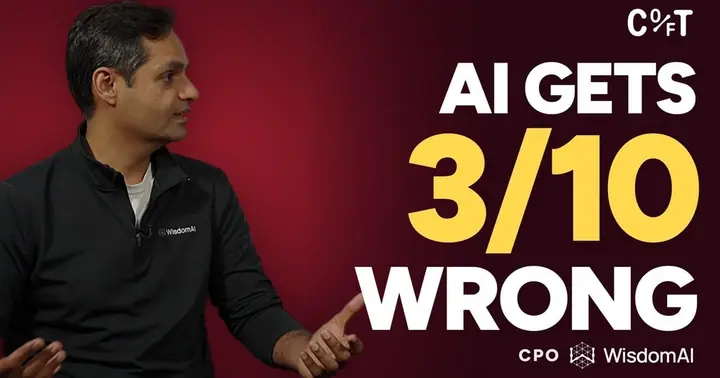
- Kelly Vaughn’s answer to the title question is unambiguous: “Yes. Agentic AI is a bubble.” But she frames it as a normal cycle — “before AI agents was AI. Before AI, it was blockchain.” Her real warning is that a lot of startups fail because they have “no differentiator,” and “First to market might give you a leg up at the outset, but you have to follow through with that.”
- On building AI-enabled products, Vaughn’s core distinction is velocity: AI products demand a fast pace because models are “getting smarter… getting cheaper over time,” so you must keep iterating. A traditional software product is “a little bit more deterministic” and, in a phrasing she immediately calls the wrong way to put it, “a little bit more velocity proof” — you don’t have to iterate as fast to stay relevant.
- Vaughn names over-promising AI capabilities as the biggest pitfall she has seen building video AI at Spot AI: “you’re never going to see 100% accuracy.” Her stakes example is a security break-in the model fails to detect — “you just missed a very important event,” an easy way to lose customer trust when safety decisions ride on it. Her second pitfall: lacking a fast feedback loop.
- On team construction, Vaughn is skeptical of job posts seeking a senior full-stack engineer who is “also an expert at AI” — “congratulations if you can find a unicorn.” She advises hiring real domain expertise on both sides: a data scientist, ML engineer, or AI engineer as a separate role from the full-stack engineers, and testing “in real world situations,” not just a lab.
- Vaughn rejects the linear-productivity narrative with a kitchen analogy: people claim AI lets them “double our efficiency,” but “have you ever had four cooks in the kitchen? Does it actually quadruple your productivity? It does not.” AI is “a very good augmentation tool,” not a replacement — and on companies swapping customer-service teams for pure AI, she says, “I’m going to watch them walk back on that one.”
- Vaughn’s through-line on AI coding tools: useful but never load-bearing. She came around on tools like Cursor after early inaccuracy, but trains her team that AI “should never become a crutch… you should be able to survive without it.” She separates a prototype from “a minimum viable product and a minimum shippable product,” insisting production code meet a real “security and scalability standard.”
Show notes
Is the agentic AI bubble about to burst? Kelly Vaughn, Director of Engineering at Spot AI, questions whether the agent craze is overpromising potential and leading startups down a path of unsustainable expectations.
Never one to shy away from a hot take, Kelly joins host Conor Bronsdon for a pragmatic look at AI, discussing the differences between building AI-enabled and traditional software, why replacing humans with AI teams will backfire (looking at you customer service), and the proliferation of AI tools.
Kelly also shares insights on constructing AI teams, navigating data governance, and building user trust while avoiding common startup pitfalls.
Connect with Chain of Thought host Conor Bronsdon:
Follow Today's Guest(s)
Kelly’s Newsletter The Modern Leader
LinkedIn Kelly Vaughn
Transcript
89 segmentsKelly Vaughn 0:00 AI can again be a very good augmentation tool, but it's not going to replace your team or double the size of your team as well. There are going to be efficiency gains if used correctly, but you have to be able to level set an expectations like what are we actually going to get out of this? Because we're never going to make our our team obsolete. We just we can't.
Conor Bronsdon 0:26 Welcome back to Chain of Thought, everyone. I am your host, Conor Bronsdon. And today, I'm delighted to be joined by my friend and special guest, Kelly Vaughn, director of engineering at Spot AI. Kelly, welcome to your Chain of Thought debut. It's great to have you here. Thanks so much for having me, and I'm excited to be chatting with you again. Yeah. This certainly isn't the first time we've been on a podcast together. I'm I'm not even sure how many times at this point, maybe half a dozen. I've kind of lost count. Yep. Yep. But you are one of the people I really respect the most in the engineering leadership community,
Conor Bronsdon 0:56 and your experience gives you unique insight from leading engineering and product at one of the fastest growing video AI companies, Spot AI, over the last three years to to writing the modern leader newsletter, your entrepreneurial ventures, your degree in psychology, the insights that brings you in, and and much more. But today, we're kicking off with a controversial,
Conor Bronsdon 1:17 maybe big question.
Kelly Vaughn 1:19 Is agentic AI a bubble? And I'd love your take on that. I love opening a podcast episode with a spicy take. Have to. This is this is a good time. Yes. AgenTic AI is a bubble. We need to unpack that. But long story short, I do believe that we are official we are currently aboard the hype train that is Agentic AI for x or whatever. You mean we don't need 30 different AI agents just to do our meeting recordings?
Kelly Vaughn 1:51 Do you? Okay. Like, joining a meeting with, like, let's say there's 12 people in there, and then you see so and so say a notetaker, so and so say a notetaker. And there's they're all different too. Like, how many AI notetakers seem to exist? There has to be a better way. And you know what's you know what's going to happen is somebody's gonna be like, yes, this is really annoying. So let me build the AI notetaker for all AI notetakers.
Kelly Vaughn 2:14 And then we have yet another AI notetaker in there. This is what happens. It's
Conor Bronsdon 2:18 it's very true. And and I'll I'll say I did see a fantastic LinkedIn breakdown. I can't remember the name of the person who did it. Of, like, 18 of these different notetakers. There's 18? I can't swing that up. I think that's how many they have. Yeah. And there's probably more they didn't even include there. But, I mean, it it does seem like they're we're in this competitive stage of 90%
Conor Bronsdon 2:39 of these AI agent startups may have challenges in two years as certain ones emerge as the best use cases. Because there certainly are great use cases for AI agents. Yeah. But there's also a lot of folks right now who maybe are fundraising off of calling a chatbot an agent.
Kelly Vaughn 2:56 Oh, I mean, but we also talked about a chatbot being AI. Like, before AI agents was AI. Before AI, it was blockchain. Like, this is this is nothing new. This is how the fundraising cycle works. This is how the venture the venture capital cycle works. I mean, look at Y Combinator always puts out a list of the startup themes they're most excited about. And what always happens every single time this list is published is you see an influx of new startups trying to tackle these issues. And there's nothing wrong with that. Like to be clear, there's absolutely nothing wrong with that. We've identified
Kelly Vaughn 3:30 certain pain points and these pain points evolve over time as society evolves over time and as technology evolves over time. What ends up happening is you see a lot of noise in the market such as 18 plus different AI agents or meeting recorders and transcribers or whatever. And then there's just you don't even know where to begin. And what ends up happening is you see a lot of startups start to fail.
Kelly Vaughn 3:52 Yeah. Because they have no differentiator. We often focus on being first to market as being the best. And that is simply not the case. First to market might give you a leg up at the outset, but you have to follow through with that. And that's what ends up actually missing out on a lot of these opportunities.
Conor Bronsdon 4:11 And I think you're spot on that part of this is the ecosystem many of us are playing in from the startup space, where VCs are incentivized to fund companies that have giant visions that can be huge wins because they expect most of the companies they fund to fail. And this incentive then bleeds back into founders as to what they want to start because, hey, if I'm gonna get the funds to have my big exit,
Conor Bronsdon 4:37 this I need this big challenge to take on. And there is another approach to this, and I think it's gonna be interesting to see how this goes as a lot of companies they're bootstrap, obviously. I know you've you've done that yourself. There are different incentives in play there where I'm curious to see if bootstrapped agentic companies or agents are going to have a lot of success versus some of these grander visions as we have a million different
Conor Bronsdon 5:07 agentic frameworks, everyone's creating their own. I'll say mea culpa, here are we. We've built our own. We have our own simple agent framework we've built for demoing. We have one we're using particularly for eval demos. We're helping contribute to one to create agent interoperability with Cisco and LangChain. And I'm excited about those. But I also think there is a need for realism to your point where
Conor Bronsdon 5:32 there are many of these AI agents that are not going to be successful. We are going to have systems of them that work. We're going to have companies that succeed really well off this. But these are not a panacea, and they will not solve all of your company's problems. So they may help you get some cash in the short term. Yeah. And and when we think about
Kelly Vaughn 5:52 the purpose behind why, like, why we're starting a company, I have bootstrapped a startup. I have also gone the venture route for another startup. So I've seen both sides of this and your mentality tends to shift, you know, knowingly or unknowingly when you as soon as you raise money because you're thinking about how much money you can make from this startup. Like this is going to be profitable. This is going to be this is going to give me my big exit. And there's nothing wrong with being money motivated.
Kelly Vaughn 6:20 Like to to be clear, there's nothing wrong with that. What happens though is if you're more focused on how much money I'm gonna make from this then how passionate I am about the problem that I'm actually solving, you'll lose sight of that bigger picture. And that's when you start to build for the sake of like what is making the most noise. And then you're going to lose the plot of what is actually your key differentiator.
Conor Bronsdon 6:44 Yeah. And I think that's a crucial thing to consider, which is, are you actually helping your customer? Are you actually driving value for them? And it's really easy to get lost in, oh, I need to build for the hype. To be clear, we're not discouraging folks who are listening to build AI agents. I think that's a fantastic trend to dive into and explore. But I think we also have to be realistic. And and that's where I I love that we're kind of starting off at this semi controversial take maybe for an AI podcast. Yeah. Because
Conor Bronsdon 7:14 there are a lot of builders out there who are going to expect to succeed. And it's important that when you are starting something, when you're trying something, you understand that most of these startups are experiments that end up failing, and it often takes multiple tries. The success is not the norm from the start, and it's really easy to get lost in the perception of that success, hearing from incredible leaders on this show and others who are succeeding or who have kind of made it past the first couple of rounds. But most startups die. Yeah. There's a lot of survivorship bias. You know?
Kelly Vaughn 7:52 We glorify those who have had a successful exit or a successful company. They're still running today, we expect that we can do the same thing. But, you know, as he said, like most startups fail. You learn so much from starting a company though. And if this is an area that is of interest to you like understanding agentic AI understanding AI in general and in ideating on what could be possible in this space.
Kelly Vaughn 8:15 This is this is what is fun about building a company. It's the I don't know if this is going to work or not. I'm going to have, you know, a belief in what I'm building and I think it could become something. But if it doesn't become something, I don't wanna be like, you know, it was the, you know, the journey that was all that, you know, what we gained in the end. Yay. This is so fun and sunshine and roses and whatever. But I still think that
Kelly Vaughn 8:38 what you learn from running a company, you can then take and apply to your next attempt at a startup or joining another company. When we think about this world of AI agents we're in right now, it's not just new companies that are sprouting up building, you know, building AI agents or, you know, building what I mentioned earlier, like the meta AI agent company. It's existing companies that are
Kelly Vaughn 9:03 incorporating AI agents into their everyday workflows because they see the value in agentic AI and they can see a way to improve their customer's life of using this product and create more stickiness by introducing this concept. And that is like, that is also an acceptable way and shocking. I'm going to bring Porsche into this conversation here. Porsche, we know as building very, very solid vehicles.
Kelly Vaughn 9:28 They're not an EV company. I own Porsche EV, but they know how to build a solid vehicle and they knew how to take the solid vehicle and then adapt it to the EV market. Then you compare it to a startup startup air quotes there, like Tesla or Lucid or Polestar. Like they're only building EVs. They're coming at it the other way. This is the exact same thing we're seeing with agentic AI, you know, at a very different scale, obviously, where you can start your own agentic AI company focused entirely around generic AI
Kelly Vaughn 10:00 agents. Or you can apply what is the hype cycle right now to your existing company to keep yourself competitive in the market because you already have customer buying. You already have that trust. You already have the product stickiness. Let's just make it even better.
Conor Bronsdon 10:15 Yeah. And I don't think either approach is is wrong by any means. It's just it's important to come in with open eyes not expect everything to succeed off the bat. Know, May Habib came on our our first episode of the show, and I always think about her quote, is that AI isn't magic despite, I'm paraphrasing, AI isn't magic despite what people want it to be. You know, it's really easy to see these incredible things that are being done with LLMs, are being done with different AI workflows, with agents, and just be like, Oh, we're solving this. This is just going to solve my problem. But the reality of it is it still takes infrastructure work. It still takes observability,
Conor Bronsdon 10:53 enablement. There's plenty of administrative overhead to this. And the same is true of jumping in and taking on these challenges. And I know that you've brought up before that there are these key differences between building AI enabled products, whether that's agents or otherwise, versus traditional software products that you've seen in your last several years building AI products.
Kelly Vaughn 11:16 What differences should folks who are listening and thinking about building an agent, thinking about building something else in AI, what should they be keeping in mind? The first thing you really need to question yourself is like, what exactly are we solving here? What is the problem that are we're solving for our customers? And is AI going to help me solve this problem? There are plenty of companies out there that do not need to leverage AI to solve problems.
Kelly Vaughn 11:40 Does your local plumber need AI? I don't really know. You know, there actually could be some some interesting use cases that I really wanna They really be need the AI notetaker. You could you could somehow build some kind of product to allow you to like see what is happening in the pipes and then report back the issue. So, know, what needs to be done. Like there are specific ways that you can do this, but when you're building a software product versus you're building an AI enabled product, the basis of this product is going to be different.
Kelly Vaughn 12:12 And the most important thing to remember is AI enabled products, you have to move at a fast velocity. You have to move at that fast pace because models are continuously changing over time. They're getting better over time. They're getting smarter. They're, you know, getting cheaper over time as well. And so you're going to have to keep on iterating on an AI enabled product where I'm not saying you don't need to iterate on a software product, but a a more traditional software product is
Kelly Vaughn 12:42 is a little bit more deterministic. And it's a little bit more velocity proof is the way the wrong way to say this. Like, you don't have to iterate so quickly to stay relevant. And and that is one of the biggest differences I would say between those two things. I think their other piece that is really important is around user trust. There's still a lot of inherent distrust in AI.
Kelly Vaughn 13:02 I work at a video AI company. Like I understand, two, three years ago, we were barely talking about AI, you know, in everyday use. You know, there was a time when my mother-in-law was not using chat GPT. And now, you know, she knows how to use it for pretty much anything in her life. Just like any kind of technology, this is gonna change over time. And you're going to
Kelly Vaughn 13:27 need to find a way to continue to build that user trust. It's a little bit easier to establish that user trust in a non AI product just because there's still a lack of trust in AI. What are you doing with my data? Are you retraining your model on my data? Who has access to my data? Even if you're not retraining it, who at your company has access to this data as well? All of these are questions that customers are going to be asking.
Conor Bronsdon 13:50 There's the base knowledge of, is this a deterministic piece of software or not? And with AI, it's nondeterministic. It can take different decision points depending on the situation, which is exciting and provides us huge opportunity, but also adds a level of complexity and creates, know, like similar to what a human may misremember or lie or whatever else, like given that we know AI can do the same thing and make up a source
Conor Bronsdon 14:20 or, you know, make something up and fool itself, there is so much confidence, by the way. With with a lot of confidence. It is it is an excellent liar. I will give it that. And I think this is where I come back to this idea of the administration, the management of AI is really crucial. It's something we have not fully figured out yet, though there are companies like Galileo and others that are working on it, just like we haven't fully figured out how to manage humans day to day. Like, okay, great. We're a lot better than we used to be, but, like, this is that nondeterminism
Conor Bronsdon 14:50 piece. Like, it's a lot easier to have a continuous flow that does the same thing over time, and often that's all we need. But for more complicated tasks, we need this ability to to reason, to think things through, to actually create things we wouldn't have expected it to. Mhmm. And with that comes a lot of administrative challenges.
Kelly Vaughn 15:11 A lot of administrative challenges and a lot of, like, high cost. You know? These it it's time and materials. It's not even like, it comes at it's the opportunity cost as well. That that is there too. You know? What benefits am I actually gaining by going down this path? Is is this again, is this actually solving a customer's problem? Or is this a fun little gimmick that we're having fun playing with right now and then we're going to move on and we're not actually gonna see customer adoption for one reason or another. It sounds like you've seen some common pitfalls
Conor Bronsdon 15:42 from shipping and building AI products the last few Yeah.
Kelly Vaughn 15:46 I mean, biggest one, over promising AI capabilities. I think we all have very lofty dreams of what AI can do and I can see it in conversations I have now. Let's say take a year ago when I was having conversations with customers, they were asking if our AI models could do certain things that they can do today, but they couldn't do a year ago. Like as soon as you can grasp onto the concept of what is capable, what is possible leveraging AI, especially like I'm in video AI.
Kelly Vaughn 16:15 So, you know, think about like what you what can you see? What events can you see? What steps can you see? I mean, a video is basically another set of human eyes that's always on. But you end up in this cycle where you're kind of over promising what AI is capable of doing. And again, AI is getting a lot smarter over time, but it still has limitations. You're never going to see 100% accuracy as well. And when you over promise an AI capability that ends up affecting the livelihoods
Kelly Vaughn 16:43 of people, then you're going to get into this like very important kind of gray area there. If people are making security and safety decisions based on what you're seeing or what the video is seeing or whatever your AI model is doing, you know, especially once you make it agentic, you know, while now it's doing its reasoning on its own and it's choosing whether or not to take action. If you're using
Kelly Vaughn 17:06 AI to detect a break in and you want to alert the authorities as soon as this potential break in is detected and you're missing the break in. Your AI model is not picking up that is actually happening. You just missed a very important event. And that's a hard thing to like, that's an easy way to lose trust with a customer. Totally. Especially when you're dealing with that that security or safety kind situation. I would say the other one that I see a lot of is a lack of a feedback loop. As we kind of talked about here,
Kelly Vaughn 17:39 given that models are constantly evolving, customers need to be able to provide feedback really quickly. And teams need to be able to apply that feedback very quickly. Like to, you know, retrain their models or to improve over time. And if you don't have a solid feedback loop, you're going to fall behind.
Conor Bronsdon 17:57 I wanna drill down on these ethical implications, the governance piece you're talking about. How do you think builders should be thinking through these challenges early on as they're ideating versus later once they're in production.
Kelly Vaughn 18:14 Talk to users upfront. Like, market research is so incredibly important before you build into this. You know, you have an idea of what a product might do or what how you might leverage AI to solve a particular use case. Talk to potential customers who have this particular problem. And don't just ask like, will this actually solve your problem or not? Dig into the concerns they have about it. And you can tee it up. Like, are you concerned about
Kelly Vaughn 18:42 where AI is learning from? Are you concerned about where the data is stored? And, you know, the more you ask these questions, especially in that frame, it's, you know, there's gonna be some bias that comes into it because now you're kind of setting it up to be a negative environment. So I'm just kind of spitballing here so you can frame it in a way that's, you know, you remove the bias out of the question. But these are the kinds of things you need to be asking upfront from a governance standpoint,
Kelly Vaughn 19:05 You know, who are, what kind of customers are you serving as well? If you're serving consumers who are, they tend to be on the earlier stage of the innovation curve, and they want to be an early adopter, their data privacy, their security, kind of stuff is going to probably rank a little bit lower for them. Versus if you wanna serve a school or a government or a large enterprise or even a mid sized company, they're gonna have much more stringent data privacy and security
Kelly Vaughn 19:35 requirements to even get a seat at the table to talk about the product. And you need to decide we're talking about the administrative work involved. That's a huge administrative task there. So you need to decide, is this something like, is this the type of customer you want to serve? And it's okay to also say at some point we do want to, but not right now. Let's start with this subset of customers. I mean, you also don't wanna boil the ocean as well and try to serve literally everybody all at once cause then you're serving nobody.
Kelly Vaughn 20:02 So that's kind of, you know, what I'm how I think about data governance governance from an AI standpoint, you know, around the transparency, the data privacy, and then the bias mitigation as well. What about the other end of this, which is
Conor Bronsdon 20:17 constructing your team for these tasks? So great. I figured out my niche that I wanna go into. How should my company be constructing the team to build this AI product? Is it different than traditional software development?
Kelly Vaughn 20:31 I would say it is. I mean, you're I I it's so funny when I see job listings for we need a senior software engineer who is a full stack engineer who is also an expert at AI.
Conor Bronsdon 20:43 Yeah.
Kelly Vaughn 20:44 Congratulations if you can find a unicorn. They exist. But usually it's going to be one side or the other. They're very passionate about AI and they do some coding on the side. Like some, you know, full stack front end, back end coding or whatever. Or you have a full stack engineer with a deep interest in AI. And you're going to need to really think about building a team that's not just of hobbyists. You need a little bit of, you need domain expertise on both sides. So finding a data scientist, if that's necessary for what you're building, on ML engineer, AI engineer,
Kelly Vaughn 21:15 and then have the full stack engineers as a separate role as well, who can take in this data and build the user experience of whatever customers are actually going to be interacting with. I'd say the other thing that they need to be thinking about is how are you actually approaching testing? AI requires iterative testing in real world situations. You cannot just build a lab and hope that what you see on,
Kelly Vaughn 21:40 you know, in in your small lab environment is going to be what customers interact with. And so again, building that customer relationship upfront, getting your team comfortable with interacting directly with like, research teams or even with customers themselves. The closer your engineering team can sit to the customer, especially when building such a high touch product, such as an AI product,
Kelly Vaughn 22:02 the more in tune your engineers are going to be with building the product that actually serves the customer's needs.
Conor Bronsdon 22:08 How are you thinking about setting up AI enabled tooling that will increase productivity for your engineering or product teams?
Kelly Vaughn 22:17 I am a big fan of having my team actually adopt AI tooling in their everyday. Like if they wanna use like a Cursor or something like that in their everyday, there's tooling that we can use to help automate some of the PR review work that we can do. I am 100% for it. Where I train my team on using this type of tooling is it should never become a crutch. Like you should be able to survive without it. And you need to understand where you can still continue to be
Kelly Vaughn 22:53 kind of, you know, questioning what you're actually seeing. We already know that AI can lie very confidently. Same way is that it can write code that is not actually that great technically might work sometimes. We also, we know plenty of times it doesn't work. But like understanding, is this something that I actually want to use in production? I'm a big fan of leveraging AI wherever possible to build prototypes.
Kelly Vaughn 23:18 But the important thing is there's a big difference between building a prototype, a minimum viable product and a minimum shippable product. And you need to make sure that what you're like, the code you're writing, which I assume you're actually writing code and not just leveraging AI generated code for the entire thing beyond the prototype, is actually up production quality from like a security and scalability standard.
Conor Bronsdon 23:40 Yeah. As someone who only really builds my own projects for fun right now, my vibe coding with Cursor is much more acceptable, where I just get, yes, you're right, Cursor, let's go through this, and then debug. Then if I was working on a product that was it maybe affects people's livelihoods or lives. Yep. I think the guardrails and the approach around that is really important,
Conor Bronsdon 24:03 both at the the product level on, hey. What are my AI girls? And also at the team level of, hey. How what are the standards I'm putting in place for my team? And this is something you write about quite a bit with your newsletter, the modern leader, which folks I definitely recommend checking out. How do you think the role of the modern leader has changed in this age of AI? How do we have to enable teams differently?
Kelly Vaughn 24:25 We need to be very familiar with AI's capabilities and limitations so we can make more informed decisions. You know, we need to understand the landscape of the company we're at and what level of risk we're willing to take and where we can find an opportunity for leveraging AI as an augmentation tool as opposed to a replacement of human teams. I'm looking at all the companies that are replacing their customer service agents with entirely AI,
Kelly Vaughn 24:58 and I'm going to watch them walk back on that one. Communication and change management also become really important now at the leadership level Because you need to be able to help your team adapt to AI. You need to be able to help your company adapt to leveraging AI. And you also need to help your customers understand how your company is leveraging AI to build their product. If you are, I do a lot of our security reviews for the company. And this this question is coming up more again and again, and we are an AI company. So they're of course asking,
Kelly Vaughn 25:32 are you leveraging AI for your company? I'm like, it's literally yes, but you have to be a little bit more specific. Like where are we leveraging AI beyond the actual end product? How are we leveraging AI to build the product as well? And being able to have a very
Conor Bronsdon 25:47 firm answer and how you approach security for that is a really, really important thing. Are there common questions or concerns that you're hearing from other leaders about AI's impact on their roles and their teams? Is it focused around security? Is it something else?
Kelly Vaughn 26:03 I'm hearing I'm hearing a lot of security questions, of course. Like, is this safe to use in the first place? And then, you know, it comes back to those governance questions. Like, you should absolutely be asking those questions before just full sending any sort of AI tool into adoption for your team. You need to understand, you know, where's data is coming from, how it's leveraging that data and who has access to that data. I'm seeing a lot of questions around like, well, if we leverage AI, we can basically like double our efficiency.
Kelly Vaughn 26:32 Right? Have you ever had four cooks in the kitchen? Does it actually quadruple your productivity? It does not. And AI can again, be a very good augmentation tool, but it's not going to replace your team or double the size of your team as well. There are going to be efficiency gains if used correctly, but you have to be able to level set an expectations like, what are we actually going to get out of this? Because we're never going to make our our team obsolete.
Kelly Vaughn 27:01 We just we can't.
Conor Bronsdon 27:02 Yeah. I think it shifts where tasks are happening. Where to your point, like, hey, great. We can get to an MVP way faster. We can have, you know, our PRDs can include a draft of the product really fast. And I think that's great and really improves parts of the process, but that then means we maybe have to spend more time on debugging, or maybe have to spend more time
Conor Bronsdon 27:23 on cycling with customers to make sure the feedback cycle is actually working. And I think for as someone who's like building individual apps, oh, great. Like, yes, AI is two x ing, three x ing my productivity, But I know that most of these things can't really make it beyond my own personal use cases. They're not shipping to production often without quite a bit more work. Mhmm. So there there is a lot to be done still to
Conor Bronsdon 27:45 enable the peak of the productivity gains. Like, I I totally believe that, like, yes, 20% productivity, something like that from AI coding enablement. Like, yes, I I think that is very valid that we're seeing that. But the the folks who are claiming, hey, we're seeing 300%, 400%. A, I'd just love to know how they're constructing their team and how they're adjusting around that. And b, I I would question whether they're factoring in other things that they have to spend more time on. And I know a lot of this episode has been kind of, like,
Conor Bronsdon 28:14 deflating the bubble a little bit. And to be clear, like, think we're both very excited about the opportunity here, but it's really easy for us to get lost in the hype here. And even on this show where we we say, oh, we're trying to make sure we look at this with a real lens, and we're trying not to get overhyped about this. I know we've gotten overhyped about this at times. We're getting the excited agents. It's an exciting thing,
Conor Bronsdon 28:36 but we have to adapt to this new world, and part of that is understanding what's possible and what's not. Based off of that, I'm curious if you've personally adapted your own leadership style or approach due to the integration of AI and AI tooling. I had a
Kelly Vaughn 28:56 much more negative take on, especially like AI development tools, like Cursor, you know, at the outset. Because I used them early on, and I also saw that they were very inaccurate. And so I was immediately like, you're writing your own code. Like this is this is not acceptable. And then I remembered, hopefully it's okay to tell this story. My husband growing up at one point, they didn't have internet and they weren't going to get internet because they're like, well, we have this Encyclopedia Britannica. So I mean, you can get everything you need from that.
Kelly Vaughn 29:30 You're gonna have to adapt your own practices over time as well. And and this is no different for me as well. And so like it has been an adjustment for my leadership style to say, okay, I see the value in this and my team has also helped me help show me that value. But I still keep a healthy dose of skepticism with it. Where I can see something. If I like, look at one of your poll requests and I'm not spending a lot of time reviewing poll requests these days, of course. But like, if I see one of your poll requests and I see like everything is so perfectly commented in your code, I'm like, you didn't write this. Like,
Kelly Vaughn 30:02 tell me what you did to actually confirm that this actually works and that this is the best way to be building this. I've also had to adjust on the rapid prototyping side of things. There's a lot of value as we said, like there's a lot of value to be able to rapidly prototype and get that iterative feedback. And with that, you then need to determine where your line is for acceptability.
Kelly Vaughn 30:22 You might be able to get something out to customers a lot faster at the expense of writing tests. With this is nothing new. This has nothing to do with AI. But given that AI has allowed us to move at a lot, like a lot more rapid pace. This is one of those things that also then kind of falls by the wayside as well. And I always had to kind of come back to that question of like, what is that line we're willing to accept? What I do on my team is not gonna be the same as another team because they're gonna have a different level of like acceptance. A comp a team that is more focused on greenfield work can have a higher risk level because it's not baked into like their customers are not like super baked in at that point. They can say this is a beta product and it's gonna have issues and you're gonna help us discover this issues, but we're gonna be able to release things a lot faster. Whereas the product I support,
Kelly Vaughn 31:09 you know, companies are running their entire security and safety programs on top of. I don't have the luxury of skipping out on a lot of the important stability practices Totally. That you might get at an early stage, startup or on an earlier greenfield team.
Conor Bronsdon 31:26 It it really brings back this idea of, like, your context is everything. Are you building for yourself? Are you building for an important production use case? Are you building on top of a product that already existed, or is it purely new? All these things are important questions to consider here. And it sounds like you see a lot of both challenges and opportunities for engineering leadership in this new AI enabled age. Yeah. Absolutely. I mean, it's hard to keep up with all the AI advancements.
Kelly Vaughn 31:54 I am very far behind, I guarantee. And as we use more AI and even in our product, not to build the product, but at the end for the customer. There's also a lot of AI related fears that I have to manage for myself as well. As well as like, I need to make sure that we're continuing to leverage AI ethically. This is something that's important to me, but it's also something that needs to be important to the company. And it's something that you need to kind of train others to think about as well. But, you know, I'm more on the opportunity side, like this can enhance productivity. This can allow us to ship a lot faster. This can allow us to automate
Kelly Vaughn 32:31 a lot of repetitive tasks as well. Like again, kinda going back to the beginning, agentic AI is not a bad thing. It might be in the hype cycle right now, but there are plenty of reasons why you can strategically leverage AI agents to solve very specific customer or team related problems without overdoing it or just absolutely saying like, I am not getting on this hype train.
Conor Bronsdon 32:54 Yeah. It's not a magic bullet, but it it is a really exciting piece of tech that has a lot of opportunities for us. And Kelly, I really appreciate the nuanced approach you've brought to this conversation, because I think it's sometimes rare as we all get caught up in this excitement and hype for us to have deep conversations about where AI is flawed and where maybe the hype is over boiling.
Conor Bronsdon 33:19 And it's important for us all to understand that while this tech is really exciting, we have to consider how we're leveraging it and how we're enabling our teams with it. And I'd love to allow our listeners to have the opportunity to follow more of your work around that, because I know you're writing about this all the time, you're talking about this all the time. Where can they go to follow your work and read more of your thoughts on these topics?
Kelly Vaughn 33:45 Yeah. The best place is my newsletter, The Modern Leader. It's modernleader. Is. And also, I post quite a bit on on LinkedIn as well. So you can find me at first name, last name, Kelly Vaughn.
Conor Bronsdon 33:57 Fantastic. We will definitely include links in the show notes. Kelly, it's been a pleasure chatting with you as always. Be sure listeners go follow Kelly and her wonderful newsletter, The Modern Leader. And if you're checking out the show notes, just go ahead and hit that subscribe button while you're there. If you're not already subscribed, like, but you're enjoying the show, like, are you doing? I mean, yeah. Yeah. Thank you. Smash that subscribe button, leave a five star review, you know, all the good things. Say nice things about this podcast. Thank you. Yeah. I appreciate that, Kelly. I appreciate that immensely. This is how you know she's a pro.
Kelly Vaughn 34:26 I'm I'm I'm wrapping up a a season of recording for our podcast. And so there's been a lot of closing us out as well for Is Ladybug gonna come out with a new season? It's coming out with a new season on on engineering management.
Conor Bronsdon 34:41 Okay. Well, if you are looking for more content on engineering management, the Ladybug Podcast is fantastic. Highly recommend. Super excited to hear there's a new season coming out. And if there's someone you would like to see on our show, reach out to me directly. I would love to hear from you on LinkedIn at Conor Bronsdon. That's it for this week. Kelly, you're welcome anytime. Thanks again for coming. It was a ton of fun. Thank you so much. We'll have you back soon. Thanks, everyone, for listening. Appreciate you.
Frequently asked questions
- Is agentic AI a bubble?
- On Chain of Thought, Spot AI’s Kelly Vaughn answers “yes” — but as a hype cycle. She points out the pattern repeats: “before AI agents was AI. Before AI, it was blockchain,” driven by how venture fundraising and Y Combinator theme lists pull in an influx of new startups trying to tackle those themes. Her concern is differentiation: many of these companies “have no differentiator,” and being first to market only helps if you follow through. She closes the episode noting agentic AI “is not a bad thing” when used to solve specific problems.
- How is building an AI product different from building traditional software?
- Kelly Vaughn says the biggest difference is velocity. AI-enabled products force a fast pace because models keep changing — “getting smarter… getting cheaper over time” — so you must continuously iterate. A traditional software product, by contrast, is “a little bit more deterministic” and more “velocity proof,” meaning you don’t have to iterate as quickly to stay relevant. She adds that AI products carry heavier user-trust and data-governance burdens, since customers ask what you do with their data and whether you retrain models on it.
- Will AI replace engineering or customer-service teams?
- No, according to Spot AI’s Kelly Vaughn. She calls AI “a very good augmentation tool,” but says “it’s not going to replace your team or double the size of your team.” On companies replacing customer-service agents entirely with AI, she is blunt: “I’m going to watch them walk back on that one.” Her efficiency analogy: claims that AI will “double our efficiency” ignore that adding capacity is not linear — “have you ever had four cooks in the kitchen? Does it actually quadruple your productivity? It does not.”
- How should you structure a team to build an AI product?
- Kelly Vaughn advises against hunting for one engineer who is full-stack and “also an expert at AI” — “congratulations if you can find a unicorn.” Instead, hire genuine domain expertise on both sides: a data scientist, ML engineer, or AI engineer as a distinct role from the full-stack engineers who build the user experience. She also stresses testing in real-world conditions rather than a lab, and seating engineers close to customers so the team builds what actually serves their needs.
- How should engineers use AI coding tools like Cursor responsibly?
- Spot AI’s Kelly Vaughn supports her team adopting AI tools like Cursor — including to automate PR-review work — but with a firm rule: AI “should never become a crutch… you should be able to survive without it.” She warns AI “can write code that is not actually that great,” so engineers must distinguish a prototype from “a minimum viable product and a minimum shippable product,” confirming production code meets a security and scalability standard. Her tell for over-reliance: perfectly commented code prompts her to ask, “tell me what you did to actually confirm that this actually works.”