In vibe coding, you describe the feature you want, run what the model produces, and iterate on the behavior — accepting that you may not read or fully understand every line. For prototypes, throwaway tools, and exploring an idea, it’s a genuine step-change: working software in minutes instead of hours, with the human acting as director rather than typist.
The tension shows up when that code has to last. Skipping the read-every-line discipline trades away exactly what production needs — understanding, testing, security review, and maintainability — so the same loop that’s perfect for a demo can quietly accumulate risk in a real system. The recurring theme among builders on the show is that AI coding shifts effort rather than removing it: less time writing, far more time on specification, evaluation, and review.
Hear it from the guest
“Everybody's talking about vibe coding. Have you done it? Have you tried?”
Quotes lightly edited to remove filler words.
From the conversation
-
 Amplitude's AI Playbook: How Wade Chambers Builds for the Agentic Future
-
 How Block Deployed AI Agents to 12,000 Employees in 8 Weeks w/ MCP | Angie Jones
-
 From Demo to Defensibility: How to Build an AI Business that Lasts | Aurimas Griciūnas
-
 Why Enterprises Need a Different Approach to AI Agents | Lyzr’s Siva Surendira
-
 Gemini 3 & Robot Dogs: Inside Google DeepMind's AI Experiments | Paige Bailey
-
 AMD's Challenge to NVIDIA: The Open Ecosystem Bet | Anush Elangovan & Sharon Zhou
-
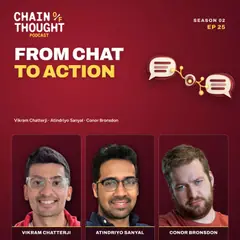 The 2025 AI Shift: From Chat to Task Completion & Reliable Action | Galileo Founders
-
 After Code Gen: What Graphite Is Building for the Post-AI Dev Stack | Greg Foster