
At the time of the conversation, Jeetu Patel was Chief Product Officer at Cisco. On Chain of Thought he laid out the three bottlenecks he sees holding AI back: infrastructure limits, a trust deficit around non-deterministic models, and a widening gap between human-generated and machine-generated data.
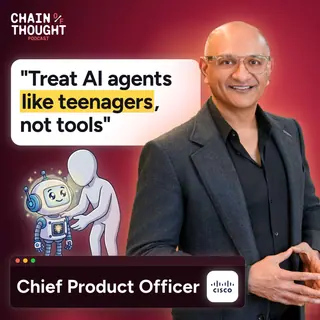
Latest episode with Jeetu Patel · EP 67
Parenting Your AI Agents for Best Results | Cisco's Jeetu Patel
Jeetu Patel, Cisco ·
Episodes
-
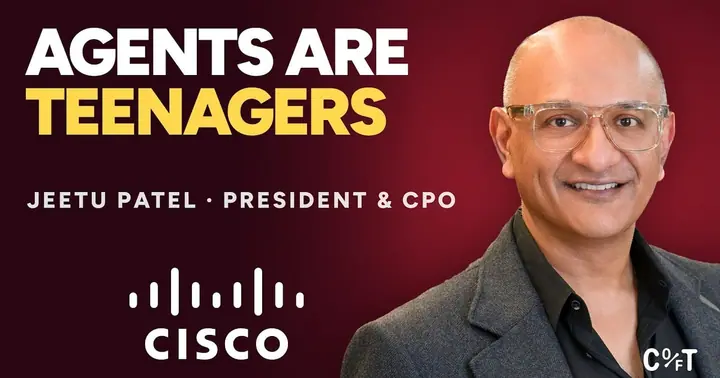
EP 67 · AI Agents
Parenting Your AI Agents for Best Results | Cisco's Jeetu Patel
-
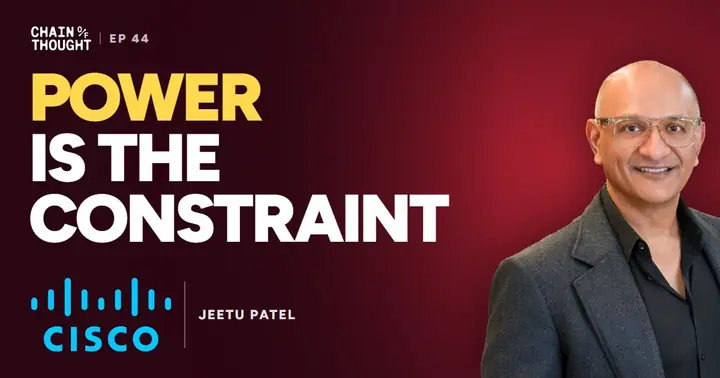
EP 44 · AI Infrastructure
The Critical Infrastructure Behind the AI Boom | Cisco CPO Jeetu Patel
What the conversations cover
These notes summarize the episodes featuring Jeetu Patel, including other speakers in panel conversations. Follow a source link to read the discussion in context.
EP 67 Parenting Your AI Agents for Best Results | Cisco's Jeetu Patel
- Jeetu Patel recommends building evaluations around your own use cases before choosing how to route work between models. A strong result on a public benchmark does not establish performance in your environment. Transcript at 14:15
- Patel argues that supervision should cover an agent’s actions and token consumption. He describes intercepting boundary violations and quarantining agents whose behavior or usage needs intervention. Transcript at 28:17
- Patel distinguishes access control from action control. Giving an agent an inbox connection should not automatically authorize every possible action; his example separates making dinner reservations from contacting a board of directors. Transcript at 34:40
EP 44 The Critical Infrastructure Behind the AI Boom | Cisco CPO Jeetu Patel
- Jeetu Patel frames AI-and-jobs as a maturity spectrum: level one is “AI is going to take our job,” level two is “someone that uses AI better than me is more likely to take my job than AI” (a real risk), and level three is realizing it will be hard to do your job without AI — just as you now can’t get a finance job without understanding the spreadsheet. Episode takeaways
- Patel argues aggregation — getting a succinct answer from the existing corpus of human knowledge — is “like 1% of the benefit” of AI. The other 99% is original insights that don’t exist in the human corpus, which he ties to tackling longevity, curing disease, ending poverty, and the climate crisis. Episode takeaways
- On model proliferation, Patel expects consumer AI to consolidate to “a dozen” foundation models holding most inference volume, while the enterprise side could run “tens of thousands of models” behind an intelligent routing layer that optimizes cost, latency, and domain fit. He cites Cursor, guessing — “I don’t know for a fact” — that roughly 70% of its queries no longer go to Anthropic. Episode takeaways
In their words
It seems like everything gets refactored every two weeks. The way I think about it is agents are like teenagers. They are profoundly intelligent, extremely resourceful, have no fear of consequence. The reality is that you have to jump in and start experimenting right away. And if you don't, you will be left behind and be irrelevant.
 Jeetu Patel Parenting Your AI Agents for Best Results | Cisco's Jeetu Patel · 0:00
Jitu is president and chief product officer at Cisco. Thank you so much for joining me. It's such a pleasure to be on your show, and I love the name of your podcast. Thank you so much.
Jeetu Patel The Critical Infrastructure Behind the AI Boom | Cisco CPO Jeetu Patel · 0:43 Transcript excerpts; ellipses mark omitted words. Some automatically selected quotes have filler words removed.
Related episodes
-
EP 80 · AI Agents
How Cisco Secures Personal AI Assistants for 90,000 Employees | DJ Sampath
DJ Sampath, Cisco
-

EP 47 · AI Agents
Gemini 3 & Robot Dogs: Inside Google DeepMind's AI Experiments | Paige Bailey
Paige Bailey, Google DeepMind
-
EP 62 · AI Agents
The First Fully Autonomous AI Attack is Coming | Kris Lovejoy, Kyndryl
Kris Lovejoy, Kyndryl
-
EP 42 · AI Agents
Architecting AI Agents: The Shift from Models to Systems | Aishwarya Srinivasan
Aishwarya Srinivasan, Fireworks AI
Related guests






Explained on AI, decoded
- How much electricity do AI data centers use?
- Why does AI run on GPUs?
- What's the difference between human in the loop and human on the loop?
- What is a token in AI, and why does it decide what AI costs?
- How do you give an AI agent an identity and permissions?
- How do you cut the cost of running an AI agent?
- What are AI agent guardrails, and how do you set them?
- Is using AI bad for the environment?