AI AgentsMCP (Model Context Protocol)
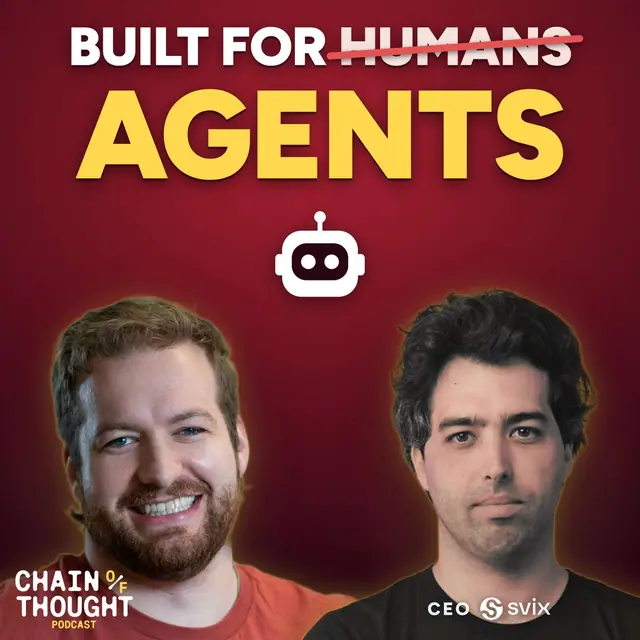
What Breaks When Agents Become the Customer | Svix CEO Tom Hacohen
with Tom Hacohen, Svix
Prefer to listen?
Presenting sponsor of season four

Show notes
What breaks when agents become the customer? Most of the integration layer, APIs, SDKs and webhooks alike, was built for human developers and for servers that are always listening. Agents are neither.
When an agent runs on a laptop, closing the lid takes down the tunnel its webhooks come through. When the lid opens, it gets a storm of retries from 12 hours earlier. Svix founder and CEO Tom Hacohen's answer is to let the agent poll for what it missed.
Svix delivers webhooks for companies like Clerk and Resend, and it created Standard Webhooks, the spec OpenAI, Anthropic and Google Gemini have adopted. In this episode of Chain of Thought, Tom joins Conor Bronsdon to talk through designing APIs for agents that adapt, whether agents still need SDKs, and why he wants less code even when agents write it. He also introduces Poke, Svix's new spec for making event-driven APIs work for agents.
This episode is sponsored by Svix.
We cover:
- Why events are harder for agents than API calls: the sender controls them, and they arrive outside the agent's session
- How polling endpoints and Svix's plugins for Hermes and OpenClaw let an agent pick up where it left off
- Why Tom calls JSON an abomination and webhooks duct tape, and why worse is better anyway
- Why Svix created Standard Webhooks when everyone implemented webhooks differently, and how the spec let Kong and ngrok add webhook verification
- Whether agents still need SDKs, and why Svix's skills work like a solutions engineer while its docs stay written for humans
- Why Tom wants less code even when agents write it, and what piling patches on patches costs
- Poke, Svix's early spec for letting agents subscribe to and trigger events across services, released so feedback can shape it while it's still malleable
Chapters:
(0:00) Duct tape, retry storms and the case for simplicity
(1:20) Why integrations got easier and harder at once
(3:09) How EteSync's webhook requests led to Svix
(5:28) Worse is better: why webhooks persist
(7:21) What changes when an agent receives the event
(9:16) What happens when the laptop closes
(11:16) Hermes, OpenClaw and agents that poll
(13:13) Letting agents choose their own subscriptions
(14:52) The long tail of the web without APIs
(19:57) Why Svix created Standard Webhooks
(24:34) How Standard Webhooks is governed
(26:33) Following real usage, including MCP
(28:34) Designing APIs for agents that adapt
(30:58) Do agents still need SDKs?
(31:44) Skills as documentation for agents
(35:13) Less code, even when agents write it
(36:44) Agentic development and the offshoring analogy
(37:56) Software factories and the plumbing underneath
(41:21) Keeping up while the standards change
(44:44) What Svix is launching with Poke
(47:08) Why Svix released the Poke spec early
(48:34) Building for your customers' customers
(50:08) Clerk, Resend and webhooks in the background
(52:49) Where to follow Tom
Links from the episode:
Svix
Poke
Standard Webhooks
Standard Webhooks on GitHub
EteSync
ssot-check
Most of the Web Will Never Get APIs for AI Agents | Dhruv Batra
Connect with Tom Hacohen:
LinkedIn
X
Svix
Connect with Chain of Thought host Conor Bronsdon:
Newsletter
Twitter/X
LinkedIn
YouTube
Transcript
The transcript for this episode isn’t available yet. Listen on any podcast app.