Open Source AIAI Evaluation & ReliabilityEnterprise AIAI Coding
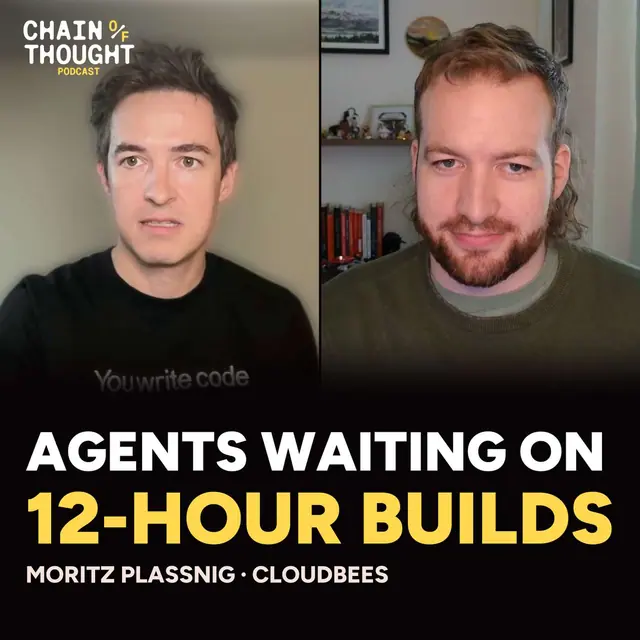
Writing Code Was Never the Bottleneck | CloudBees CEO Moritz Plassnig
with Moritz Plassnig, CloudBees
Prefer to listen?
Presenting sponsor of season four

Show notes
Enterprises are spending tens of millions, sometimes hundreds of millions, on tokens for their engineers. Ask what they're shipping as a result and, Moritz Plassnig says, the answer can be just a few more pull requests.
In big companies, he says, writing code was never the bottleneck. Builds run for hours. Policies still require a human to review every line. Releases wait weeks for security and governance sign-off. Generating more code doesn't move any of that.
Moritz is the CEO of CloudBees and the founder of Codeship, the CI/CD platform CloudBees acquired in 2018. He tells Conor where enterprise AI adoption stalls, why the people inside a company take longer to adapt than the technology, and what has to be rebuilt once there's a hundred times more code.
We cover:
- Why enterprise AI adoption is moving faster than anything Moritz has seen, and still slower than it looks from San Francisco and X
- The large bank that rolled out several agentic coding tools while its policy still says every line of code must be reviewed by a human
- Measuring tokens against pull requests, then production, then revenue, and the thought experiment of giving a company ten times the engineers
- Why Moritz tells companies not to over-focus on ROI at first, and what relearning how to swim taught him about that
- Policies as code, and why developers should keep their choice of models and tools
- Why enterprises are signing with several model vendors at once, and why the moment the US government moved to regulate who gets the best models still shapes those deals
- GitHub losing its place as the default, and why CI has to be rethought for a hundred times more code: predictive test selection and not rerunning tests that already passed
- Rethinking pull requests, feature flags and the rest of software delivery from first principles
Connect with Moritz Plassnig:
X / @moritzplassnig
LinkedIn
CloudBees
CloudBees on X
Connect with Chain of Thought host Conor Bronsdon:
Newsletter
X / @ConorBronsdon
LinkedIn
YouTube
Thanks to CoralBricks for sponsoring this episode. CoralBricks serves open models through one API, fast and at low cost: DeepSeek V4.1 Flash streams at over 300 tokens a second. Get $5 in credits on signup, plus another $5 on your first purchase
Transcript
136 segmentsMoritz Plassnig 0:00 Because if you have a hundred times more code, it's just like the complexity will just like balloon. And so I think we'll rethink everything from first principles. We're just starting.
Conor Bronsdon 0:14 Generating more code does not tell you whether or not a semiconductor company can ship a better product. The distance between those two things is where enterprise AI gets interesting. Welcome to Chain of Thought. I am your host, Conor Bronsdon. Joining me today is Moritz Plassnig, CEO of CloudBees and co-founder of Codeship. Moritz, so lovely to see you. Let's start off with... I think a really interesting question for folks. Since returning to Cloud B's. What has sparked The most excitement from you as you've been talking to customers and partners at the company?
Moritz Plassnig 0:49 Yes, I came back four or five months ago. And I spent pretty much All those weeks and months traveling, meeting customers, and our customers are big global organizations, public companies. So I I try to meet as many As I can, especially in person, and just talk about what's happening around agentic coding in your specific organization. And I think. What's so exciting is when I look back at other big technology changes, like let's say the cloud, for example. It it obviously had a huge impact and I feel like Us nerds got really excited about it early on, but then it took like years and years until it fully played out.
Moritz Plassnig 1:26 And I think it's still playing out. And what's different with AI and especially agentic coding is you go to any large company. And they are All in. It doesn't mean that the Are actually doing it right now, but nobody is questioning that it's the future, right? Everyone agrees. Code will be written by AI. And it's gonna happen and it's gonna happen really, really quickly. And everyone is focused on Well, how do we figure this out? Everyone is focused on making it happen. And I think the big difference is when I look at other technology changes, is that there's this like, Momentum that's bottomed up, right?
Moritz Plassnig 2:03 Developers playing with Codex, Claude Code, all the tools, and then there's this top-down pressure where every CEO, every board of a public company is thinking about, well, what are we doing for AI? Right? We must do AI, everyone else is doing AI. So there's this like huge FOMO, and you can like. Make a little bit fun of it, and some people believe it's a bubble and all of that, and we can talk about that. But I believe the positive impact is that there's this tremendous focus on.
Moritz Plassnig 2:26 Let's figure it out. This is real. Let's figure out how we do it. What gets me most excited about that is I think those Big, I always call them the big boring enterprises, right? Not the San Francisco startups. I think the big, boring enterprises is where AI will really have a huge impact on everyone else in the world, right? Because if you work with a large bank, like all their customers, right? Like whether it's my parents or or people that are not that exposed to technology, they will benefit from it because they ultimately get better products and better software.
Moritz Plassnig 2:56 So, yeah, I mean, I when I look back at at Codeship, uh, it was like a bottom-up developer-centric product and company. And then ever since I've done enterprise, and I I love bottom-up, but I also love just like talking to those real real companies that have millions and millions and millions of customers.
Conor Bronsdon 3:12 (Sponsor read: Sponsor thank-you) Before we dive in, I want to say a quick thank you to our presenting sponsors for Chain of Thought, Inngest for long -running agents, plus this episode's other sponsors, Coral Bricks .ai, providing lightning -fast open model inference.
Conor Bronsdon 3:26 I think the nature of this transformation is really Important. consideration for us to dive into. Because it frames everything else happening from the enterprise to the fast-moving startup. We have seen Certainly, a bit of an informational bubble with the pace of change of AI progress around. the people who are always on Twitter and the startups in San Francisco that are leaning all in. Where do you see the different adoption curves that are occurring here. As to your point, you know Many organizations are still adopting the cloud.
Conor Bronsdon 4:01 Are you seeing it move much faster in enterprises though today, based off of this compression from both bottoms up and top down that you're talking about?
Moritz Plassnig 4:09 It's moving faster than anything moved in the past that I've seen, but it's not moving as fast as everyone. Like makes you believe you would go on on Twitter and X, right? If you go on Twitter and X, everyone is like Yeah, like software factories are like fully automated, autonomous, dark factory, right? Like hands-off, like, yeah, you just get code out the other door. I mean, that is not happening in any large enterprise. They are moving really, really quickly for their pace, right? So it compares to their benchmark of usually moving very slowly and carefully and considering right the impacts.
Moritz Plassnig 4:42 Uh so I think Yeah, they're they're they're moving fast, but I think the What what's often forgotten is that in those big companies Writing code was never the bottleneck. And even I didn't fully appreciate that. And I have many arguments and this debates with customers about that. It was not what slowed them down. They hire thousands, then thousands of engineers. They are writing a lot of code. But then when you talk with them about well, how long does it take you? Let's say the code is written.
Moritz Plassnig 5:12 How long does it take you until it's fully tested, fully reviewed? And then ready to get released. And then, how long does it take you to release it out the door? In enterprises, we're talking weeks, even months. And that sounds like crazy, right? If you are in the I guess startup, like uh uh world and bubble because you're like, well, no, we we automated this a long time ago. And like if I if I merge on master, it just goes out the door, right? And it's like all feature flagged and then we do like those really smart release motions or canary deployments and all of that.
Moritz Plassnig 5:43 But I think that is like if there is a bubble, it's like Um that is the bubble, right? We we overestimate Um Or we believe that great developer tooling and great developer experience became the norm and the standard everywhere over the last 10, 15 years. And in the average Fortune-500 company, that's just not the case. That is why they're struggling and catching up because their builds might run like 12 hours. Right. And just imagine you're you're working with an agentic coding tool and then you want to run your test suite and it just takes hours after hours after hours or you need to do it overnight.
Moritz Plassnig 6:19 Right. And then there are random flaky failures because it didn't pay attention after that. And then you have to go back and rerun everything. And then it's finally all done and you're ready to release it, but you have to wait a month, right? Because security didn't shift left yet, right? And then. Like data governance and all of that, and privacy plays a big role. And there's those manual sign-offs, right? Like, it's just a completely foreign world. I feel like if you come out of the startup world and come from companies with great developer experience, but yeah, that is ultimately what holds us back, right?
Moritz Plassnig 6:50 So it's like writing code is not. The bottleneck for those companies, it's everything that happens after it. And so, what I see is there are companies that spend tens of millions, hundreds of millions on tokens for the engineers. And then when you talk about how is that going? How much more are you shipping? It's like, yeah, we are like seeing a few more PRs, right? But there's not like the the hundred million right that going on the left side is not resulting in like a lot more capabilities, features, improvements getting shipped yet. I believe we will figure it out, right? It's a temporary state, but like today those companies are struggling.
Conor Bronsdon 7:25 Yeah, the future is unevenly distributed. And I think we have this interesting phenomenon happening around the term AI psychosis, too, where. You know, we're seeing this joke about people getting AI-psychosis. I've joked about having AI-psychosis myself sometimes when I'm deep in Agentic coding. But I almost think that term has flipped from meaning someone who was all in on AI, building a ton with it, believing in the future of it. And now we're seeing this. Resistance group, too, where there are groups of people who are saying, Oh, AI is purely a bubble, there's nothing behind this, it's going away.
Conor Bronsdon 8:00 and are refusing to accept that This is a transformational technology that is changing the way we work. I personally think it's more on the scale of the Industrial Revolution than any of the more. recent technology changes. But even if you don't go with me on that argument. It's very clear that AI is changing the way technology operates and the way the world operates in many ways. And even if there's a massive valuation bubble, which I think it's fair to have that conversation, particularly about certain companies.
Conor Bronsdon 8:32 And that is a very common thing, right? Where the startup ecosystem will kind of build this bubble and then have to pop a little bit. But the technology is still very valuable. A great example of this is the internet, right? Where there was a massive bubble in 2000 evaluations, and yet the internet has transformed the world. Um And I I think I'm personally struggling with. How do we align people's expectations? when they're not already AI pilled and bought in here. And how do we help people make this transition when it is a very Challenging transformational time that does require a lot of change in how you work. And I'd love to hear your thoughts on this.
Moritz Plassnig 9:14 Yeah, I I and I honestly believe that yes, there are still people who are like questioning it. I don't meet As many of them anymore now compared to a year ago, right? I feel like a year ago, there was still a lot more of like, well, I tried this agentic coding tool. And it it got me like eighty percent there, ninety percent there, but then I need I had to spend so much time for the like remaining 10 percent. And I feel like ever since like Thanksgiving last year and then like Christmas, right, where it right like Claude Code uh initially took off, Everyone is like Okay, this is like actually working.
Moritz Plassnig 9:47 And so It got like significantly better since then. And so I feel like there is just this belief right now with most people I meet. No, this is real. It's just a question of How quickly can we adopt it? And where are there pockets where it maybe doesn't work? And I think. Um One thing that we all we often forget is, right, if you are building like Like distributed systems in the cloud, right? Like SaaS applications, I think that is where every like the models really shine today and that is where the startups are pushing the envelopes.
Moritz Plassnig 10:19 I think there, like, we are doing very well. But in the intro you mentioned, right, the semiconductor, right? That's like obviously a very different world when you build software that runs on a chip. Um so I think it will just take some time until I think it it diffuses into every part of the economy and every company is like truly using it. And and and and depending on what type of software you write, cloud based software versus like software that is still physically shipped somewhere and it runs like on premise.
Moritz Plassnig 10:45 Um like it it will just take longer, but I've I've I've no question that, uh It's happening everywhere eventually. And I believe that because I believe if we today like freeze the progress on the model side, I believe just like. productizing what we currently get in terms of intelligence from those models. And helping Every company in the world adopted. uh will have a huge impact on the world. Ah, and the reason why not every company has adopted it is not because the models aren't good enough or the harnesses aren't good enough, right?
Moritz Plassnig 11:17 I think what's happening here is. And again, I think in the startup bubble, we often forget that. The technology got so good so quickly. And the humans are currently the ones that are catching up, right? You need to learn how to let go. Change like the culture in your organization, change all your rules and processes. Just to give one silly example, I talked with a large bank and they are. They've Rolled out multiple Agentic coding tools to all their engineers, and they're all using them in one way or another.
Moritz Plassnig 11:47 But their internal policies still say Um every line of code that's written. must be reviewed by a human. And so, if that is the rule, it doesn't matter how much you do, right, on the code generation side, you will still be bottlenecked and you won't get the full benefit of it. And the reason for that is not that. They don't believe AI code review tools aren't like good or helpful, right? Changing those rules and processes in a large organization. takes time, right? The human needs to learn how to let go.
Moritz Plassnig 12:17 And then it's not just one human, right? It's the whole organization. And it's like different teams in a big company coming together and that is where Like lots of meetings happen and that where things slow down. And I always compare it with when you look at self-driving cars. And I'm pretty sure you've been in one, right? Whether that's like a Waymo or something else, or maybe you have a Tesla, right? That technology is amazing. And I believe like It is there, you can use it and we have all the data to prove.
Moritz Plassnig 12:44 But It's safer. Right. Fewer accidents, fewer fatalities, right? Fewer injuries. Um both on Whoever is like in the car, but then also like pedestrians, cyclists, all of that, right? The data is there. But then, why is not everyone in the whole world using the technology? And I think it's because Humans just need to adjust to it and that takes time right you need to trust to let go? Like take your hands off the steering wheel. And that just takes time, right? You need to experience it.
Moritz Plassnig 13:15 and you need to experience it some more and like other people need to do it and and so I think In a nutshell, the technology is there, the technology got really good, really, really fast. But we forget sometimes that humans adopting technology, getting used to it. especially in larger organizations. Takes time. And so it's not always just about the technology and I think we're seeing this right now.
Conor Bronsdon 13:39 So As organizations navigate this pivot. and the all the change management that comes with it. Mm-hmm. thanks to the mass technology transformation we're undergoing. Are there particular customers or partners that you've seen doing this extremely well that you would point to as examples to learn from.
Moritz Plassnig 14:00 I mean, I think there are there there there are many. large companies move faster is where they feel that there's more competition. Or they feel they must figure it out faster because it's so essential to the business. So when I talk to large software companies, again, not like startups, but like the big software companies that were founded many, many, many years ago and that built software the last 20, 30 years, I mean, they are all in, right? That is where You're like, wow, this is like this is game changing if we don't if we don't adopt the technology.
Moritz Plassnig 14:28 then there will be the little startup, right, that builds like a new CRM, right? Or A new competitor in our area, and they will just run so much faster than we are. So I think they are all in. I'm also seeing it a lot with financial services, banks, right, that feel. Um a lot of pressure from like the new banks that Our like In the past, we said like digital native, right? And they they they build great engineering teams, they build great product experiences, great mobile apps, right?
Moritz Plassnig 14:54 All those um more modern like fintech companies are a huge threat to the more established banks. I feel like Data Um Companies are also moving fast. Then, when you get down the list and get into areas where companies are Maybe a little bit more protected, or where software Is part of their company because every large company does software now in one way or another. We like went through the software is eating the world, so everyone has engineers. But where software isn't as mission-critical, I feel like they are.
Moritz Plassnig 15:25 they are moving they are moving a little bit slower or what i'm also seeing is companies where For example, I talk to a company and they are doing software for air traffic control. Systems, right? That is a world where Sure, like they believe they could move faster. They believe in AI. But like ultimately what matters most for them is that planes don't crash. So there's just like this risk reward is a little bit off for them where they are like, okay, we what matters most for us is that we are secure.
Moritz Plassnig 15:57 High quality, the software always works. And we will figure out how to layer AI into our development process to move. Move faster because they believe in the upside of it. For example, when it comes to security, right? They believe they can react faster to security issues, they can find more security issues more proactively. So they see that, but they will never compromise on quality ultimately and reliability. So they are the opposite of. Let's move fast and break things. But then I think some of the software companies are totally willing to move fast and break things right now because they see it as such an existential threat.
Moritz Plassnig 16:30 So it comes, I think, down to risk appetite. And then obviously other things, right? How much are you willing to spend? How are you bringing your people along? And the people that are in the companies that I've seen do it well spend a tremendous amount of time on just bringing their existing engineers along, right? Incentivizing them. Showcasing where it works, right? Giving them a choice of the tooling, right? And not being like, oh, you use this one specific, right, coding harness, but maybe you get a choice of multiple.
Moritz Plassnig 16:58 And that they spent a lot of effort in bringing the people along because, yeah, I know, like, Transformation, culture change, right? Change management are like boring, big enterprise terms, but they matter if you have like engineering organizations that are 10,000 people. So.
Conor Bronsdon 17:12 And I would almost point to the shirt you're wearing today. And for listeners who are not watching this on YouTube, it says you write code for a reason. And You know, we write code to problem solve, right? To solve challenges. It's a method of. expressing ourselves to a machine to help it accelerate our problem solving. And Many of us have offloaded the code generation part of that to LLMs. But The constraints with which we operate under can vary widely depending on are you a regulated enterprise, how many users do you have in production, what are the risks of breaking things, to your point, about who's moving fast versus who's being a little more conservative in their approaches here.
Moritz Plassnig 17:16 Yeah.
Moritz Plassnig 17:21 Yeah.
Conor Bronsdon 17:56 And a crucial part of this is actually identifying Huh. Will your use of AI change a business outcome? and let you write that code faster, let you solve the reason you were trying to solve the problem here. Or is it simply a vanity metric? How are you thinking about This you know, value delivery piece of it versus simple PR numbers.
Moritz Plassnig 18:22 Yeah, and and it it's probably my most favorite topic, right? So I think one big di difference between like The startups and the enterprise is But if you are in a startup, if you are a founder, A founder-minded person. I mean, you are an optimist when it comes to technology, right? You have a lot of ideas. Uh I mean, I'm a a a product builder, right? So when I look at agentic coding, I'm like, oh my god, this is awesome. Finally, I can build all the things I always wanted to build, right?
Moritz Plassnig 18:46 I was always constrained by how much we can. build out versus Um, like, I was never constrained by ideas, so I think. Ask him again like This quote startup bubble, we are like, this is awesome because we can build all the things we want to build. And then we have more ideas and we can just build. And building more is net positive because we have so many great ideas. And I think when you go into the enterprise, again, they have thousands, then thousands of engineers, and I think they are much more.
Moritz Plassnig 19:13 ROI focused ultimately. And yes, today, They are just trying to somehow figure out uh agentic coding and they're spending money there and then All the measure today is things like DORA-metrics, right? And they measure things like. Are we having more pull requests? They are focused on the does. Um Money on the left side, money that goes to Anthropic, OpenAI, whoever does it result in more Pull requests, right? That's the first step. And then if there are more pull requests, that'll result in more actually getting into production.
Moritz Plassnig 19:44 That's the next step, because then you at least know: okay, we are accelerating all the way into production, we are shipping more to our end customers, whether that's our own customers, users, internal teams, et cetera. Um And so that is the whole focus today, but I believe that those enterprises because they're ultimately like ROI focused, they will ultimately start looking to it. Like Okay if you are accelerating, but like What does it do for the business? And I think that is currently not being talked enough about.
Moritz Plassnig 20:11 Like, does it actually help? Ask people to go through this thought experiment, right? If you are a random company, you have 2000 engineers. Right like What would it do for you if you have twenty thousand engineers? Would it like really positively impact the business? Let's say you are a smaller bank, right? You have suddenly three times as many engineers. Does it really impact your business? Like Mm-hmm. Maybe it does, like, but does it impact it? so much that it's worth like hiring three times as many people.
Moritz Plassnig 20:42 And I think When you go for the thought experiment, you then can also apply it to ultimately your your token usage, right? Like, okay, you're spending let's say 50 million. Uh tokens for your engineers today. Should you spend 500? Should you spend 5 billion? Should you spend 25? Like, what's the right number? Nobody knows. And everyone is currently just spending, trying to figure it out because everyone else is trying to figure it out. And like, everyone believes, obviously, there is a benefit. But I think over the next one, two years, right, when we solved.
Moritz Plassnig 21:11 Those like challenges we talked about earlier were Things get stuck in the delivery pipeline and don't make it into production. Once we start shipping into production, at some point, somebody will look and be like, Okay, we now shipped a lot more last year. By the way. Revenue grew Fifteen percent. And the year before it also grew 15%. So what's like the impact of this? Like, were we able to sustain our growth rate because of it? Or is it just irrelevant? Like, we just accelerated, but it didn't move the needle.
Moritz Plassnig 21:39 And that is why I would say we write code for a reason. And we had that before, like you mentioned, the Industrial Revolution, right? I believe we had software factories before. Just had a lot of people in it. We will have software factories going forward with fewer people in it and more people coordinating versus writing the code. Yeah, Does this full automation. Actually move the needle. Nobody knows. And I think we need to focus on that more and start measuring this like end-to-end loop because then we can smartly allocate.
Moritz Plassnig 22:07 Where do we spend tokens? But we can also smartly allocate because I think the human will always stay in the loop for big companies. But where do the humans spend their time, right? And what ideas? Resonate with the end user and the customer? What ideas don't, right? What do we throw away? Maybe what did we build? Because it was so much easier to build, but what do we need to throw away? Because otherwise, everything just becomes too complex. I think those are big topics we are currently not talking about because everyone is just figuring out: well, let's figure out how to run faster first. And once we run really fast, Let's see if it gets us to where we wanna get to.
Conor Bronsdon 22:39 (Sponsor read: Inngest) Season four of Chain of Thought is presented by Inngest. Long -running agents need endurance. They must endure waiting for users and weather tool failures. They must take each new jump in model intelligence in stride. Inngest makes long -running agents durable, observable, and improvable over time. Check out their generous free tier and a sleek local dev server for testing for hosting your workflows. Grab the Inngest link in the description or visit Inngest .link slash cot dash pod to get started. Build for the long run with Inngest.
Conor Bronsdon 23:19 Yeah, one of the common themes in my recent conversation on the show, and this includes. You know, Tom Hacohen at Svix. This includes Uh I've been talking to Andrea Malagodi at Sonar. is the value of engineers who are willing to cut lines of code. And like it's great that we're generating all this code, but We actually want to simplify our code bases often because it makes it easier to transform them over time, it makes it easier to understand them. It reduces costs on things like builds over time, et cetera, et cetera, et cetera.
Moritz Plassnig 23:35 Mm-hmm.
Conor Bronsdon 23:51 And I think we have maybe shifted to a mindset that we've previously criticized as engineering metrics: oh, let's go optimize for lines of code, let's optimize for velocity, let's optimize for a number of PRs, let's optimize for a number of story points. And We have to You know, accept that yes, there's value in just increased velocity from the standpoint of like that lets you iterate faster. If you get that loop down, it can help you a ton. but you need to still attach it to that value.
Conor Bronsdon 24:19 Of, like, what are you iterating towards? What are you delivering for the product? You know, what's the ARR game to your point? And I think part of the challenge we're having is that there's some keeping up with the Joneses occurring. Where we are all seeing on Twitter you know, potato over at SpaceX, Lauren is shipping 500 PRs a day sometimes and And doing some incredible stuff. And there are 10x engineers who are just doing insane things with AI. And also have massive token budgets behind it and are spending millions in tokens at API prices.
Conor Bronsdon 24:52 And that's possible for folks at Frontier Labs, but Maybe for you and me, we don't have an unlimited API to go call. We have to have a CFO or my own accountant who's telling you, like, Conor, how much are you spending on your tokens right now? Uh so there are definitely Trade-offs that we need to make and considerations we have to make around value delivery for. the amount of token spend and I think it's harder because we're seeing competitors and just other folks in the industry who are saying, oh, I'm doing XYZ, I'm shipping so fast, my velocity is up so much. Uh and so we feel like we have to keep up with it.
Moritz Plassnig 25:29 Yeah, I mean there's definitely again like a lot of FOMO and so uh People are just doing it because everyone else is doing it. But I mean, I think at the core, it's still real, right? And I believe that. Um I once told like uh a group of engineers the story of like Well, I I I know how to swim. I learned how to swim as a kid, but like When I say I can swim, like I float, right? I don't drown. And I'm not like a competitive swimmer, right?
Moritz Plassnig 25:53 But I'm always going with this idea of should I do like a triathlon or an Iron Man? And for that, because I love running and biking. And so for that, I need to figure out how to swim much faster because I'm a competitive person. Uh When you try to unlearn this old skill that you learned as a kid and try to learn a new skills, whenever I try to like swim better. It's like incredibly hard because it's like so ingrained, right? And the new way of doing it with the proper technique in the beginning is like so frustrating because you're slower.
Moritz Plassnig 26:23 But at some point, right, the new way, the right way, the better way of doing it, like hits the line where it like, Crosses like the old way, right? And then you get you are better, you're faster, right? And then it starts compounding, and you only get there by like. Grinding through like this frustrating initial phase where it's not as good. And I think there's like. true in general, whenever you try to learn a new skill and you have your old way of doing it and you perfected it, but it has a ceiling.
Moritz Plassnig 26:49 And then the new way can break through that ceiling and you'll get ten times faster. But in the beginning, the first week, the second week, you aren't faster. I think the same is true just with uh agentic coding, right? When you go from like writing all your code by hand to like you need to prompt this and then it's like eh, it's like I don't like how I did it or it didn't fully work and then you go back into like, oh, I just fixed it manually.
Moritz Plassnig 27:10 Then over time, you go back and you just keep prompting and prompting and prompting, and you get better with feeding it the right context. You start to build this intuition, okay. When does this specific model start going sideways, right? When does it not go sideways? Like, how does it best work? You start building this intuition and then you get good, and then you. Then it starts making fun, you get the positive feedback loop. So, I believe to like break through this initial frustrating phase, you just need to do it for the sake of doing it.
Moritz Plassnig 27:39 And that is ultimately why I believe. My advice to companies is always: don't overly focus on the business outcome initially, right? Like, just get everyone doing it, get people excited. And once you're doing it, then figure out: well, how do we do it so that it also helps the company? And I'm I'm Following that approach, because I'm ultimately such an optimist, I believe it will be great. Um and if you if you if you don't get going at all Like Because you're overthinking the potential ROI.
Moritz Plassnig 28:11 I feel like you're just completely missing out. So, like, yeah, let's waste various on tokens, right? Like, in the first year, let's maybe overspend. But then You know how to do it and then you can get smart and figure out how to do it more efficiently and it will get cheaper anyway. And then yeah, I think eventually we need to figure out how to measure if the code we wrote actually happened then it impacted. But um Yeah, let's not overthink it in the beginning is still my my belief.
Conor Bronsdon 28:16 Yes.
Conor Bronsdon 28:37 I do think it's funny being uh Cautious optimist, or maybe a realistic optimist, in this moment, because. People are so fully all in on acceleration on one end. And it sounds like you and I are both kind of on the standpoint of like, oh, we're pretty bought in on this idea, but we do need to think about the implications here, depending on what type of business you're running and depending on how you're approaching it. Like, in my own personal vibe coding, like, yeah, I can just.
Conor Bronsdon 29:04 Throw code away. I can just go after it. It's fine. But once I have real users in production and I have businesses that I'm beholden to, there are different considerations I need to have. And With enterprises in particular, which are a lot of the folks that CloudBees works with. There are controls that you need to have. To enable enterprises to delegate more work while keeping clear owners, while actually succeeding. What are the controls that you think The enterprise side of this conversation I need to be thinking about.
Conor Bronsdon 29:34 versus how should startups be thinking in this moment. While they're all still having to go through this. cycle of learning and having to accept a bit of waste in that learning.
Moritz Plassnig 29:45 Yeah, I think the yeah, my advice is completely like different for startups versus uh versus enterprises. I mean enterprises it's yes, you have a lot of rules, your rules are ultimately downstream from regulations and the law. And then your like internal culture and risk appetite and yes, the rules. in a company that exists for like existed for like a hundred years, the rules like Right, only build up, and so there are a lot of rules. My advice to enterprise companies is always like try to simplify, try to standardize and then bake it into code, right?
Moritz Plassnig 30:14 Like if you have rules around who needs to review code, if you have rules around who needs to approve releases, who can deploy into a pre-production environment versus production environment, Um codify all those policies and then start enforcing them across your whole SDLC. regardless of the tools you're using and keep giving your developers choice because developers want choice, right? Some people prefer OpenAI models, some people prefer Anthropic models, some people prefer something different, some people maybe prefer like CloudBees. Uh right, a cloud P CI solution, some people prefer GitHub actions.
Moritz Plassnig 30:49 Right, I think you should give people the choice and your developers the choice, um, because otherwise they will work around you, but then figure out how can you do the governance holistically, right, so that you have clearly defined policies, as code, Um that define well what is a human allowed to do depending on what application to work on, what is a human allowed that um directs an agent to do something, right? Where is an agent code review enough? Where do you need an agent plus a human?
Moritz Plassnig 31:13 Just standardized it. Automated as much as possible for policies as code so that you are. That you have the right level of governance and control, but also focus on velocity because your risk as a large enterprise is finding this. Golden middle path of like, yes, we have governance and controls, but also we need to increase like right velocity and developer productivity and move faster. For startups, my advice is very different. I feel like for startups nowadays, Again, like the code generation is even less the problem, right?
Moritz Plassnig 31:49 For startups, you need to figure out how do you actually break through the noise here? Because I feel like for every single problem, if you go online right now, They are like 20 different products, right? Like when you look, for example, right, I feel like over the last couple of months. People got really frustrated. Um with GitHub actions. It's like Slow, it's expensive, right? I'm doing now so much more code, run so much more builds, it's really expensive. And like Fast forward to the day, you suddenly see like five, ten different startups, right, that offer faster CI as a service, which I think is awesome.
Moritz Plassnig 32:24 It gives the developers choice, right? But if you're building in that space, you really need to think hard about: well, how do I break through the noise? How do I differentiate? And then how do I stay competitive? Because what I think we have seen in the developer tool space is I when I look at like even just the last year, it was like cursor, then it was Claude Code, then it was codex, then we went maybe back to call, then we're back to code, right? Like it's like this like mad rush where people are switching and if you look on X and Twitter, you're like, Oh well, Anthropic is dead.
Moritz Plassnig 32:52 Like, OpenAI is dead, like a week later, right? The switching cost appears to be very low, and the willingness of people to switch, again, outside of the enterprise world. is very high, right? You just use whatever is best um depending on the week. And I think in that world, you need to like move really quickly as a startup, but I think we actually need to spend more time on well. How do you break through the noise? How do you get awareness for what you're building? And what's the reason why you can exist in the long run?
Moritz Plassnig 33:19 Because you might get initial direction quickly, but then it might move away because somebody else comes up with something slightly better. And there's currently I feel like little loyalty to any like tool or vendor, which I think is also awesome, right? Competition builds better products, but like as a founder, think hard about it because it's really hard to break through the noise.
Conor Bronsdon 33:41 Yeah, I am seeing this on the angel investing side of things. I think you do some angel investing as well, where It feels like it's a lot harder today to identify what startups are going to have a real moat. in uh a year or two and uh because often technical moats are easily copyable today. I don't really See technical moats surviving in this current moment, unless you can build a data, a data flywheel off of it. Oh, we're getting unique data or unique network effects. But Just saying, oh, I have this cool thing I've built.
Moritz Plassnig 33:46 Yeah.
Conor Bronsdon 34:13 is no longer enough to get you to the next stage because Someone else can do a clean room rebuild of that if they get a good sense of your idea. And we're seeing this. with game development where people are packing games together and it you know, triple-A games are under threat. We're seeing this in so many areas today. Where, like, look at agentic infrastructure, where there's seemingly, to your point, 20 different ways of doing the same thing. But At the enterprise stage, Some of these considerations are quite different.
Conor Bronsdon 34:48 To your point. We need to Transform these legacy pipelines while not also shutting them down. You can't totally throw them away wholesale. They have important functions. There's reasons behind many of them. When you talk to an enterprise, about that transformation of their traditional software approach to a software factory that's agent enabled. or from a legacy pipeline that's shipping incrementally to you know, a company-wide migration to much more regular builds and releases How are you starting that conversation and what's the process you think they need to go through? to begin the transformation.
Moritz Plassnig 35:17 Mm.
Moritz Plassnig 35:27 The first really important thing to internalize when you have those conversations is that Enterprises will always have a foot in the past and a foot in the future. Right, I mean enterprises still run mainframes. And if you look at like revenue numbers from IBM, et cetera, I mean, there's still a lot happening there. And you can argue it's like this melting ice cube and it's slowly like going away. But I mean, that has been playing out over so many years and will continue to play out over many, many more years to come.
Moritz Plassnig 35:54 So what makes enterprises so unique is. Technology is and has always been changing faster than they can change. And that's now more true than ever. And so They have uh still a foot in the mainframe world. Then they have a foot in the pre-agentic coding world, and then they also have a foot in two free legs, right? They also have a foot in the agentic coding world. And so. When you work with them, you need to understand that and understand where do you play and when you want to get to the point of like true enterprise-wide deployments.
Moritz Plassnig 36:26 You must ultimately also support what you think. Oh my God, this is like so legacy and this makes no sense, and this is the past, right? You need to really meet them where they are. and help them move into the future. Uh and that is the big difference to like the smaller companies and startups, right? Where When you look at the Even like the bigger startups, like they fully went into agentic coding, right? And they're doing it across the board for their whole code base. All the engineers are doing it.
Moritz Plassnig 36:55 They can shift around like that, but the big enterprises can't. So you need to figure out how do you work with them on the past and the future. Uh and that is That is very, very challenging because the technologies are so different, the people are so different, the willingness to change is so different. Um but then if you figure it out again you you can help Like a real company that operates out there in the real world has been around for, I don't know, fifty years or longer.
Moritz Plassnig 37:22 Um truly transform and have an impact. Uh and I think that is like very, very rewarding and you don't get that as much when you work with the with the little startups.
Conor Bronsdon 37:30 (Sponsor read: CoralBricks) This episode is also brought to you by CoralBricks. CoralBricks serves open models through one API at the lowest prices and the fastest speeds. DeepSeek v4 .1 Flash streams at over 300 tokens a second. Plus, CoralBricks also just put out MotionBench, a benchmark that asks a simple question. Can a model animate? I've personally contributed to the open source MotionBench, and I was impressed that DeepSeek v4 .1 Flash managed a close third place behind a leading Claude Opus 5 .5 at about an eighth the cost per task.
Conor Bronsdon 38:04 (Sponsor read: CoralBricks) The animation for this ad came out of that benchmark. We used Claude Opus 5 .5 and DeepSeek V4 .1 Flash via CoralBricks to create and edit it. Get lightning fast open model inference at chainofthought .show slash CoralBricks with a free $5 in credits on signup plus an additional $5 credit on first purchase.
Conor Bronsdon 38:25 As these enterprises transform and they have to keep this foot in the past, as you put it. there's a need for them to preserve flexibility because While Today, Opus 5.5 is probably the best coding model in the world as we're recording. By the time this episode comes out in a week or two, it might not be anymore. Um But enterprises get locked into these big contracts, their transformations take longer. They have to be more careful as they consider some of the pros and cons of the change management side of this. How should enterprises be preserving flexibility? when the best model or development tool keeps changing.
Moritz Plassnig 39:03 Yeah. What's different this time I feel like is when I compare it to again like people move into the cloud is I feel like with the cloud, the big like their Provider of choice, and then ultimately everyone used multiple, right? But there were people that went all in with AWS because they were obviously the first ones and then people were like maybe a little bit the Laggards they then went with Microsoft right because they already use Microsoft for everything else and so they picked their pro their their their um preferred vendor to work with and then they added the second one maybe I think with large language models.
Moritz Plassnig 39:33 Everyone I'm talking to Always pick. Multiple vendors. And then it's also looking at open weight models. And that's very different than What happened in the past? And I think the reason why is, and there are two reasons. The first reason is what you said, you just don't know. Which model is better, right? Like, okay, I picked the model that's best today. And then maybe next week, right, the other vendor, right, of meha or Anthropic comes out and builds something way better. Or there's suddenly this new startup, right, that builds something amazing.
Moritz Plassnig 40:04 So. Uh you just don't know. Um Where to place your bets? So you are Just placing multiple bets. And that might continue, right, if the labs continue to compete as hard and continue to release better and better models. The second reason is though, and I think we almost forgot about that because everything in the AI world is moving so quickly. There was this moment in time. Where the US government decided to regulate, like, who can get the latest, the best model. And Maybe you and I are not thinking much about that anymore, right?
Moritz Plassnig 40:40 And the discourse went on and like the industry, but enterprises remember that and they remembered even more. If they are outside of the US, or if they at least partially operate outside of the US. So there's this big fear of, okay. What if we Do a contract with OpenAI and Anthropic. But then the US government decides, well, you can't get the latest model. What does that do to our business? And can we stay competitive, right? And that is why. So many companies then additionally do like cost optimization benefits, look at open weight models and try to have these other alternatives.
Moritz Plassnig 41:17 So we will, I think. for quite some time, see this bifurcation and just see a lot of choice, which is awesome for all the developers working in those companies because they they get choice and it's very different from what we have what we have seen in the past. And then we'll see how it plays out, right? I think it really comes down to how do things get regulated. Um do we keep seeing like those step function improvements with the new models? Um Do we see people at some point defaulting to one or another vendor?
Moritz Plassnig 41:50 Because they're like. Well if there is a comp Better if vendor launches a new model than my vendor catches up in a month, anyway, right? We've seen this now for a year or two. We have to see how it plays out, but right now I feel like everyone is like Yep, I need the existing multiple. multiple vendors, it's like too much of a risk to the business to go all all in with one.
Conor Bronsdon 42:11 So if I am driving an AI transformation enterprise and I'm having to make these decisions on these multiple vendors, what would your advice to me be as I think through the pros and cons and how to handle The fact that each of these vendors wants to be the exclusive one.
Moritz Plassnig 42:27 Yeah, I think it's another reason why I should have multiple, because then you can negotiate mu much, much better, right? Because they're both trying really hard to get into every large enterprise account. So like um uh leverage, right, that flexibility, play them off each other and get get ultimately better contracts. Um I think you should also seriously explore do you want to use a third party harness? Uh right whether it's one of the the companies that are offering uh a third party harness, whether it's some open source approach like buy, but really, really think hard about like how what does your developer doing around the code generation?
Moritz Plassnig 43:04 part really look like. Because the code generation part is where you will spend like a lot of money, right, in the next couple of years. So at no point go all-in with one. I think they would be would be really foolish and would be very, very expensive. Like, try to do multiple and and ideally figure out the harness parts so you're also not locked into Um wonhaners provider doomage.
Conor Bronsdon 43:28 Obviously one of the big Topics of conversation this year has also been reliability as we've seen the scale of AI code accelerate. Um we've seen massive amounts of outages in certain areas. GitHub's obviously one that I think everyone has talked about. Um you know they've had some better luck with reliability the last couple of months, but Especially early this year, seeing huge challenges around their CI tooling, seeing huge challenges about the entire platform staying up. What are you seeing happen on the transformation front around CI and some of these Core developer infrastructure tooling pieces that are having to change to keep up with. the massive amount of code we are now generating.
Moritz Plassnig 43:57 Oh.
Moritz Plassnig 44:12 Yeah, but start with with GitHub. Since you mentioned GitHub, I think what's like Crazy on the one hand. Um but then also I feel like very good is When I look back my my whole adult life. GitHub was just
Conor Bronsdon 44:26 Yeah.
Moritz Plassnig 44:26 And it and it Mm. It was something like, I don't know, Google. Right, like you do not, like when I, I guess now I ask models, but like and less Google, but in the past, right. When I Had to find something out. It was just Google was the default choice, right? Like, that is why they became so successful. Um and and in the same way, GitHub just was the default choice. You just didn't think of oh, starting a new company, where do I put my code?
Moritz Plassnig 44:53 Of course, GitHub, right? And doing something on the side, where do I put my code, GitHub, right? Like GitHub was the default choice. Doesn't matter that there was like GitLab and like there were always some other other players, right? But GitHub was just like dominating that space and like had like this this mindshare and default choice. And that is now changing. Right. It wasn't like That they were unreliable once or twice, or then 10 times, right? Like, I don't know what broke it, but at some point, I feel like the discourse just changed.
Moritz Plassnig 45:23 And so many friends or developers I talk to are like, no, I'm now thinking about what else should I use, right? It's like. Um and once that starts, I think it's incredibly hard. to get it back. Um doesn't matter if Microsoft will do it. Good job or not, like making GitHub more reliable. I don't know if they will, I'm skeptical, but let's say they do. I think something just like broke in this like trust default choice behavior. And so now we're seeing obviously like Corso Origin, right?
Moritz Plassnig 45:50 We see a lot of like smaller startups, a lot of the PR computing company, some others. Um we just saw Anthropic right make a big deal uh uh of like their internal STM that they built and and and I think OpenAI will probably talk a about it at some point too. So there's now suddenly a lot of choice and a lot of like uncertainty. Is it even Git or is it something else? I think that changes a lot in the developer tool space because for the longest time, Git was just the default, right?
Moritz Plassnig 46:22 And so then everything happened from there. And that also impacts CI because I think because GitHub was the default Uh GitHub actions became more and more the default, right? You just got it with it and it worked. And sure, maybe you wanted something faster. And then you maybe went to some other solution. But for the longest time, that was also like a default choice in the last many years. And I think that is now completely changing because Everyone is realizing, oh shit, I spent money on tokens and accelerating.
Moritz Plassnig 46:56 And right, I'm talking about like startups and like not the big enterprises that are on github.com, right? I spent money on tokens to accelerate. And then now I also have to spend so much more on CI because my CI bill is exploding because I'm generating more code. I'm also generating much more tests, right? So in terms of like build minutes. It gets really expensive and then With agentic coding you still have this like Oh, it it it like y you Share it some code. Um maybe if if it's like a a small application, you run your full test suite locally, but more often than not you don't.
Moritz Plassnig 47:32 And so then you get into this like, okay, I pushed the kid up. Uh it kicks off CI, it runs, I find an issue. I let my agent maybe loop over it to fix that issue, right? And so I just waste build minutes over build minutes and over build minutes. I think what we accepted as a design pattern is You write some code, you run some tests locally, then you push to GitHub, you run tests, then you do PR, you run tests, right? Maybe then you run tests again before you deploy in the production.
Moritz Plassnig 47:59 You just keep running tests all the time, and that was fine for a while. But I think what's happening now is that just completely breaks if you have 100 times more code. I think what we will do going forward is a couple of things. So the first one is We will do predictive test selection, something that Google, Meta, a bunch of the bigger software companies have been doing for a very long time. You run a subset of the tests that you know you can correlate with the code change you made.
Conor Bronsdon 48:11 Hmm.
Moritz Plassnig 48:24 Um and then maybe once before you're dual released into production, maybe then you like run your full test suite. But before that, you only run a subset. I think that is going to happen and just become it will become the norm. I think what will also happen is Did we figure out an approach where if If you ran a certain set of tests. Yo. don't need to rerun them again unless the associated code changed. And so Through those mechanisms, I think it would just run CI much more efficiently.
Moritz Plassnig 48:56 And I think we'll also break this like pattern of I run something locally and and then I rerun it when I push and then I rerun it on a PR and then I'll rerun it again later. I think we'll break up that pattern because again, it doesn't scale for a hundred times. Uh more code changes. And so I think we are starting to rethink CI. That is why I mentioned earlier there are like a lot of small startups now. I mean, we are obviously in the space, right?
Moritz Plassnig 49:20 Because I mean, Jenkins, like, I guess, was the OG, right? CI tooling, but we also have a new CI as a service product that we are working on. So there's a lot of work happening there because I believe you need to rethink CI from scratch. in that world. and do it more efficiently because It is just so slow and so expensive us otherwise. And that That won't work.
Conor Bronsdon 49:41 Yeah, with how abundant code is today and how easy it is to have code be output. It's just no longer a blocker to have to create the code itself. It's now the factory rounder has become even more the challenge. Not that it already wasn't, like we already saw major challenges around that, particularly with your point earlier about enterprises. Already having the capacity to kind of do as much coding as they needed. It was everything around it that was the challenge, and making sure the craft landed, making sure the problems were actually solved.
Conor Bronsdon 50:10 But that is so much more true today be as we've 10x or more the amount of code we're able to ship. Everything else is a constraint. We've once again shifted left on where we have. than our time and the abstraction length.
Moritz Plassnig 50:19 Yeah. And they're still so early, right? I think what's happening is going back to we've talked about like self-driving cars, right? Self-driving cars, when you look at them today, it's like there's still the steering wheel in them, right? It's still like it's a normal car. And it's like self-driving bolted on. And then the more Yeah, right. Comfortable humans get with it, the more that technology gets diffused into like every different part of the world. the more we will open up to like, okay, now let's like redesign Transportation cars like for this new era, right?
Conor Bronsdon 50:34 It's a vestigial wheel.
Moritz Plassnig 50:52 And now we're starting to see cars that are like. Um, purpose-built for it, right? And there's no steering wheel in it, right? And I think over time we will see like different types of cars, right? Where maybe Uh right like just how you sit in the car is different, right? Like maybe it looks like I don't know, you have a big table in there, you can actually get work done, right? If you're commuting for an hour, right? Like, I think we'll like see how we now.
Moritz Plassnig 51:15 like redesign first principles for this new world. And when I look at developer tooling, we are going through the same transformation, right? Like currently, we are all just bolting on and like. Trying to change the development process to make it somewhat work for this new era. Um and that obviously keeps breaking left and right. And so we see companies now And right and throwing about their their what what they are doing instead of Git is like Like a thing like The future, right? You need to rethink from first principles.
Moritz Plassnig 51:47 Well, how will this work in this new era? And we need to do that for every single step of the development process that comes after. After creating the code, right? CI is obviously the first one, or maybe like code reviews are before that, or after, depending on how you see it, right? Code reviews we are rethinking. I think we will rethink pull requests, right? Are they still a thing? And why were they a thing in the past? I think human code reviews played a big role, why they became a thing.
Moritz Plassnig 52:15 So we will rethink that. We will rethink CI. Obviously fully automating releases. I think we're also rethinking feature flags, for example, right? Because I think you want feature flags because you can only know in production if it like really works or not. And then You want everything like behind feature flags as much as possible so that then agents can automatically turn it off and on, right, if something doesn't work. But that, right, it's not The humans that are doing all of that, right? Because if you have a hundred times more code, it's just like the complexity will just like balloon.
Moritz Plassnig 52:47 And so I think we'll rethink everything from first principles. We're just starting. um there right because again I feel like This Thanksgiving moment is now almost a year ago. I feel like this Claude Code Thanksgiving moment kicked this really off. Um and I don't even know what the revenue numbers of right uh Anthropic and Open AI were like before that. Because it's like just crazy, right? I don't remember what happened like even a month ago. It's like uh but like it's just like it's crazy how much happened over the last year.
Conor Bronsdon 53:10 So Fu fun fact. Uh
Moritz Plassnig 53:17 And we're just all trying to kijak and uh Yeah, I think We will start to like rethink from first principles and how should this work in this new era. And then we will get to better tooling and I believe it will be amazing and Yeah, it ultimately then will diffuse into enterprise companies and will do will help us a lot.
Conor Bronsdon 53:35 to your point about first principles, I think we need to be spending a ton of time rethinking everything we do from first principles. Because everything we have built and thought about was based off the idea that intelligence was not abundant. that we were limited. in what we could do. And one of the most successful things I've seen personally with models today and each generation of them. Let alone as a business, is to be more ambitious, be braver, take on things. You are able to do more than you think.
Conor Bronsdon 54:08 Our beliefs are often a limiting factor right now. And the systems we previously built are often a limiting factor right now. as intelligence becomes ever more abundant for us. And even if you think the like subscription model is going to get more expensive. The efficiency and the intelligence delivery of Opus 5.5 compared to even Opus 4.8, which was, by the way, six months ago. One of my favorite accounts on Twitter is the AI six months ago. Like, this is changing so rapidly. And It is only accelerating the level of capacity and what these products and these models can do today. Uh and we all need to be a bit more ambitious and and rethink how we're doing things.
Moritz Plassnig 54:48 Yeah, I mean, I totally agree, right? It will, I mean, it definitely will get cheaper, right? Like, same level of intelligence today is cheaper than in the past. It will be cheaper tomorrow, right? It will be amazing. I I don't believe because there's like The bubble talk, and like, oh, like the open weight models, right, will be able to give you that level of intelligence, and then you don't pay for OpenAI or Anthropic as much anymore. I don't think that that is necessarily like it will play out like that, because I believe that.
Moritz Plassnig 55:13 Yeah. If we can get The intelligence for a lower price, there will be ultimately so much more demand. And what we're seeing today is, and that is why it's like so expensive, right? It's like we are constrained ultimately by supply. And so. I think the cheaper it gets, the more demand we'll have and at the same time The technology just gets diffused more and more through the economy, which will again increase demand. And then with uh agentic coding specific call they write in the BAST The analogy I always look at is like when Uber first became a thing, and people were arguing, oh, the taxi market is only this big, and so Uber can only be that big, and they're overvalued.
Moritz Plassnig 55:51 And I think now everyone acknowledges well. If you make it really easy to order a car. Then you start ordering a car for a lot more things that you would have never ordered a car. Before. And I think there's the next level to that with fully self-driving cars. And so. The market ultimately was much bigger. And I think the same is true with agentic coding and developer tools. There will be so many more people building that were not able to build before. And hence, they will all need developer tooling.
Moritz Plassnig 56:20 And yes, I think there's more competition, right? When you think about SaaS apocalypse, like I don't think that people will build everything in-house. I think there will be just more competition, which will decrease the price. But then the market is so much bigger, right? That is why I'm so bullish. There is ultimately long-term no bubble, right? I think when you look at How few people, I mean, use something like ChatGPT daily, not even like uh agentic coding, right? The normal like old school chat LLM stuff, right?
Moritz Plassnig 56:49 Like how many people use that? So few when you look at how many humans we have in the world, or how many millions of people we have in the US or in the Western world, right? However, you want to slice and dice the market, you are still so. early and I think with uh agentic coding. Yeah. even earlier because right now it's still mostly like professional developers, right, that are, and software engineers that are playing with it and Wow. I think it would be amazing, right? If like Everyone can build and Um that will be a massive market for people that are ultimately building companies in that space.
Conor Bronsdon 57:24 I think this is a fantastic note to end the episode on, and it gives me a couple of clear framings that'll probably end up in the title. So, anyone who finishes this episode may see the episode title as something like. Be braver with AI or rethink your AI software factory from first principles because I think Mo had some amazing insights that he shared with us. I really enjoyed the conversation. For folks who want to follow your work more and learn more about what CloudBees is up to in this era. Uh where should they go? What are the links? What's the best place to follow you?
Moritz Plassnig 57:57 Yeah, it's probably it depends on like the audience. I think if you are like the the startup uh person, uh developer, founder, then probably X and Twitter. Uh like my first name, last name, uh on Twitter. If you're the enterprise person, then LinkedIn, right? I feel like I post very different things on those two platforms because just very different audiences, right? If you're a Twitter person, go on LinkedIn, you're like, oh my god, like, what's this guy post doing? And uh and the same if you go the other direction. So self self-direct yourself right in the and in the right place. Mm-hmm.
Conor Bronsdon 58:15 Ah.
Conor Bronsdon 58:27 Amazing. Well, we will
Conor Bronsdon 58:31 We will link both of those in the episode description. Mo, thanks again for coming on. It's been fantastic chatting with you.
Moritz Plassnig 58:37 Yeah, thank you. This is great.