At the time of the conversation, Sharon Zhou was VP of AI at AMD. On Chain of Thought, recorded live at AMD’s Advancing AI 2025 event, she discussed making AMD’s software stack accessible to developers as part of the company’s open-ecosystem bet against NVIDIA.
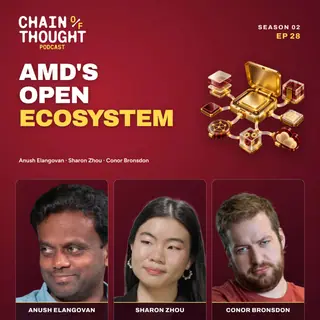
Latest episode with Sharon Zhou · EP 28
AMD's Challenge to NVIDIA: The Open Ecosystem Bet | Anush Elangovan & Sharon Zhou
Anush Elangovan & Sharon Zhou ·
Episodes
What the conversations cover
These notes summarize the episodes featuring Sharon Zhou, including other speakers in panel conversations. Follow a source link to read the discussion in context.
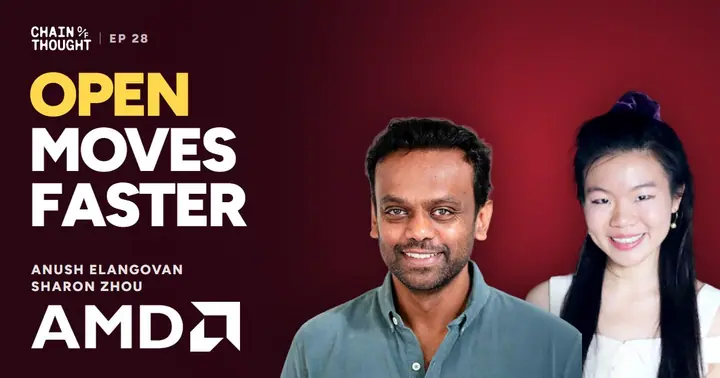
EP 28 AMD's Challenge to NVIDIA: The Open Ecosystem Bet | Anush Elangovan & Sharon Zhou
- Anush Elangovan frames AMD’s MI350 GPU series, built on the CDNA 4 architecture, as delivering 20 petaflops of FP4 performance, which he calls “mind blowing.” He credits AMD’s chiplet design for NUMA load balancing and power savings, since unused chips can be turned off and only what a workload needs is powered on. Episode takeaways
- CDNA 4 introduces new AI data types — both FP4 and FP6 — and Anush highlights that FP6 throughput is nearly that of FP4. That lets data scientists step models down from FP8 to FP6 as an intermediary before reaching FP4, which he frames as where things are headed. Episode takeaways
- Anush says the MI350 series reaches 288 GB of memory, enough that “500,000,000,000 parameter models that can run on one GPU,” with at-scale deployments going far larger. He cites deep partnerships with seven of the ten top AI companies as evidence the generational hardware investment is paying off. Episode takeaways
In their words
Yeah. So, I have a few different thoughts around what will help drive it. But I think right now, it's a combination of the three different audiences that we're looking into. One is AI developers. That's probably number one. The second is AI researchers. AI researchers are helpful because they're a little bit lower level and more willing to try something experimental.
 Sharon Zhou AMD's Challenge to NVIDIA: The Open Ecosystem Bet | Anush Elangovan & Sharon Zhou · 37:07
Transcript excerpts; ellipses mark omitted words. Some automatically selected quotes have filler words removed.
Related episodes
-
EP 80 · AI Agents
How Cisco Secures Personal AI Assistants for 90,000 Employees | DJ Sampath
DJ Sampath, Cisco
-
EP 73 · AI Agents
Genspark's Bet: AI Agents Become the Users of Software | Wen Sang
Wen Sang, Genspark
-
EP 72 · AI Agents
Tuning GPU Performance with AI Agents | AMD’s Anush Elangovan on ROCm 10
Anush Elangovan, AMD
-
EP 66 · MCP (Model Context Protocol)
Data Federation, Not Centralization, Is What Enterprise AI Needs | Jitender Aswani, Starburst
Jitender Aswani, Starburst