Jitender Aswani
- 1 episode on Chain of Thought
- 3 topics covered
- 1 full transcript
- Jul 2026 first on the show

Jitender Aswani was customer zero for Presto at Meta, scaled it at Netflix, and now runs engineering and security at Starburst, the data platform built on Trino. On Chain of Thought he explained why the average enterprise has 52 to 200 data sources, why centralizing them will never work, and what happened to Starburst’s query volume the day they shipped an MCP server.
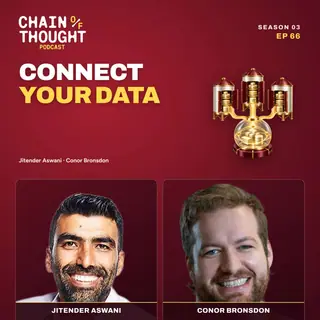
Latest episode with Jitender Aswani · EP 66
Data Federation, Not Centralization, Is What Enterprise AI Needs | Jitender Aswani, Starburst
Jitender Aswani, Starburst ·
Episodes
-
EP 66 · MCP (Model Context Protocol)
Data Federation, Not Centralization, Is What Enterprise AI Needs | Jitender Aswani, Starburst
What the conversations cover
These notes summarize the episodes featuring Jitender Aswani, including other speakers in panel conversations. Follow a source link to read the discussion in context.
EP 66 Data Federation, Not Centralization, Is What Enterprise AI Needs | Jitender Aswani, Starburst
- Jitender Aswani’s core argument: fragmentation is a condition to design around, not a project to finish. “A traditional enterprise will have anywhere between 52 to 200 data sources,” accumulated naturally as each new service brought its own store. A decade of moving it all into one place produced debt instead of answers: “Centralization was a fine, fine strategy when the data was growing not as fast as your ability to move it,” but “as the data volume continues to explode, the ETL tech debt starts to really accumulate.” His conclusion, and the thesis of the episode: “The federation is the only model that scales with entropy. Can centralization scale with entropy? No, because the entropy is constantly, constantly increasing.” Episode takeaways
- Agents broke the query-volume assumptions underneath enterprise data platforms. Because they “operate in this react mode, they reason, they act, they reason, they act, they are generating queries at insane speed. Some people call it at machine speed. I think they’re generating it faster than the machine itself.” Sometimes they also fire unbounded ones, because “they’re not making judgment of, shall I fire that query?” Starburst watched it happen to its own service: “when we launched our own MCP server, we saw the query volume go through roof,” and “many of our customers reached out because they had to scale the compute capacity behind it.” Aswani also says “80% of our code is now generated by agents” — his own first-party number, not an audited one. Episode takeaways
- Some of the large language models driving those agents are, in his phrase, “overzealous,” and that is a line item. “They want to prove themselves right. They do not want to come back and say like, oh, I was wrong.” His example is a FinOps agent Starburst built internally that only had AWS data wired up. Asked to break cloud spend down by provider, “it starts firing queries. It’s just frantically firing queries without stepping back and thinking, do you even have GCS and Azure data?” And it is a pattern he keeps seeing, not a one-off: “sometimes I’ve seen that after 30 minutes, they’re still doing it. And I know you are wasting my tokens. Just stop.” His sliver of hope is guardrails and precise context — not fewer queries, but “they will become smarter and they will structure their queries better.” Episode takeaways
In their words
A traditional enterprise will have anywhere between 52 to 200 data sources. The federation is the only model that scales with entropy. Can centralization scale with entropy? No, because the entropy is constantly increasing. Imagine agents without access to all the data, without access to the right contacts. What would they do?
 Jitender Aswani Data Federation, Not Centralization, Is What Enterprise AI Needs | Jitender Aswani, Starburst · 0:00
Transcript excerpts; ellipses mark omitted words. Some automatically selected quotes have filler words removed.
Related episodes
-
EP 80 · AI Agents
How Cisco Secures Personal AI Assistants for 90,000 Employees | DJ Sampath
DJ Sampath, Cisco
-

EP 73 · AI Agents
Genspark's Bet: AI Agents Become the Users of Software | Wen Sang
Wen Sang, Genspark
-
EP 72 · AI Agents
Tuning GPU Performance with AI Agents | AMD’s Anush Elangovan on ROCm 10
Anush Elangovan, AMD
-
EP 48 · AI Agents
How Block Deployed AI Agents to 12,000 Employees in 8 Weeks w/ MCP | Angie Jones
Angie Jones, Block