
Richmond Alake is Director of AI Developer Experience at Oracle and one of the more concrete voices on agent memory, with a talk that crossed 100,000 views and the open-source MemoRIS library to his name. On Chain of Thought he framed memory engineering as its own discipline and demoed an agent that runs vector, graph, spatial, and relational search in a single query.
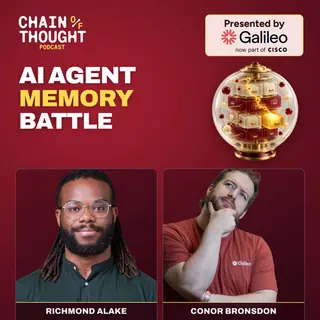
Latest episode with Richmond Alake · EP 53
Agent Memory: The Last Battleground in the AI Stack | Richmond Alake, Oracle
Richmond Alake, Oracle ·
Episodes
What the conversations cover
These notes summarize the episodes featuring Richmond Alake, including other speakers in panel conversations. Follow a source link to read the discussion in context.
EP 53 Agent Memory: The Last Battleground in the AI Stack | Richmond Alake, Oracle
- Richmond Alake maps four memory concepts onto agent architecture: working memory for the current context, semantic memory for knowledge, episodic memory for timestamped interactions, and procedural memory for skills. He presents this as an analogy drawn from human memory. Transcript at 19:47
- Alake describes ranking memories using relevance, recency, and importance. His example makes retention a deliberate design choice: information can lose priority when it is no longer retrieved or useful. Transcript at 28:11
- Alake recommends choosing storage around application maturity. Files can simplify an early demonstration; he argues that customer-facing systems at scale need more established storage and retrieval infrastructure. Transcript at 45:59
In their words
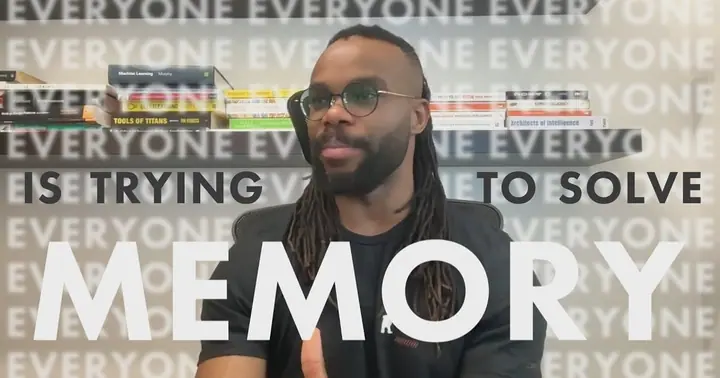
Memory is the last battleground for anyone that operates in the AI stack. And here's what I mean. Everyone is trying to solve memory. Database companies, model providers, everyone has got a say on how memory should be modeled in a genetic systems. But a single developer can build a memory system that can remember better than a chat GPT.
 Richmond Alake Agent Memory: The Last Battleground in the AI Stack | Richmond Alake, Oracle · 0:00
Transcript excerpts; ellipses mark omitted words. Some automatically selected quotes have filler words removed.
Related episodes
-
EP 61 · AI Agents
The AI Framework Era Is Over: Why Context Is the Moat | Jerry Liu of LlamaIndex
Jerry Liu, LlamaIndex
-
EP 52 · AI Agents
Context Poisoning is Killing Your AI Agents: How to Stop it | Michel Tricot, Airbyte
Michel Tricot, Airbyte
-
EP 42 · AI Agents
Architecting AI Agents: The Shift from Models to Systems | Aishwarya Srinivasan
Aishwarya Srinivasan, Fireworks AI
-

EP 80 · AI Agents
How Cisco Secures Personal AI Assistants for 90,000 Employees | DJ Sampath
DJ Sampath, Cisco