
Kapil Chhabra is co-founder and chief product officer of WisdomAI. On Chain of Thought he explained how companies keep business definitions current for AI agents, and how a specialized harness checks and repairs answers to questions about their data.
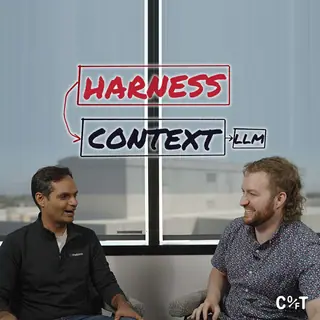
Latest episode with Kapil Chhabra · EP 75
Why Context Alone Isn't Enough for Enterprise AI Agents | WisdomAI CPO Kapil Chhabra
Kapil Chhabra, WisdomAI ·
Episodes
What the conversations cover
These notes summarize the episodes featuring Kapil Chhabra, including other speakers in panel conversations. Follow a source link to read the discussion in context.
EP 75 Why Context Alone Isn't Enough for Enterprise AI Agents | WisdomAI CPO Kapil Chhabra
- Kapil Chhabra, co-founder and CPO of WisdomAI, sees the enterprise AI stack settling into layers: company data at the bottom, the models, a context layer that bridges the model’s view of the world and the company’s data, and a harness specialized for one task on top. He says the harness is little talked about today and “will become a big deal.” In his analogy, the model is the surgeon, the context is the patient history, and the harness is the hospital system with its charts, checklists, instruments and back office. Episode takeaways
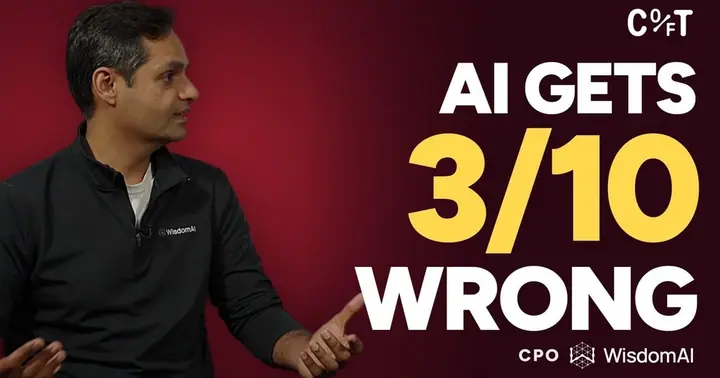
- In a WisdomAI survey of senior AI, analytics and data leaders, Chhabra says 93% were using LLMs and agents to access internal data, but only 7% could say they had scaled those operations. He puts the gap down to trust: data leaders can’t yet deliver trust in the data coming out of these chat systems, and the missing piece is context, such as the company’s own definitions of ARR, churn and when the fiscal year ends, which no model knows out of the box. Episode takeaways
- A semantic layer is necessary but not sufficient, Chhabra says. It was designed for deterministic BI tools, while a chat agent reasons on the fly over any question. The context layer adds natural-language instructions (finance may mean a fiscal quarter by Q1 while marketing means a calendar quarter) and examples of what good SQL or Python looks like. He keeps institutional context, set by a person with authority such as a subject-matter expert, separate from personal memory: his own dislike of pie charts belongs in memory, not in the company’s definitions. Episode takeaways
In their words
Only 7% across the whole set were able to say that they have scaled the operations. And that's the missing gap.
 Kapil Chhabra Why Context Alone Isn't Enough for Enterprise AI Agents | WisdomAI CPO Kapil Chhabra · 14:27
It is necessary, but it is not sufficient.
Kapil Chhabra Why Context Alone Isn't Enough for Enterprise AI Agents | WisdomAI CPO Kapil Chhabra · 17:57 Transcript excerpts; ellipses mark omitted words. Some automatically selected quotes have filler words removed.
Related episodes
-
EP 61 · AI Agents
The AI Framework Era Is Over: Why Context Is the Moat | Jerry Liu of LlamaIndex
Jerry Liu, LlamaIndex
-
EP 42 · AI Agents
Architecting AI Agents: The Shift from Models to Systems | Aishwarya Srinivasan
Aishwarya Srinivasan, Fireworks AI
-
EP 71 · AI Agents
Slack Wants to Be the Context Harness for Code | CPO Jaime DeLanghe
Jaime DeLanghe
-
EP 53 · AI Agents
Agent Memory: The Last Battleground in the AI Stack | Richmond Alake, Oracle
Richmond Alake, Oracle
Related guests






Explained on AI, decoded
- What is the difference between a semantic layer and a context layer for AI?
- What is a token in AI, and why does it decide what AI costs?
- Why do LLMs hallucinate?
- What is the difference between prompt, context, and memory engineering?
- What is context in an AI agent?
- What makes an AI agent different from an LLM?
- How do you decide what information an AI assistant may receive?
- What's the difference between human in the loop and human on the loop?