
Bob van Luijt is the co-founder and CEO of Weaviate, the open-source vector database. Across two Chain of Thought appearances he helped define agentic architecture and then returned for the Season 2 premiere to dig into how RAG and AI infrastructure are evolving, arguing that this is the time to start building.

Latest episode with Bob van Luijt · EP 8
AI Infrastructure & the Evolution of RAG | Weaviate's Bob van Luijt
Bob van Luijt, Weaviate ·
Episodes
-

EP 8 · RAG & Retrieval
AI Infrastructure & the Evolution of RAG | Weaviate's Bob van Luijt
-
What the conversations cover
These notes summarize the episodes featuring Bob van Luijt, including other speakers in panel conversations. Follow a source link to read the discussion in context.
EP 8 AI Infrastructure & the Evolution of RAG | Weaviate's Bob van Luijt
- Weaviate already had what we today call RAG — they called it “generative search.” When the research-paper term caught on, they simply adopted the language: “in the product itself, nothing changed. It was just how we talked about it.” Episode takeaways
- Bob frames the arc in three steps: RAG is “one directional” (query → retrieve → generate), agents add a feedback loop, and generative feedback loops — his favorite — let the agent “put stuff back inside the database.” Episode takeaways
- The killer use case is master data management. Pre-Weaviate, consulting for a global candy manufacturer, Bob watched humans hand-reconcile messy data (Fahrenheit vs. Celsius, British vs. American spelling) — losing, because “data is coming in faster than these people could handle it.” Generative feedback loops let a model do that reconciliation instead. Episode takeaways
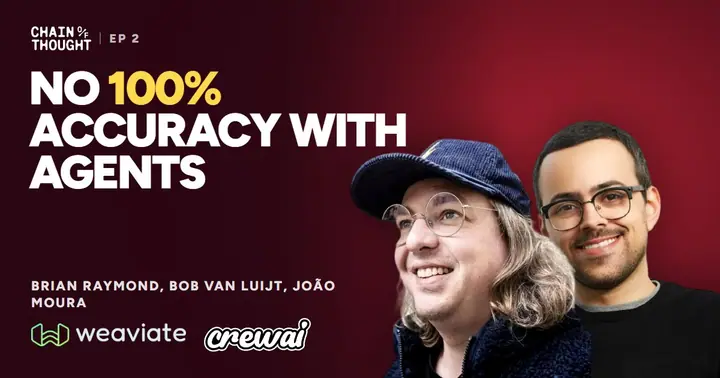
EP 2 Got Agents? Agentic Workflows & Architecture | Weaviate, Unstructured & CrewAI
- João Moura (CrewAI) draws the line at agency: a fixed if-this-then-that flow isn’t an agent. An agent “controls the flow of the application,” using an LLM “as a brain” to reason about what tools to use, when to use them, and how to format the answer — “something that has agency.” Episode takeaways
- Bob van Luijt (Weaviate) argues data is still the bottleneck, not models. A CIO told him: “it’s all great what you guys are building over there… but I still have like 15 ERP systems and I can’t, you know, I can’t make heads or tails of it.” Low data quality and not getting to insights remains “the number one problem.” Episode takeaways
- João Moura (CrewAI) warns agent architectures start simple but explode in production: once inside an enterprise you bolt on a caching layer, a memory layer (long-term memory of what the agent has done and learned), guardrails, validation, security, and distribution — and the complexity “can get…to skyrocket a little bit.” Episode takeaways
In their words
It's brought us very far, but now we need to start to bring in loops, right? So what if you have more questions? What if we need to query multiple times? And that is something we at We've Hit, we put a lot of work in that. So we'll probably get to that later, but the feedback loops to get might be multiple sources of information, do multiple queries from the database.
 Bob van Luijt Got Agents? Agentic Workflows & Architecture | Weaviate, Unstructured & CrewAI · 16:49
Transcript excerpts; ellipses mark omitted words. Some automatically selected quotes have filler words removed.
Related episodes
-
-

EP 79 · AI Agents
For AI Agent Fleets, the Model Is Rarely the Bottleneck | Theory Ventures' Andy Triedman
Andy Triedman, Theory Ventures
-
EP 61 · AI Agents
The AI Framework Era Is Over: Why Context Is the Moat | Jerry Liu of LlamaIndex
Jerry Liu, LlamaIndex
-
EP 80 · AI Agents
How Cisco Secures Personal AI Assistants for 90,000 Employees | DJ Sampath
DJ Sampath, Cisco
Related guests






Explained on AI, decoded
- What is agentic RAG, and how is it different from regular RAG?
- What's the difference between agentic and non-agentic AI?
- What is RAG, and why do AI systems use it?
- Should you use prompting, RAG, or fine-tuning to customize an AI model?
- Vector database or knowledge graph — which should you use for AI retrieval?
- Which AI agent framework should you use — LangGraph, CrewAI, or AutoGen?
- How do you evaluate a RAG system?