
Dan Klein is the co-founder and CTO of Scaled Cognition and a professor of computer science at UC Berkeley, where he leads the NLP group and won the ACM Grace Murray Hopper Award. On Chain of Thought he explained why LLMs are plausibility engines rather than truth engines, and how his team built APT1 for under $11 million.

Latest episode with Dan Klein · EP 54
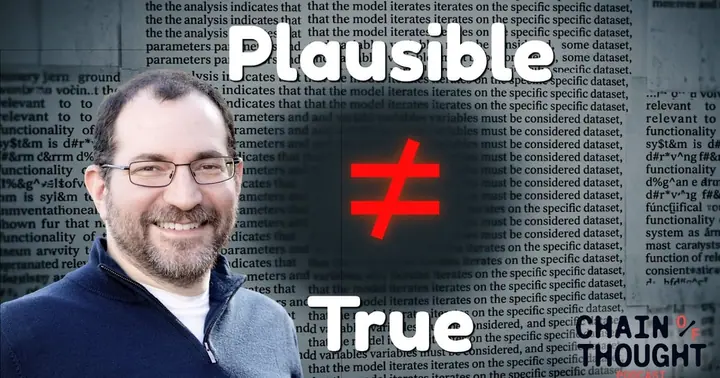
Why LLMs Are Plausibility Engines, Not Truth Engines | Dan Klein, Scaled Cognition
Dan Klein, Scaled Cognition ·
Episodes
-
EP 54 · AI Evaluation & Reliability
Why LLMs Are Plausibility Engines, Not Truth Engines | Dan Klein, Scaled Cognition
What the conversations cover
These notes summarize the episodes featuring Dan Klein, including other speakers in panel conversations. Follow a source link to read the discussion in context.
EP 54 Why LLMs Are Plausibility Engines, Not Truth Engines | Dan Klein, Scaled Cognition
- Dan Klein describes prompting as a flexible but imprecise control surface. Rewording an instruction can change behavior, but natural-language instructions alone do not provide a guarantee that the model will follow them. Transcript at 5:40
- Klein argues that teams need a more precise definition of hallucination. A retrieved answer, a paraphrase, and a changed meaning require different checks; treating all mistakes as one phenomenon obscures their causes. Transcript at 29:24
- Klein cautions that adding models to check other models brings cost, latency, and additional failure modes. His concern is whether a complex checking system can provide dependable behavior across a whole conversation. Transcript at 57:46
In their words
And that's why even if you could make this work, it's still better to have a model that in its natural operation doesn't make the mistake in the first place. And that's absolutely one of the advantages of APT1 is it gets it right in its natural operation rather than after seven other models have signed off.
 Dan Klein Why LLMs Are Plausibility Engines, Not Truth Engines | Dan Klein, Scaled Cognition · 1:00:15
Transcript excerpts; ellipses mark omitted words. Some automatically selected quotes have filler words removed.
Related episodes
-
EP 57 · AI Agents
Every AI Agent Has an Evaluation Gap | Alex Ratner, Snorkel AI
Alex Ratner, Snorkel AI
-
EP 12 · AI Evaluation & Reliability
The Making of Gemini 2.0: DeepMind's Approach to AI Development and Deployment | Logan Kilpatrick
Logan Kilpatrick, Google DeepMind
-

EP 5 · AI Agents
Practical Lessons for GenAI Evals | Chip Huyen & Vivienne Zhang
Chip Huyen & Vivienne Zhang
-

EP 3 · Open Source AI
GenAI Predictions for 2025 | Databricks & Cohere
Sara Hooker, Craig Wiley & Vikram Chatterji
Related guests






Explained on AI, decoded
- How do large language models actually work?
- Why do LLMs hallucinate?
- What does it actually take to ship AI in a regulated industry?
- When should you use a reasoning model instead of a standard LLM?
- What's the difference between agentic and non-agentic AI?
- What should you measure on an AI agent besides accuracy?
- Are AI hallucinations a data problem or a model problem?
- What is LLM-as-a-judge, and when can you trust it?
- Are AI hallucinations always bad?