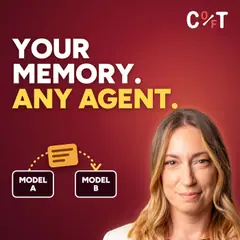
In episode 77 at 4:41, Kimberly Logan describes an import as a point-in-time solution: people continue to use different models for different tasks. In episode 75 at 1:19:55, Kapil Chhabra argues that customers should be able to take their institutional context with them when they change vendors. Those are related portability needs, though personal memories and company context can have different owners and access rules.
A practical test: export a small set of approved preferences, an updated fact, and a withdrawn preference. Import it into a second agent. Check what it retrieves, whether the update supersedes the old fact, and whether the withdrawn preference stays excluded. Repeat after another change at the source. These are suggested acceptance cases, not measured results from either guest’s product.
A downloadable archive establishes that records can leave a system. It does not establish that a second model will use them the same way, or that later corrections and deletions will propagate. Keep record format, retrieval behavior, authorization, and update handling explicit.
See agent memory for what persists, and the four memory types for what those records do.
Hear it from the guest
“The problem is not solved with an import function either.”
“Context is the IP of the company and it needs to stay with the company.”
Quotes lightly edited to remove filler words.
Sources
- Kimberly Logan on model switching and point-in-time imports — Logan explains why an import alone does not serve workflows that keep using multiple models. Walrus sponsored this interview.
- Kapil Chhabra on customer-owned context — Chhabra describes export and repository-backed context as features of WisdomAI. WisdomAI sponsored this interview.
Go deeper
- How do you make an agent's memory portable across apps? AI, decoded · How to Make Agent Memory Portable Across Apps
- What are the types of AI agent memory? AI, decoded · The 4 Types of AI Agent Memory
- What is the difference between prompt, context, and memory engineering? AI, decoded · Prompt vs. Context vs. Memory Engineering