The State of AI Podcast Feeds: Transcripts, Cadence, and Hygiene Across 8 Shows (2026)
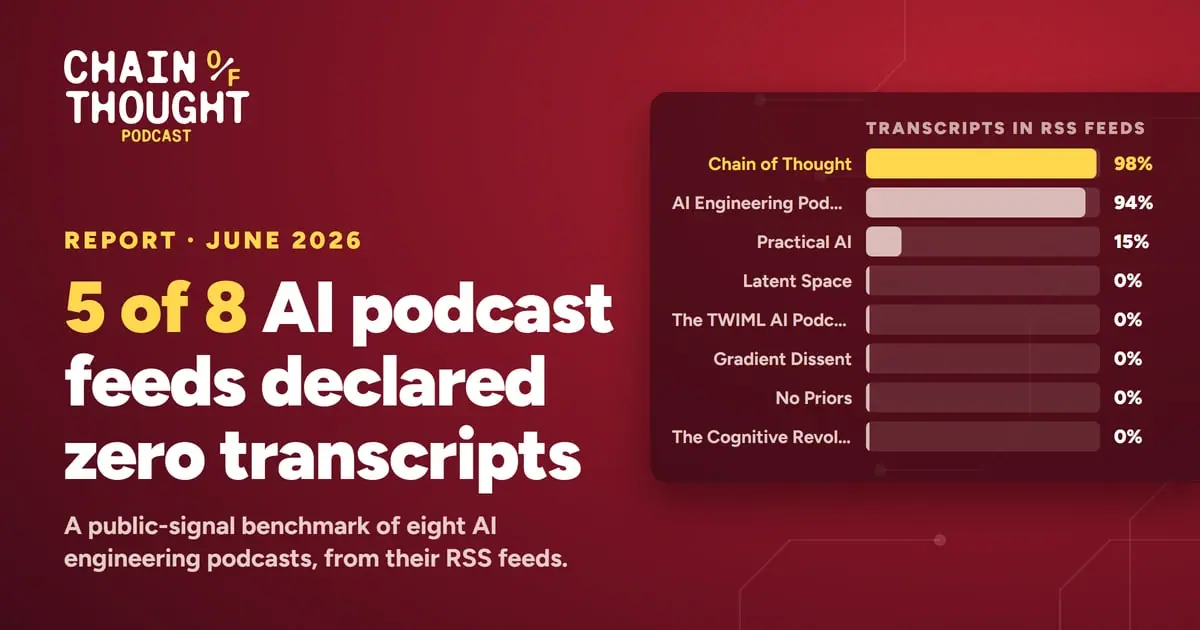
Five of the eight AI podcasts in this benchmark declared zero transcripts in their RSS feeds on June 11, 2026. Across the 2,148 items those feeds served at collection, 190 carried at least one podcast:transcript tag. That’s 8.8% of the sampled feed items. An absent tag does not establish whether a transcript exists on a website, video platform, or elsewhere.
September 5 clarification: This revision narrows the interpretation of the original June data. It adds no new feed observations and makes no claim about current coverage or measured search impact.
This report benchmarks Chain of Thought against seven AI engineering podcasts: Latent Space, Practical AI, The TWIML AI Podcast, Gradient Dissent, AI Engineering Podcast, No Priors, and The Cognitive Revolution. Every number comes from public signals: each show’s live RSS feed and Apple’s iTunes lookup API, fetched 2026-06-11. No download estimates, no chart scraping, nothing private. Methodology below, and the full dataset is downloadable above.
The practical question is what a feed tells a reader or application about an episode’s transcript. The Podcasting 2.0 transcript tag links to a transcript or captions file. This audit counts those declarations. It does not test which answer engines consume them, whether the linked files work, or whether adding tags changes citations or search traffic.
Key findings
All figures from public RSS feeds and the Apple iTunes lookup API, as of 2026-06-11.
- 5 of 8 AI podcasts benchmarked declare zero transcripts in their RSS feeds: Latent Space, The TWIML AI Podcast, Gradient Dissent, No Priors, and The Cognitive Revolution.
- 190 of the 2,148 episodes (8.8%) served across all eight feeds carry a
podcast:transcripttag. - Chain of Thought leads on feed-declared transcripts at 98.4% (61 of 62 episodes), followed by AI Engineering Podcast at 93.7% and Practical AI at 15.2%.
- No show scored 4/4 on feed hygiene. Chain of Thought and AI Engineering Podcast tie for first at 3/4; the other six score 2/4.
- Publishing pace varies nearly 8x across the set, from Latent Space at 8.85 episodes per month to Gradient Dissent at 1.15.
The benchmark at a glance
| Show | Catalog eps | Eps/month (6mo) | Avg min | Transcripts % | Hygiene /4 | Days since last ep |
|---|---|---|---|---|---|---|
| Chain of Thought (subject) | 62 | 2.62 | 45.4 | 98.4 | 3/4 | 7 |
| Latent Space | 207 | 8.85 | 71.1 | 0.0 | 2/4 | 6 |
| Practical AI | 361 | 3.28 | 46.4 | 15.2 | 2/4 | 6 |
| The TWIML AI Podcast | 787 | 1.80 | 46.3 | 0.0 | 2/4 | 1 |
| Gradient Dissent | 137 | 1.15 | 53.6 | 0.0 | 2/4 | 15 |
| AI Engineering Podcast | 79 | 1.31 | 53.8 | 93.7 | 3/4 | 106 |
| No Priors | 166 | 3.77 | 38.6 | 0.0 | 2/4 | 0 |
| The Cognitive Revolution | 349 | 8.03 | 98.0 | 0.0 | 2/4 | 0 |
Data as of 2026-06-11. Apple ratings were also collected but Apple’s public API no longer returns them for any show, so that ranking is omitted entirely rather than guessed at.
The transcript gap
Transcript availability measures the percentage of episodes in each feed that carry at least one podcast:transcript tag, the Podcasting 2.0 standard that tells apps, directories, and crawlers where the text of an episode lives.
| Rank | Show | Feed-declared transcripts | Episodes tagged |
|---|---|---|---|
| 1 | Chain of Thought (subject) | 98.4% | 61 of 62 |
| 2 | AI Engineering Podcast | 93.7% | 74 of 79 |
| 3 | Practical AI | 15.2% | 55 of 361 |
| 4 (tie) | Latent Space | 0.0% | 0 of 207 |
| 4 (tie) | The TWIML AI Podcast | 0.0% | 0 of 787 |
| 4 (tie) | Gradient Dissent | 0.0% | 0 of 137 |
| 4 (tie) | No Priors | 0.0% | 0 of 166 |
| 4 (tie) | The Cognitive Revolution | 0.0% | 0 of 349 |
Here, 0% means zero transcript declarations in the sampled feed. Website transcripts are a separate publishing surface that this percentage does not measure. A transcript tag exposes a link to applications that support it; the audit does not establish which applications use the link or how they rank the episode.
The 8.8% aggregate weights every feed item equally, so larger feeds contribute more. TWIML accounts for 787 of the 2,148 sampled items and had no transcript declarations. Read the pooled count alongside the per-show table: neither the aggregate nor this selected peer set estimates adoption across all AI podcasts.
Chain of Thought had declarations on 61 of 62 feed items; its untagged item was the trailer. Hosting support, configuration and catalog history are possible explanations for coverage differences. They were not measured here. Chain of Thought and Practical AI both used Transistor feed URLs but had different coverage, so a hosting provider’s name alone cannot explain the result. Publisher corrections could help identify the causes and the effort required to change coverage.
Feed hygiene: a metadata checklist
Feed hygiene is a 4-point checklist read from each feed’s channel metadata: channel artwork, category tags, a podcast:funding tag linking to financial support, and a podcast:locked tag indicating whether the feed may be imported into another hosting platform. The score assigns one point to each declaration. These elements serve different purposes; the total is not a validated measure of crawlability, feed quality or search performance.
| Rank | Show | Score | Has | Missing |
|---|---|---|---|---|
| 1 (tie) | Chain of Thought (subject) | 3/4 | artwork, categories, locked | funding |
| 1 (tie) | AI Engineering Podcast | 3/4 | artwork, categories, funding | locked |
| 3 | All six other shows | 2/4 | artwork, categories | funding, locked |
All eight feeds declared artwork and categories. Funding and locked were each declared by one show. The audit records their presence, not whether a show needs each element, whether its host supports it, or why it is absent.
Cadence and catalog: where the tradeoffs are honest
Publishing cadence, episodes per month over the trailing six months:
| Rank | Show | Eps/month (6mo) |
|---|---|---|
| 1 | Latent Space | 8.85 |
| 2 | The Cognitive Revolution | 8.03 |
| 3 | No Priors | 3.77 |
| 4 | Practical AI | 3.28 |
| 5 | Chain of Thought (subject) | 2.62 |
| 6 | The TWIML AI Podcast | 1.80 |
| 7 | AI Engineering Podcast | 1.31 |
| 8 | Gradient Dissent | 1.15 |
Catalog depth, total episodes:
| Rank | Show | Catalog episodes |
|---|---|---|
| 1 | The TWIML AI Podcast | 787 |
| 2 | Practical AI | 361 |
| 3 | The Cognitive Revolution | 349 |
| 4 | Latent Space | 207 |
| 5 | No Priors | 166 |
| 6 | Gradient Dissent | 137 |
| 7 | AI Engineering Podcast | 79 |
| 8 | Chain of Thought (subject) | 62 |
Data as of 2026-06-11.
Chain of Thought had the smallest catalog in the set at 62 episodes, against TWIML’s 787 and Practical AI’s 361. Its measured cadence was 2.62 episodes per month; Latent Space and The Cognitive Revolution each exceeded eight in the same trailing window. Catalog size does not by itself establish a show’s age.
Duration shows the format spread: No Priors runs tightest at an average 38.6 minutes, The Cognitive Revolution longest at 98.0, and Chain of Thought sits at 45.4.
Catalog size, publishing pace and transcript declarations describe different parts of a feed. High declaration coverage does not establish an advantage in audience reach or AI citations. Testing that relationship would require separate outcome measurements and a design that accounts for other differences between shows.
Methodology
This benchmark was generated by a command-line tool that fetches public data and writes every raw number with a per-source fetch timestamp. All data was collected 2026-06-11 (07:26 UTC).
Sources:
- Direct fetch of each show’s public RSS feed (the same XML every podcast app reads).
- Apple iTunes lookup API for catalog depth (
trackCount) and genre.
How each metric is computed:
- Catalog depth: Apple
trackCount. In this run, every show’s feed served its full archive (feed item counts matched Apple’s catalog counts), so feed-derived metrics cover whole catalogs. - Publishing cadence: episodes published in the trailing 183 days, divided by 183/30 (30-day months). Computed from feed pubdates.
- Average duration: mean minutes across in-feed episodes that report a duration.
- Transcript availability: percent of in-feed episodes carrying at least one
podcast:transcripttag. - Feed hygiene: one point each for channel artwork, category tags, a
podcast:fundingtag, and apodcast:lockedtag. - Days since last episode: from the newest feed pubdate to the collection date.
What was deliberately not collected: download numbers (private to each show; no public source has them, and estimating would make the report worthless), Apple or Spotify chart positions (scraping violates their terms), and anything behind authentication. This report benchmarks public signals only. It says nothing about audience size.
The full raw output, including every per-source fetch timestamp and per-episode data, is in benchmark.json (590 KB). The flat per-show table is the CSV download above.
Limitations
- Transcript availability reflects the
podcast:transcriptRSS tag only. A show can publish transcripts on its website without emitting the tag, in which case it reads as 0% here. The metric measures feed-declared transcripts, not all transcripts that exist. - Declared transcript URLs were not validated for availability, format correctness or transcript accuracy. Declaration coverage does not establish usable transcript coverage.
- Feed-derived metrics cover the episodes a feed actually serves. Some hosts cap feeds to recent items, which would truncate the window; in this run no feed was truncated, but a re-run against different shows should check that flag in the JSON.
- Apple’s public lookup API no longer returns rating counts or averages for any show. Ratings were collected as N/A across the board and the ranking is omitted rather than estimated.
- Catalog counts can differ by a few episodes between sources depending on trailers and crawl timing. The JSON records which source each number came from.
- This is a point-in-time snapshot of eight shows chosen as Chain of Thought’s peer set in AI engineering. It is not a census of AI podcasts, and a different peer set would shift the rankings.
If you run one of these shows and a number looks wrong, the raw JSON has the fetch timestamps and per-episode data to check it against. Tell me what I missed.
About Chain of Thought
Chain of Thought is an AI engineering podcast hosted by Conor Bronsdon, with guests from NVIDIA, Google DeepMind, AMD, Cisco, Databricks, and Vercel, covering agents, evals, infrastructure, and the business of AI. Every episode publishes with a full transcript on this site, which is also why this report exists: the bet that machine-readable feeds matter is one the show has already made.