Think of a chain as an assembly line for text. To turn a sales call transcript into a follow-up email, one call extracts the customer’s questions, a second drafts answers from approved product facts, and a third rewrites the draft in the company’s tone. Between steps, ordinary code can check the work, for example by refusing to continue if the first step found no questions. Anthropic calls these checks “gates” and describes chaining as a fixed workflow for tasks that split cleanly into steps (Anthropic, Building effective agents).
The main reason to chain is control. Each step has a smaller job, so it is easier to write, test and debug than one long instruction, and you can log or evaluate every intermediate output. Anthropic’s current prompting guide notes that newer models handle more multistep work inside a single call, but still recommends explicit chains when you need to inspect intermediate results or enforce a structure; its most common example is a draft, a review against criteria, then a revision, which is a form of self-correction (Anthropic, Prompting best practices). The cost is more model calls, more latency and errors that can carry forward from one step to the next.
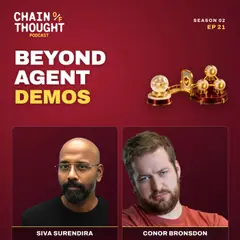
A chain is not an AI agent. In a chain, the developer fixes the steps in advance; in an agent, the model decides what to do next. In episode 21 at 12:20, Lyzr’s Siva Surendira makes that point about early workflow builders: Flowise showed steps stacking one after another, and it “was just prompt chaining basically” before the industry called such flows agents. Episode 21 aired while Galileo, Conor’s employer at the time, sponsored the show; Conor plugs Galileo at 36:57.
Editorially, chaining is often the right first design: start with the simplest fixed sequence that passes your tests, and move to an agentic workflow only when the steps genuinely cannot be known in advance.
Hear it from the guest
“It was just prompt chaining basically”
Quotes lightly edited to remove filler words.
Sources
- Anthropic: Building effective agents — Describes prompt chaining as a workflow that decomposes a task into a sequence of steps, each LLM call processing the previous output, with optional programmatic checks between steps; checked October 24, 2026.
- Anthropic: Prompting best practices — Says explicit prompt chaining remains useful to inspect intermediate outputs or enforce a pipeline, and that the most common chaining pattern is draft, review and refine; checked October 24, 2026.
- Wu et al.: AI Chains — Research paper that introduced chaining LLM steps so people could see and edit each step's output; checked October 24, 2026.
- Chain of Thought episode 21 at 12:20 — Lyzr's Siva Surendira says Flowise originally described its stacked steps as prompt chaining rather than agents.