Ask a chatbot “which cargo airlines still fly trijets?” and it answers from memory in seconds. Ask a deep research agent and it writes a plan, searches, reads the pages it finds, notices gaps, searches again, and several minutes later hands back a report with citations. The product name comes from Google’s Gemini feature; OpenAI, Anthropic, Perplexity and others ship similar modes, and teams build their own on top of an agent harness.
Under the hood it is an agent loop specialized for reading: the tools are search, browsing and document retrieval, and the output is synthesis. That makes it slow and comparatively expensive per question, and it inherits the weaknesses of its sources. A long, confident report can still cite a page that doesn’t say what the report claims, so the usual advice to check an AI answer applies with more force, not less.
In episode 69 at 34:34, Thomson Reuters’ Joel Hron describes legal deep research as a model in an agent harness that searches and synthesizes recursively until it reaches an answer, built on the company’s own legal content. Hron reports that the company’s Thomson model outperformed larger models on that task when given access to that content; that is the company’s own result. Episode 69 credits Svix and Walrus Memory as Season 4 presenting sponsors (Svix read at 27:04, Walrus Memory read at 44:12).
In episode 39 at 12:03, Vercel’s Malte Ubl suggests building a deep research tool that can access a company’s private data. The episode was sponsored by Galileo (mention at 44:37). Google’s Logan Kilpatrick frames it in episode 12 at 28:52 as a long-running asynchronous experience where you don’t sit and wait. The episode was sponsored by Galileo (mention at 18:07).
Hear it from the guest
“Where a model within an agent harness goes out and … searches and synthesizes, searches and synthesizes … recursively until it reaches an answer.”
Quotes lightly edited to remove filler words.
Sources
- Google AI for Developers: Gemini Deep Research agent — Google's API documentation for its Deep Research agent, which plans, searches and synthesizes multi-step research tasks into a report; checked October 24, 2026.
- Google Gemini: Deep Research overview — Google's product overview of Deep Research in the Gemini app, describing a research plan, multi-site browsing and a report with sources; checked October 24, 2026.
Go deeper
From the conversation
-
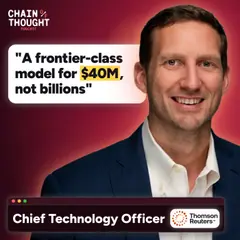 Thomson 1: The New $40M Legal AI Model | Thomson Reuters Joel Hron
-
 Vercel's Playbook for AI Agents: From Vibe Check to Production | Malte Ubl
-
 The Making of Gemini 2.0: DeepMind's Approach to AI Development and Deployment | Logan Kilpatrick
-
 The AI Framework Era Is Over: Why Context Is the Moat | Jerry Liu of LlamaIndex
-
 Every AI Agent Has an Evaluation Gap | Alex Ratner, Snorkel AI