Best Chain of Thought Episodes from Frontier AI Labs
Guests from the labs that pretrain their own foundation models.
Each episode here has a guest from a lab that pretrained its own foundation models from scratch when the episode was recorded, rather than fine-tuning someone else’s. That is a short list, and four episodes come from it. Logan Kilpatrick and Paige Bailey cover Google DeepMind from the Gemini 2.0 launch to Gemini 3. Poolside’s founders walk through how they train a model for code, and Sara Hooker, then head of Cohere’s research lab, gives her predictions for 2025.
- 4 episodes
- 7 guests
- 3 hours of listening
- 4 jump-to moments

- 1
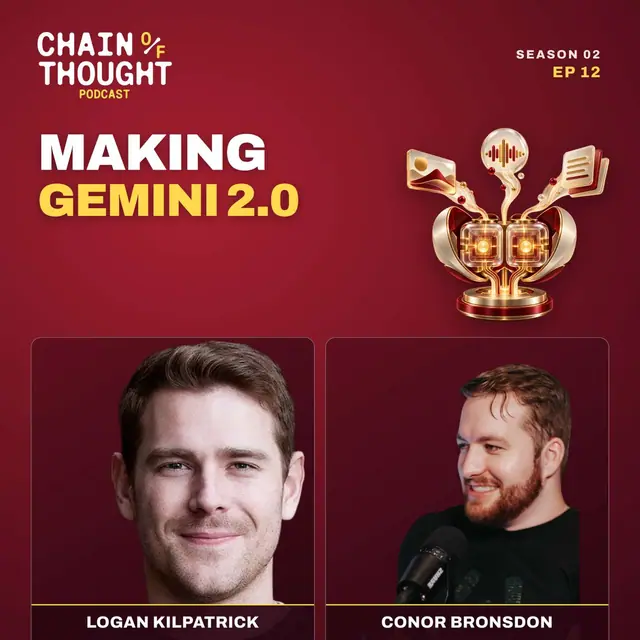
 The Making of Gemini 2.0: DeepMind's Approach to AI Development and Deployment | Logan Kilpatrick Logan Kilpatrick, Google DeepMind Logan Kilpatrick on how Google DeepMind and Google Brain came together to build Gemini, and his case that long context, native search and video, image and audio input set Gemini apart. Jump to the moment · 22:10 · What sets Gemini apart →
- 2
 Gemini 3 & Robot Dogs: Inside Google DeepMind's AI Experiments | Paige Bailey Paige Bailey, Google DeepMind Paige Bailey on how Google went from PaLM 2, built by a team of about 40, to a Gemini effort whose credits run for pages, plus Gemma, the open models Google gives away. Jump to the moment · 15:33 · From PaLM 2 to Gemini →
- 3
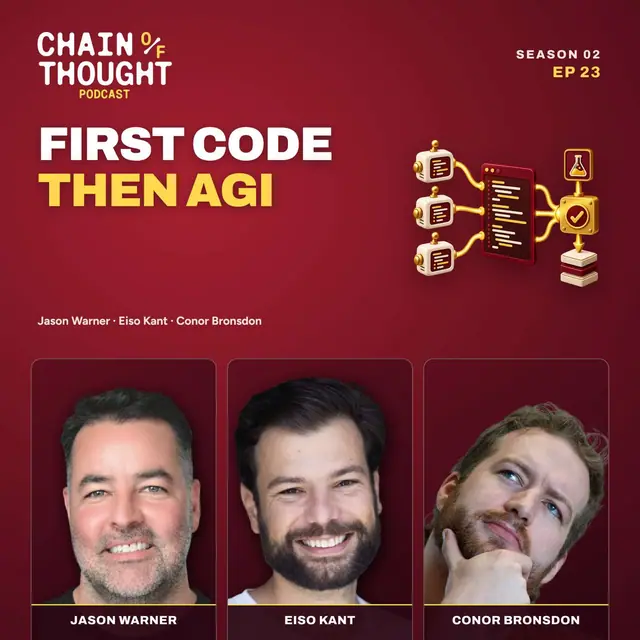
 First Code, Then AGI: Software’s Event Horizon with Poolside Founders Jason Warner & Eiso Kant Jason Warner & Eiso Kant Eiso Kant on Poolside’s training run: an early phase that looks like any general foundation model, a turn toward software about a third of the way in, then reinforcement learning on code execution across almost a million containerized repositories. Jump to the moment · 11:30 · How Poolside trains its models →
- 4
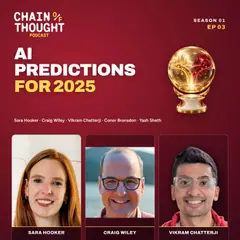 GenAI Predictions for 2025 | Databricks & Cohere Sara Hooker, Craig Wiley & Vikram Chatterji In a 2025 predictions panel, Cohere’s Sara Hooker argues that tool use is harder than it looks because every API is designed differently, and predicts that models will get both bigger and smaller. Jump to the moment · 32:00 · Tool use is underrated →
- Best Chain of Thought Episodes for AI Founders Building an AI company: defensibility, GTM, and where the market stands.
- Best Chain of Thought Episodes for Engineers Shipping with AI: the craft, the workflow, and where it falls short.
- Best Chain of Thought Episodes on AI Agents How agents work: architecture, memory, context, frameworks.
- Best Chain of Thought Episodes on AI Evaluation Measuring whether AI works: evals, reliability, trust.
- Best Chain of Thought Episodes on Agent Memory How agents remember: memory stores, context engineering, and what breaks without them.
- Best Chain of Thought Episodes on Multi-Agent Systems Many agents, one system: orchestration patterns, protocols, and the overhead they add.
- Best Chain of Thought Episodes on Open Source AI Open weights, open ecosystems, and what they cost in production.
- Best Chain of Thought Episodes on AI Coding Agents What changes downstream when agents write most of the code.
- Best Chain of Thought Episodes for Enterprise AI Leaders Getting AI past the pilot: ROI, rollout, and the data underneath it.
- Best Chain of Thought Episodes on AI Security Attacking agents, defending them, and the part software cannot cover.
- Best Chain of Thought Episodes on RAG & Retrieval Getting the right context to the model: chunking, vectors, graphs, and what breaks at scale.
- Best Chain of Thought Episodes on AI Infrastructure & Hardware What AI runs on: power, GPUs, networks, kernels and small models.
- Best Chain of Thought Episodes on Building AI Products Deciding what to build, setting a quality bar and shipping fast.
- Best Chain of Thought Episodes from AI Unicorns Guests from AI companies valued at $1 billion or more while privately held.