Best Chain of Thought Episodes on Building AI Products
Deciding what to build, setting a quality bar and shipping fast.
These episodes are for the people who decide what an AI feature should do and whether it is good enough to ship. Laurie Voss starts with the product engineer, the role he expects to remain as agents write more of the code. Loïc Houssier explains how Superhuman adapts its speed expectations for AI calls and breaks evals into dimensions a PM can own. Wade Chambers and Claire Vo cover customer feedback and shipping velocity, and Jiaona Zhang closes on measuring where AI pays off.
- 5 episodes
- 5 guests
- 4 hours of listening
- 5 jump-to moments


- 1
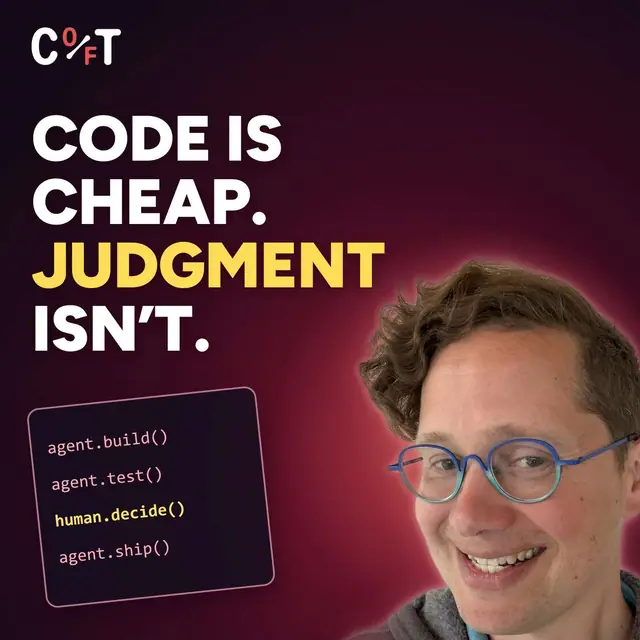
 AI Codes: Product Engineers Decide What to Build | Laurie Voss, Arize Laurie Voss, Arize Laurie Voss on the product engineer: the person who works out what users need and directs a team of agents to build it, even without writing code. Looking roughly ten years ahead, he calls it possibly the only job left in software development. Jump to the moment · 32:32 · The product engineer →
- 2
 How Superhuman Built AI Into a 100ms Product | Loïc Houssier Loïc Houssier, Superhuman Loïc Houssier on adding AI to a product built around a 100-millisecond bar and an architecture designed to work offline. He explains why LLM calls force a change in expectations and argues that defining a feature’s eval dimensions is the PM’s job. Jump to the moment · 28:45 · The PM defines eval dimensions →
- 3
 Amplitude's AI Playbook: How Wade Chambers Builds for the Agentic Future Wade Chambers, Amplitude Amplitude’s Wade Chambers on proprietary usage data and feedback loops as a lasting advantage, and on engineers embedded in customer accounts because there is no substitute for customer interaction. Jump to the moment · 9:55 · No substitute for customers →
- 4
 How AI Velocity is Rewriting the Rules for Engineering Leaders | ChatPRD's Claire Vo Claire Vo, ChatPRD Claire Vo on velocity as a differentiator. What worries her is an upstart with a clean codebase shipping features with AI, and she urges people to build something themselves to feel how much has changed. Jump to the moment · 10:34 · Velocity as a differentiator →
- 5
 Stop Token Maxxing: Find Where AI Actually Pays Off | Jiaona Zhang, Laurel Jiaona Zhang, Laurel Jiaona Zhang on finding where AI saves time or drives revenue instead of using it everywhere. She says very few people quantify those gains, and many have no way to measure them. Jump to the moment · 1:47 · Start with visibility →
- Best Chain of Thought Episodes for AI Founders Building an AI company: defensibility, GTM, and where the market stands.
- Best Chain of Thought Episodes for Engineers Shipping with AI: the craft, the workflow, and where it falls short.
- Best Chain of Thought Episodes on AI Agents How agents work: architecture, memory, context, frameworks.
- Best Chain of Thought Episodes on AI Evaluation Measuring whether AI works: evals, reliability, trust.
- Best Chain of Thought Episodes on Agent Memory How agents remember: memory stores, context engineering, and what breaks without them.
- Best Chain of Thought Episodes on Multi-Agent Systems Many agents, one system: orchestration patterns, protocols, and the overhead they add.
- Best Chain of Thought Episodes on Open Source AI Open weights, open ecosystems, and what they cost in production.
- Best Chain of Thought Episodes on AI Coding Agents What changes downstream when agents write most of the code.
- Best Chain of Thought Episodes for Enterprise AI Leaders Getting AI past the pilot: ROI, rollout, and the data underneath it.
- Best Chain of Thought Episodes on AI Security Attacking agents, defending them, and the part software cannot cover.
- Best Chain of Thought Episodes on RAG & Retrieval Getting the right context to the model: chunking, vectors, graphs, and what breaks at scale.
- Best Chain of Thought Episodes on AI Infrastructure & Hardware What AI runs on: power, GPUs, networks, kernels and small models.