A wind-farm operator keeps a software model of each turbine that receives live sensor readings for wind speed, vibration and temperature. Engineers can see the state of every blade from a control room, run “what if we change the pitch?” on the model first, and get warned when the model predicts a bearing is close to failing. That model is a digital twin. Factories, power grids, buildings, supply chains and computer networks all use them. NIST describes the key properties as a virtual representation of something real that stays synchronized with it at a chosen frequency and fidelity. A one-off simulation or a 3D drawing isn’t a twin unless it keeps updating from the real system.
AI connects to digital twins in two directions. Models can run inside the twin to forecast failures or optimize settings. The twin can also be a safe test bed for AI: an agent or a reinforcement learning system tries actions in the copy before anyone applies them to the real world, the same idea behind sim-to-real transfer in robotics. A world model is related but different: it is a model’s own learned picture of how an environment behaves, while a digital twin is an engineered copy of one specific real system.
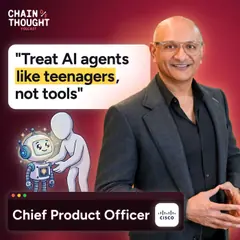
In episode 67 at 21:14, Cisco’s Jeetu Patel describes this pattern for IT security. When a vulnerability is found, a fix shouldn’t go straight into production. Instead, “a digital twin gets spun up right away off your environment,” live recorded data is run through it, and the change is deployed only once the twin runs without problems (21:32). That is his description of how Cisco approaches automated remediation, not an independent result. Episode 67 names Svix as the season’s presenting sponsor (sponsor read).
Why it matters (editorial synthesis): digital twins let organizations test risky changes, including changes proposed by AI agents, without risking the real system. A twin is only as useful as its fidelity, though. If the copy drifts from reality or leaves out the conditions that matter, tests pass in the twin and fail in production. Twins also concentrate sensitive operational data, which is why NIST treats their security as a topic of its own.
Hear it from the guest
“That remediation and fix requires that a digital twin gets spun up right away off your environment.”
Quotes lightly edited to remove filler words.
Sources
- NIST IR 8356: Security and Trust Considerations for Digital Twin Technology — NIST report defining a digital twin as a virtual representation of real-world entities and processes, synchronized at a specified frequency and fidelity, and covering the security questions twins raise; checked October 24, 2026.