A support team with thousands of tickets and no category system can turn each ticket into an embedding, a list of numbers that places similar text close together, and run a clustering algorithm. Groups emerge: login problems, billing disputes, a bug in last week’s release. Nobody had to label tickets first; people read a few examples from each group and name it afterward.
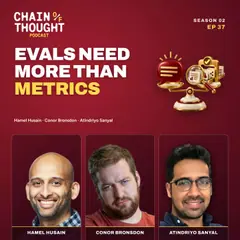
Builders of AI applications use the same move on their own logs. In episode 37 at 16:55, Hamel Husain lists clustering traces, the step-by-step records of what an AI system did, alongside navigating and analyzing them as part of the open-ended data exploration that evaluation work needs. That is his view of the skill set; the episode is about learning from real failures before writing tests. Galileo sponsored Season 2, including episode 37; co-host Atindriyo Sanyal, Galileo’s co-founder and CTO, is introduced at 0:35.
Different algorithms make different assumptions. K-means clustering needs the number of groups up front and favors round, similar-sized groups; hierarchical methods build a tree of merges; density methods such as DBSCAN can find irregular shapes and leave outliers unassigned. Every method will report groups, even in data with no real structure, so check whether the groups are stable when you rerun them and useful for the question you are asking. Clustering is a form of unsupervised learning; unlike classification, there are no correct answers to score against unless you bring your own.
Hear it from the guest
“Like clustering those traces or navigating them or analyzing them”
Quotes lightly edited to remove filler words.
Sources
- scikit-learn: Clustering — Compares clustering algorithms including k-means, hierarchical clustering and DBSCAN, their parameters and the cluster shapes each handles; checked October 24, 2026.
- Ester et al.: A Density-Based Algorithm for Discovering Clusters (DBSCAN, KDD 1996) — Introduces DBSCAN, which finds clusters of arbitrary shape from point density and labels points in sparse regions as noise; checked October 24, 2026.