The AI Hiring Doom Loop: Applications Up 239%, Hires Down 75% | Daniel Chait, Greenhouse
with Daniel Chait, Greenhouse
Prefer to listen?
Presenting sponsor of season three

Key takeaways
- Per Greenhouse data, applications per job posting are up 239% since ChatGPT launched in 2022 — while 75% fewer applications reach the hire stage. The doom loop is self-reinforcing: each side’s AI-driven response (mass applying, AI filtering) feeds the other’s escalation.
- Software engineers use automation the most in the auto-apply arms race. According to Greenhouse data, they send out more automated applications than any other professional category — which is particularly self-defeating, since AI-homogenized résumés make everyone look identical to the AI screeners filtering them.
- The trust problem is growing: a Greenhouse survey cited in the episode found 91% of recruiters have spotted candidate deception, the episode also cites résumé hacks like white-fonting and prompt injection up 500%, and Greenhouse sees roughly 1.5–2% of applicants fail identity verification — about half a dozen people in a pool of 200–300 who are not who they claim to be, while the more common cases, distinct from North Korea, are a stand-in interviewer or a side tool used to pass the interview. Separately, Daniel Chait describes a smaller but rising industrial-scale North Korean infiltration effort — deepfake call centers rotating interviewers, U.S.-based laptop farms — which he says he has reviewed forensic evidence of (IP logs, device fingerprints).
- AI screener interviews backfire when companies aren’t transparent about them — nearly two-thirds of job seekers have now encountered one, and almost 40% have walked away from a process because of how janky and poorly communicated the experience was. The technology itself has improved substantially; the failure mode is the surprise.
- High-signal beats high-volume. Greenhouse’s Dream Jobs feature — where candidates designate one application per month as their top priority — converts at 5× the rate of standard applications and has already placed 2,000 people. The constraint is the signal: scarcity forces intentionality, and intentionality is exactly what AI-spray applications destroy.
- The résumé itself may be the real problem. Daniel Chait argues the core hiring artifacts — the résumé and the job ad — are still digital replicas of their paper-and-newspaper originals (“help wanted” ads moved to Indeed; the résumé rectangle moved to a screen). The better path is replacing the résumé with an AI conversation that surfaces demonstrated skills directly, removing the name-and-demographic-bias surface entirely.
Show notes
Job applications are up 239% since ChatGPT launched, tech layoffs show no signs of slowing down, and the market for technical talent is a topsy turvy mess.
Greenhouse has a unique vantage point to understand all of this: they process 22 million job applications a month across 7,500+ companies including HubSpot, Anthropic, Coinbase, and the NFL. CEO Daniel Chait has had a front-row seat to the strangest hiring market in decades, and he's here to advise us all on how to navigate it.
Daniel coined the term "AI doom loop" for what's happening: applications up 239% since ChatGPT launched, resume hacks like white-fonting and prompt injection up 500%, and 75% fewer applications reaching the hire stage. 91% of recruiters have spotted candidate deception. 38% of job seekers walk away from processes that include an AI interview.
It's the worst job market for candidates and the hardest hiring market for recruiters.
Daniel explains how technical talent can break the loop.
We cover:
- Why software engineers, according to Greenhouse data, are the worst auto-appliers and what to do instead
- The North Korean infiltration problem: deepfakes, laptop farms, and why companies are flying candidates in for in-person interviews again
- How AI screener interviews open up the funnel when companies are transparent about using them, and break it when they aren't
- Greenhouse Dream Jobs: how a single high-signal application a month converts at 5x the rate
- Why take-home assignments don't survive contact with AI and what Greenhouse uses instead
- What a coding interview looks like when leetcode is dead and engineers run 10+ Claude Code sessions in parallel
- The case for killing the resume entirely and rebuilding hiring around AI conversations
Connect with Daniel:
Connect with Chain of Thought host Conor Bronsdon:
Transcript
150 segmentsDaniel Chait 0:00 In the AI era, why do we have job applications? Why do we have resumes at all? And I think if you're willing to think about those questions from my perspective, I think we see huge opportunities to not just guard against biases or protect ourselves against the risks, but actually sometimes completely transcend them altogether, like
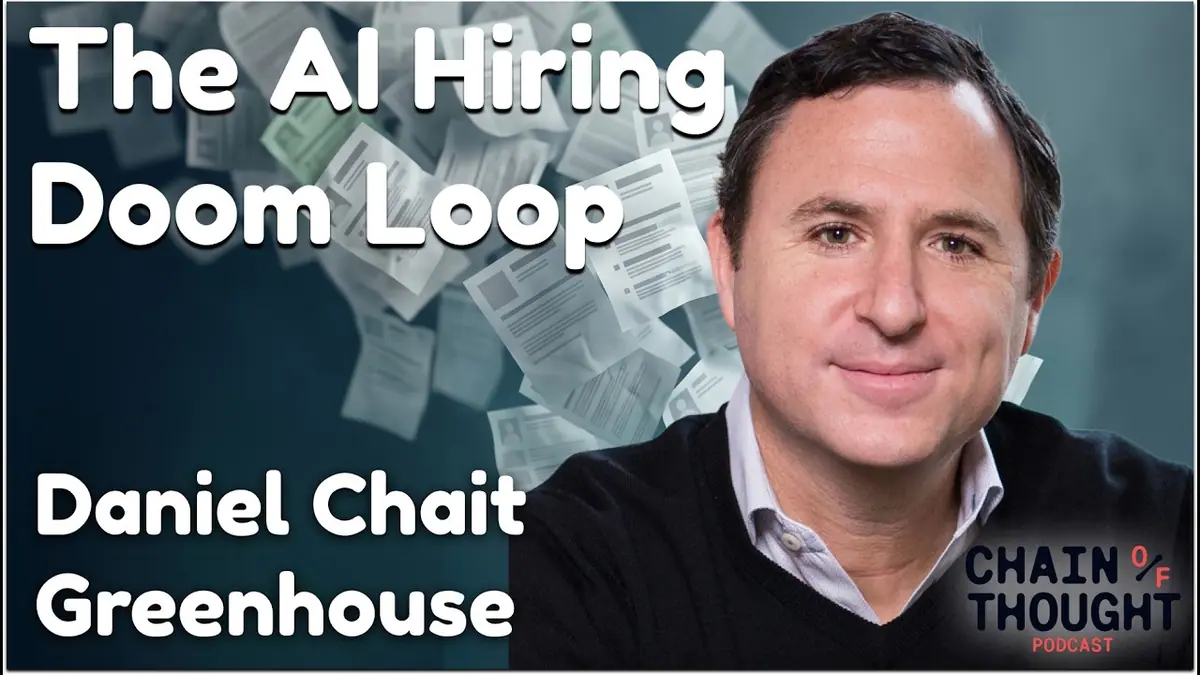
Conor Bronsdon 0:23 Welcome back to Chain of Thought, everyone. I am your host, Conor Bronsdon. Today, I am joined by Daniel Chait. He is the CEO and cofounder of Greenhouse, a hiring platform that many of you may have used. And it's, in fact, used by more than 7,500 companies, including HubSpot, Anthropic, Coinbase, and the NFL. Daniel's been building Greenhouse for fourteen years at this point and has had a front row seat to an incredible transition in the way we hire and the way we apply to jobs and one of the strangest moments in hiring history. He coined a term for it, the AI doom loop. Applications are up 239%
Conor Bronsdon 0:58 since ChatGPT launched. Many of you have probably experienced this, but resume hacks like white fonting and prompt injections are up 500%. Recruiters are drowning in a 500 to one application ratio. Anyone who is hiring knows that it is extremely difficult to sort through the number of applications you're getting. And the people who are on the applying end or looking for their next role are struggling too.
Conor Bronsdon 1:22 75% fewer applications are making it to the higher stage. Both sides are losing. Nobody's happy. And this matters for engineers no matter what stage of their career they're in, whether they're doing the hiring, whether they're looking for the next role. It's simultaneously the worst job market for candidates and the hardest hiring market for recruiters. So what broke? What's Greenhouse doing about it? And can AI fix the problem it created? Daniel, welcome to Chain of Thought. It's great to see you. Where are you joining us from? Great to be here. I'm here in Midtown Manhattan in New York City, and this is just a wild time in hiring, so a really interesting conversation. I'm looking forward to it.
Conor Bronsdon 1:57 I'm very excited to chat with you about this, especially because I know Greenhouse just put out some new information based on your data around what job seekers are experiencing. And one of the headline moments of that was that sixty three percent of job seekers have faced an AI interview. We're all seeing AI get embedded throughout every process today. It's what a lot of the show is about. But before we talk about hiring with AI and what it means for job seekers, how should they be thinking about their approach,
Conor Bronsdon 2:25 you know, how should we be preparing for our next opportunity, how should we be hiring teams today, I do wanna say a quick thank you to our presenting sponsors, Galileo. I wanna say a massive thank you to them for sponsoring season three. As presenting sponsors, they have driven a ton of ability for us to have incredible guests like Daniel on the show, And they've also helped many of us, including myself, to evaluate our AI agents and our AI systems to ensure accuracy.
Conor Bronsdon 2:52 And whether you're hiring, whether you're building agents for, you know, Salesforce, whether you're doing any other work with your AI systems, it is crucial that you understand what's happening with them and observe them, understand them, and evaluate them for the success. That's where Galileo comes in. You can check them out at galileo.ai. And a huge thank you again to them for sponsoring season three of the podcast.
Conor Bronsdon 3:13 Daniel, I wanna focus in here a bit because, you know, we've been talking about a couple stats already here as I've thrown out the open. But you have this term that you coined called the AI doom loop to describe what's happening in hiring right now. And that that's pretty ominous. You know, we talk about P doom in this industry sometimes. But it sounds like there's already a sense of doom that's impending for anyone who's in the hiring market. For people who haven't heard that term before,
Conor Bronsdon 3:38 walk me through this cycle and why it's different from any hiring downturn you've seen before. It is a really interesting dynamic,
Daniel Chait 3:45 and and you're right. It's it's bad news. I mean, you know, I I think it came out of, you know, empathy for hearing what was happening to so many job seekers who are just struggling to find a job, and and more like not feeling like the system was was working for them. It wasn't meant for them, and so they had to kind of fight it or figure out how to hack around the system. And meanwhile,
Daniel Chait 4:07 our customers, the thousands of companies that are out there trying to hire, are also experiencing these huge problems, and they're not able to hire anyone either. And so as we started to look into what's happening, here's what we found, is you kinda go back to 2020 when all of a sudden, everybody moved from, you know, work was generally done in an office and hiring was generally done in person. What that meant was,
Daniel Chait 4:30 you know, mostly you applied to jobs that were near you, and when the pandemic happened and so much work went remote, all of a sudden people were eligible for millions of more jobs because it could apply to jobs kind of anywhere. And so application volume started to come up, and then add on to that, changes in the economy, the end of the zero interest rate environment meant that jobs are harder to come by, and people were finding, you know, a shortage in available postings,
Daniel Chait 4:57 and so application volumes went up again. So you had these predecessors of just, like, economic and job market changes. They were already making it more you know, less of a candidate market and more of a hiring market to start with. And then, of course, 2022, ChatGPT comes out, and everything accelerates. Since then, basically, we're all using AI more and more in all aspects of our life. Just this week, I I pointed ChatGPT at my fridge and asked it what I should make for dinner.
Daniel Chait 5:26 And so it's it's impacting everyone at home, everyone at work, and it's impacting how people look for jobs. And so on the back of that, what's what's happened is job seekers feeling the softening job market and sensing that they need to up their game and apply to more jobs are using AI to do just that. And so they're really doing two things. One is they're automating the application process. It's going from a
Daniel Chait 5:49 world where people used to think about which jobs to apply for and then put some effort to applying into them, to having AI just kind of like find as many jobs as you can, apply me to all of them. And then secondly is AI can also automatically customize every single job application according to that post. So it'll read the job description, and it'll try to make sure that your resume and your cover letter are as similar as possible to what's in the job description in an attempt to kinda give you an edge as a job seeker. So those are some of the things that job seekers first started to do, and I don't blame them. I understand that when the job market is soft and you just want a job and you have these tools available to you, you're going to use them. But what it meant for companies
Daniel Chait 6:31 that are hiring is that all of a sudden, those application volumes went through the roof. So, you know, since 2022, when basically ChatUBQ was launched, application volumes are up almost two and a half times per job what they used to be, and recruiting teams have not grown. In fact, most recruiting teams have held steady or shrunken in in size, and so they now have if you look at the number of applications
Daniel Chait 6:56 each recruiter is responsible for, it's even more. That individual recruiter may be looking at four or even five times as many applications as they were just a couple of years ago, and so companies are now using AI to say, okay, I can't look at a thousand applications when I open up a job. I gotta get I gotta filter this back down, and so their first attempt is to basically take off the shelf AI tools and say, hey, I'm gonna throw Claude at
Daniel Chait 7:20 my inbox and say, hey, can you just tell me the 20 people or 30 people I should call and forget the other 970 applications? And so it shrinks it back down, and why we call it a doom loop is because, again, that's an understandable response on some level, but that also makes it harder to get seen and harder to get a job, and so the candidates respond to that difficulty by sending in more and more resumes,
Daniel Chait 7:43 and the companies respond in turn by filtering more and more out, and that's why we've called it a doom loop, because as bad as things are, and I can't remember a time when both sides were as unhappy,
Conor Bronsdon 7:55 AI is not making it better. AI is making it worse. I feel like you just opened a can of worms for us to talk about here, where there's a million different directions we could take this. But I wanna address, and I'm mixing my metaphors here, but one of the elephants of the room, which is that there is a perception that software engineering jobs are in trouble.
Conor Bronsdon 8:17 And part of this is because we're seeing a change in how those roles are hired. We're seeing a change in the leveling of where those roles are hired. And yet, when you talk to the Bureau of Labor Statistics, they project that software development employment is going to grow 15% by 2034. When you look at job postings for engineers, I believe they're increasing.
Daniel Chait 8:40 So why does it feel so painful right now, and what's actually happening to technical talent that's on the market? I think there's a number of different things happening at the same time that make the picture really confusing, and so here's the way I see it. On the one hand, you know, it's unavoidably true that the job of software engineering and software development is already radically different than it was, you know No two or three years ago, but even sixty days ago. I mean, like, the pace at which change is happening is astonishing,
Daniel Chait 9:14 and, you know, keeping up with that is almost its own full time job. And so I think there's a a big shift in what it even means to do that work and and and how those are being seen, and some people are looking at that and saying, oh my gosh, A software developer can produce so much more code, so many know, can ship so much more functionality that we need we need less of them.
Daniel Chait 9:43 And you've seen some big public pronouncements from companies saying they're having to make layoffs or staffing cuts because of AI. I think a lot of that's probably overblown. I think that's a lot of cuts that maybe were gonna happen anyway that We overhired already. Let's have a good narrative for the stock market. Yeah. It's a much better it's a it's a much better story to say we you know, we're using AI to be so much more efficient than, like, geez, I over hired, or the business isn't going so well.
Daniel Chait 10:07 So I wouldn't I don't necessarily think a lot of that represents real productivity gains yet by AI. But what I do think to address your question of why there's still so much hiring is, what I do think is if if software is cheaper and cheaper to build, which it is, I think there's more and more appetite for it. I think there's so many problems that software can still address that haven't been tackled because there's a lot of software to build, and it's been expensive that as it gets cheaper, I think, ultimately, there's need for more and more of it. So certainly, that's happening.
Daniel Chait 10:37 But but nonetheless, you'd say, okay, so then there's lots more job postings. Surely, it should be easier and easier, but that's where you get back to the AI doom loop, and ultimately, what it becomes is kind of a signal problem. It's like a matching problem that if everybody's sending in hundreds or even thousands of job applications, you know, when they when they're looking for a role, which is happening,
Daniel Chait 10:57 and by the way, software engineers are the worst, according to our data, they send out they use automation the most. They send out the most applications. We've been taught to automate for I mean, hey, they're cutting edge. It's what you and again, like, this is you know, they I do not think they're the they're the bad guys in this story by any stretch. They're just trying to get jobs. I totally empathize.
Daniel Chait 11:16 But nonetheless, the fact of the matter is, when there's that big of a pile of resumes and the pile keeps getting bigger, it doesn't matter how many job postings there are, it's like a needle in a haystack, and when you add to the fact that everybody's resume is starting to look more and more the same, because AI does that really well, right, is all of a sudden, the signal is getting more and more attenuated, is that, you know, you're getting a thousand resumes, they all kind of look the same,
Daniel Chait 11:39 and so the experience of a job seeker is just getting worse. It's like you're sending in, you know, a needle to an ever growing haystack, and you're making your needle look more like hay. It's just it's just gonna mean, you know, difficulty in finding in finding jobs and and getting matched. And so something's gotta give. The the process isn't working, and and that same pain is felt acutely on the side of companies who are saying,
Daniel Chait 12:03 basically, the mirror image of that. I open up a job, and look, I have a a software engineering background. I graduated as a as a programmer. I worked as a as a programmer. I spent ten years hiring programmers before starting Greenhouse. And for decades, you know, getting an engineer to respond to an outbound recruiting was like the holy grail, like, oh my gosh, I got a candidate to talk to me. Like, this is the greatest thing that ever happened to me, because engineers basically sit there at their job and get job offers, like, showered down on them. And and so,
Daniel Chait 12:35 you know, that's kinda where I think recruiters are used to, is like, oh my gosh, if I could only get some candidates, I'd be golden. And now, careful what you wish for, because they're awash in candidates. There's thousands of them at every job, and it's it's still it's still a bigger bigger problem than ever. So that's where it's just like, the system just isn't working for for anyone.
Conor Bronsdon 12:54 I wanna talk about how to fix the system. Yeah. But I feel like there are other problems that we haven't even addressed yet, which is beyond volume, we are also dealing with a trust crisis in hiring. Your survey last year found that, well, ninety one percent of recruiters have spotted candidate deception, forty one percent of candidates admit to using prompt injection to bypass AI filters,
Conor Bronsdon 13:18 and forty six percent of US job seeker seekers I'm gonna say that one more time. 46% of US job seekers say they lost trust in hiring this past year. This problem seems to be continuing to worsen, particularly as we're now seeing AI interviewing candidates and 38% of candidates walking away from hiring processes because it included an AI interview, which I would love to talk to you about.
Daniel Chait 13:41 But how bad is this fraud problem? Is this a true underlying concern that everyone needs to worry about as well? You know, I think it it's definitely a big a big problem, and it's growing in scope. There's a bunch of different angles to it. Let me pull it, because you talked about a bunch of different things. Let me pull some of those apart. Because they're they're they're quite different. So one thing that's happening absolutely, as I as I mentioned a minute ago,
Daniel Chait 14:05 job seekers are using AI to sort of magnify the amount of jobs that they're applying to and to make their resume kind of look more and more alike. In the middle of all that, there are people who are basically making fake resumes or fake job applications that aren't really at all true about what they've done, and that deception just ends up as noise in the system that has to get worked out. If you move a little bit further down into the interview funnel,
Daniel Chait 14:32 you have job seekers, legitimate job seekers that actually want the job using AI to help them pass interviews. Right? We've seen InterviewCoder and other kind of interview copilot tools get better and smarter and harder to detect, so that as I'm being interviewed typically over Zoom and they're asking me questions or watching me code, that really I'm using AI as a job seeker to, like
Daniel Chait 14:59 a lot of people would call it cheating, to basically give me the answers to that that I'm being asked by by the interviewer, and that's a real problem, and that starts to erode trust as well. And I sort of hesitate, or I put scare quotes around the word cheating because, you know, it raises these really interesting questions. After all, aren't we hiring people to use AI at work? Isn't the company using AI to run the job process, to write the job description, to help interview candidates? And so why am I at the disadvantage I can't use AI? And companies are saying, well, look, you know, I don't wanna know what ChatGPT thinks, wanna know what you think. And so I think
Daniel Chait 15:35 the real answer is probably somewhere in between, and society kinda has yet to figure out the rules of the road as these technologies have advanced so fast about what is and isn't fair AI to use in a job interview setting, and then you have the real bad guys. So those are, we just talked about, sort of legitimate job seekers doing stuff to try to give them an edge with varying degrees of okayness. Then you've got the real bad guys because in the midst of all this noise and chaos and AI slop,
Daniel Chait 16:01 it creates opportunities for bad guys to sneak in, right, because there's like, it's hard to mind all the all the all the doors at the same time. And so there's a growing industrial scale North Korean effort to infiltrate remote IT jobs using techniques like deepfakes, so they'll have typically a call center full of people, all pretending to be the same job seeker, trying to get in that one job, and they'll take turns on interviews.
Daniel Chait 16:28 They'll deceive their way into your organization. They'll set up laptop farms in The US, and basically, they're trying to infiltrate supply chains, perform espionage, and so there's some real scary stuff out there as well. And so I don't wanna you know, those are all symptoms of what's going on right now. They're obviously very different in nature, and and you need different tools to try to weed them out as well. And it's definitely part of why we're seeing a return to flying candidates in for in person interviews, even if it's a remote role, or onboarding in person to try to help solve this.
Conor Bronsdon 17:05 But it seems like the problem of fake engineers applying is only increasing. What's the scope of this challenge for companies that are trying to hire Rowan engineers?
Daniel Chait 17:18 Yeah. I mean, I think the as a percentage of overall, you know, resumes that you may collect when you open up a job, it's not a huge percentage. So in our in our data, we see about one and a half to two percent of job seekers fail an ID verification, meaning, you know, the the technology that we use in Greenhouse to assure that this person is who they say they are, about a percent and a half or so are just failing those. So they're not they're definitely not who they say they are. So it's not that many, but if you think about opening up a job and getting two or 300 applicants,
Daniel Chait 17:58 and you realize that, like, maybe a half a dozen of those or so are simply not who they say they are, like, you better hope you don't hire one of them. And so it's less about, you know, the how many of them are there, and more about, are you sure you're not hiring one of them? Because if you do, you know, obviously the ramifications, I don't need to tell you or your audience,
Conor Bronsdon 18:16 of hiring a North Korean spy are pretty bad. Yeah. Maybe not an ideal day at work to make that hire.
Daniel Chait 18:22 And listen, I mean, it sounds kind of fantastical. I can certainly tell you, when I started this job and began to launch Greenhouse in 2012, I didn't think I'd be fighting North Korea. That wasn't part of my my game plan here, but but here we are, and it and I've seen the evidence. I have watched videos of, you know, people purporting to to apply for jobs that have been discovered, you know, to be to be North Korean spies.
Daniel Chait 18:47 I've seen the forensic evidence when they do the detailed logs of looking at IP addresses and device fingerprints and, you know, the sort of digital exhaust of when you apply for a job, and and so this stuff is is quite scary. But, again, I think the more common thing that people come across is simply, you know, this is misrepresentation. This person either is sending a friend to interview for the job, you know, for them, and so it's the person I'm interviewing isn't actually the person who applied,
Daniel Chait 19:17 because they're trying to help them, you know, get get the job, or they're using some, you know, side tool to help pass an interview when it wasn't really their thinking that went into it. Those things are almost universal. Those things are extremely common. So if
Conor Bronsdon 19:32 we're just seeing both sides of this process, both the interviewees and interviewers lean into AI to help sort through or spread themselves farther.
Daniel Chait 19:45 But it's not really solving the problem yet. How should we be trying to solve this doom loop that's occurring? Yeah. So, I mean, that's what I spend my days thinking about, and as much as we've talked about the problem and given it this catchy name of the doom loop, you know, the real job is how do we how do we fix it? And it starts by understanding the problem deeply.
Daniel Chait 20:03 I wanna be clear, AI is not the problem itself. I think AI I'm an AI optimist. I think there's a ton of possibility. There's a ton of potential. AI's already had tremendously positive impacts in almost every area of work, including in hiring, but it's the way that people it's the tools that people have had available to them, and the way that they've used those tools that's created this problem. And so that points to a way out, which is to say, what if we created better tools, better ways to use AI to help people get jobs, to help people make hires in ways that
Daniel Chait 20:36 didn't make the process worse, but rather made it better? And so that's the thing I think about all the time at Greenhouse, and what we're trying to do is how can we take advantage of the power and the potential of AI to make things better and to help bring humanity, bring trust back into the process, and to help accelerate the process, make it easier, make it more efficient to hire and to get a job.
Daniel Chait 21:02 So that's, I think, where the way forward lies. One of the ways you can obviously leverage AI
Conor Bronsdon 21:08 to help solve this is to have AI screener interviews. We're starting to see this be a common first line of defense.
Daniel Chait 21:16 How is that going so far? Yeah, I think it's gonna become increasingly common. You know, it got off to a bit of a rocky start. We've just published a survey, you know, highlighting some of the concerns that job seekers had with sort of the first generation of, you know, AI led interviewing tools. And, you know, not surprisingly, that first wave, like, the voice quality was was a little spotty, and and there's a lot of things where it's like an uncanny valley. You feel like you might be talking to a an image of a robot instead of an actual person.
Daniel Chait 21:49 It interrupts you when it shouldn't or, know, vice versa. And so I think it hasn't been always a smooth or a great experience. And I think more to the point is, additionally, companies haven't always been transparent, surprisingly, about whether you're gonna speak to an interview with a person or whether you're gonna speak to an AI, and so if you're expecting an interview and you show up and there's a there's an AI bot,
Daniel Chait 22:13 it's really jarring. And so, in our most recent survey, almost two thirds of people have now come across an AI interview somewhere in the wild, which is a big growth from where it was a year ago, but over a third, almost 40% of people have walked away from a process because the process has been so janky, and so I do think that there's a ways to go. I think the new generation of AI interviewing tools is much better. I think the quality of voice AI has gone way up.
Daniel Chait 22:43 I think it's much more naturalistic, and I think we're being a lot more transparent now about, hey, here's how this works, and here's what you're going to expect, and I think when you explain it to people, what they start to see is like, hang on a second. The fact that the company's using AI to do, say, a first interview, it it means that you can remove the gatekeeping.
Daniel Chait 23:04 It means that that whole problem of getting lost in the pile, you know, sending in, you know, a needle in a haystack to thousands of other resumes, hoping that you're one of the few people granted an expensive, time consuming, hard to schedule interview, instead, you can really open up the funnel and say, pretty much anyone can get a first interview, and give yourself a fair chance to show what you're capable of. And so,
Daniel Chait 23:30 I think as long as the experience is is good, and I think as long as there's transparency about what is and isn't gonna happen, I think people are gonna start to really, warm up to the idea that, again, this is a way where AI can actually open up opportunity, where AI can be less biased, more available, and there's innumerable ways. I mean, if anything, I've built my career here at Greenhouse on the notion that most job interviews are bad and need to be helped,
Daniel Chait 24:00 and so I think the the bar for the current, you know, human led job interview is pretty low, and when you think about I mean, I can give you so many examples. Who hasn't had the example where, for exam you know, you you take a job interview, the person spends fifty seven of the minutes of the hour, you know, hammering you with questions, then and they go, Alright, got three minutes left. What questions did you have for me? It's like, you
Daniel Chait 24:23 know, you don't really get a fair shot at asking what you wanna know. There's all this pressure to not ask about things like benefits or vacation. But if you're interviewed by an AI, of course, you don't have those problems. It can be infinitely patient. It can answer any question, you know, that you want. It's not gonna judge you. It's not gonna care if you have an accent.
Daniel Chait 24:42 It's gonna be available to work around your schedule, so if you're working full time, or if you're a caregiver. So there's a lot of ways in which the current system just doesn't work well for people taking face to face interviews, that an AI led interview can actually make things much better. So I do think it's a very promising technology for bringing trust and making process
Conor Bronsdon 25:03 better and more efficient as well. I like this perspective of AI interviews, when communicated effectively and set up effectively, actually opening up opportunities for applicants. Because one of the natural things we've seen from companies as a response to this mass amount of applications has been to lean into referrals. While referrals can be great to find qualified candidates,
Conor Bronsdon 25:24 and those of us who are farther along in our careers often benefit from them, especially if we've been intentional about building networks, They can also be challenging for early career job seekers looking for opportunities, looking to get involved. So having other tools in the process that can help people get an opportunity and stand out does seem like the right approach to avoid us continuing to
Conor Bronsdon 25:47 push, you know, newer end job market entrants from being
Daniel Chait 25:51 kept out of some of these roles. Yeah. I think that's right. You know, historically so just to put some context, know, Greenhouse across our entire customer base collect about 22,000,000 job applications a month, so we see lots of hiring data. And forever, employer referrals has been the most effective source of hire. In other words, they have the highest chance of getting a hire when a referral is made versus any other way of getting a candidate. The problem is there's just not enough of them, there's no real way to make more.
Daniel Chait 26:21 And so for a company, that means, you know, there's only so much you can do to get referrals, and to your point for, you know, if you're a job seeker, like, you know, there's not that many referrals available. They're not available to everyone, and so it's just not a systematic answer to the problems of the job market as a whole. So my advice to a job seeker is absolutely if you can if you can get a referral, get one, but most people can't.
Daniel Chait 26:42 It's not really gonna scale. What we can do is think about what is why does that work, and what can we do to help it scale? And so that's why we created this feature of DreamJobs. So last year at Greenhouse, we launched this tool for job seekers called My Greenhouse and gave them access to this DreamJob feature functionality, which basically is simply lets them apply
Daniel Chait 27:07 to all the jobs that they want across all the Greenhouse customers. But one time a month, they can indicate one job application as their dream job. And simply doing that is a really powerful signal of intent because, after all, that's a limited resource. I only get one a month as a job seeker, and so the job seeker's gonna think really carefully about where am I gonna use that one? It's gotta be a job I really want. It's gotta be a job I think I'm really good at, and have a chance to get. And so it's a little bit like kind of an early declaration
Daniel Chait 27:35 of college admittance, where, you know, it's a signal to that college that you really wanna go there because of the scarcity. It's the same on the on the on the on the job side, and and so Dream Job, on the company side, when they open up their role, and if you if you think about that image that we've talked about where they have thousands of applications, they'll have a prioritized inbox
Daniel Chait 27:53 that will show them internal applications from other employees for that role, employer referrals that they've collected of people who work there who say, you know, I've got a candidate to refer to you, and dream job applicants. Why? Because those are the high signal jobs, really a strong signal of intent and fit, you're and gonna be much more likely to find a hire in in that group, and it's really working. 2,000 people are have already gotten their jobs through Greenhouse Dream Job, and they converted about five times higher of a rate than every other job seeker
Daniel Chait 28:23 who applies to those jobs. And so it we we have shown that when you bring some signal, you know, to the table, you can actually cut through a lot of this noise. You can sort of break it or interrupt the doom loop and make the process actually work better for people. Thanks to Galileo for sponsoring this episode.
Conor Bronsdon 28:40 Their new 165 page comprehensive guide to mastering multi agent systems is freely available on their website at galileo.ai, and provides you the lens you need to understand when multi agent systems add value versus single agent approaches, how to design them efficiently, and how to build reliable systems that work in production. Download it for free at the link in the show description to discover how to continuously improve your AI agents,
Conor Bronsdon 29:12 identify and avoid common coordination pitfalls, master context engineering for agent collaboration, measure performance with multi agent metrics, and much more. This is a lot of great data, and I think it's a very interesting innovation here too to provide candidates an opportunity to more strongly signal, hey, this job is important to me. I think I'm deeply aligned with it.
Conor Bronsdon 29:33 What would be your advice broadly to people listening who are job hunting or are thinking about finding their next role? You mentioned finding a referral if you can, indicating your top jobs if you're applying for Greenhouse Dream job is a great option. What's the broader strategy that candidates, particularly technical candidates, should be using in today's job market? Yeah, look, you know, I think
Daniel Chait 29:54 it's not there's no silver bullet. It is a difficult job market, and unfortunately, the best advice boils down to, you know, a bunch of hard work in elbow grease. What I would say is, generally speaking, those auto applies don't really work. It's sort of a false progress. You feel like, I've applied to so many jobs, you know, but you really haven't. You've just pushed a button and spun the wheel.
Daniel Chait 30:17 I talked to someone earlier today. He's graduating from undergraduate. He's got a mathematics degree, and he's like, Look, I went into Claude, you know, and he's a son of a friend of mine. He called me for job advice. Said, went into Claude, and in about thirty minutes, I created a bot that's automatically applying to Jobstream. I applied to so many, it's not working. I'm like, yeah, know, I see the data. Everyone's doing that. It doesn't work. And so,
Daniel Chait 30:39 you know, it can feel good to sort of take that step and see the numbers go up, but but it's not really getting you anywhere. And, unfortunately, the real advice is, you know, as you kinda said, like, if you can find referrals, definitely do. By the way, you don't always have to ask people, hey. Can you nominate me to be hired for a specific job? But asking for advice is a great
Daniel Chait 30:59 way to get a job. There's an old adage in startup circles, if you ask for money, you get advice, and if you ask for advice, you get money. Same applies here, like, you ask people for, you know, help or thoughts in your job, you know, they may, oh, gee, actually, have a place that you might want to apply to, or I can call a friend and see if they've got an opening. So, you know, you can you can do those kind of things. I think being involved in
Daniel Chait 31:20 online and offline communities is a great way because recruiters know that too, and they're looking in those communities. So this has been happening forever. I started, for example, the first dot net programmers community back in the early two thousands, really as a way to find talent, and so we buy pizza, and we'd host 30 or 40 people a month to talk about programming topics, and when you found the smart ones, you know, when you had a job opening, you knew you knew who to call. So going to those things and meeting people can can really, you know, be be there, and then it really is just about patience and hard work, and, you know, count
Daniel Chait 31:53 yourself as applying to a real job where you've done the research, where you've sent a personalized message saying something real about the company, saying something real about the job, ideally even getting someone that you may know there. Like, those, if you if you notch those repeatedly for a period of time, you'll get much more progress on a job than just like, spray and pray. Big plus one for me to a couple of things in particular. One,
Conor Bronsdon 32:16 the idea of putting the legwork in to meet people at the companies you want to work in. This has been something that's been really successful for me. When I was a junior senior in college, I did a whole informational interview series with 20 plus people across various companies to, a, understand where I wanted to apply, and b, meet a network of folks, and it had an incredible impact.
Conor Bronsdon 32:37 The and and I'll note on that front, by the way, anyone who is listening, who is an early career professional, who wants to talk to me, please reach out. You can reach me on LinkedIn, on Twitter, through the Substack app. But I if you're a listener and you would like to chat, I would love to talk to you and and see if I can help push you to your next role. Super thankful for all of you listening, and I think it's a really important thing to do to give back. And anyone who's listening who is an executive or is a leader here or is farther in their career, I think almost all of us have had this experience where someone we knew, whether it's someone we worked with or someone we'd met at a conference or whatever else,
Conor Bronsdon 33:16 has been impactful for us around finding the next role, finding the next promotion. It's so important to give back when you have the opportunity. This obviously creates reciprocal positive network effects. The other thing that you mentioned that I love is this idea of joining communities and building in public. Open source software is having an absolute renaissance.
Conor Bronsdon 33:38 You can code more than ever. You can buy a Claude Code subscription or Codex or whatever your favorite is. You can use open code, and there is an opportunity for you to build in public and and gain recognition for it. And even something as simple as like a a Claude code skill I developed that now has like 1,200 GitHub stars is out there. Like, you know, that doesn't matter to me today. I'm not looking for a new job, but it's a great signal of, Oh, someone is someone who's building. There's a reason I do this podcast.
Conor Bronsdon 34:05 Part of it is that I enjoy it, but do I also think about the long term benefits of knowing people in the industry, being public about my work? Absolutely. So I highly encourage anyone who is thinking long term about their search to, or even short term as well, to say, maybe you should write a blog post about something you're building. Maybe you should, you know, post a LinkedIn like this, I built this thing on GitHub.
Conor Bronsdon 34:26 You should go chat with this person. I know it's higher effort, but these things pay off, and they compound long term too. Yeah. And I wanna and I wanna highlight something in particular that you said
Daniel Chait 34:36 around, you know, the opportunity to build something and put it out there. You know, I think one underappreciated dynamic of the fact that these technologies are evolving so quickly that can be really powerful if you're a job seeker is the fact that when there's a new technology, it's new to everyone. And so if you're on the job market today, you can kind of have as much experience as almost anyone in the world at building Claude Code skills and whatever they're gonna ship next week.
Daniel Chait 35:05 And so, yeah, it's hard to be the world's most experienced, you know, at some technology that's been out for ten or fifteen years, and so I think, you know, people worry, oh, geez. What am I gonna do as an entry level person? I would argue that you have a real opportunity, particularly in today's market, where the technology is changing literally every month, to be a first mover and to develop real expertise at something
Daniel Chait 35:28 that very few people can, and showcase it. I think that is by far the best opportunity to stay current, to develop skills, and then ultimately, Conor, to your point, to develop a bit of a public profile and some reputation that can help you in innumerable ways, including in getting a job. I love this mindset reframe, because I know it can feel really scary right now with how fast change is happening.
Conor Bronsdon 35:49 Look, we've all heard a million executives talk about the importance of a growth mindset to long term, and, you know, it can feel overblown. But in this moment, I cannot recommend enough leaning in and building and trying things because, as Daniel's saying here, there is an uncalculable level of opportunity, and there is an extremely level playing field. If you get, you know, a five x Codex subscription
Conor Bronsdon 36:14 or a five x Claude Code subscription, and you run a couple parallel agent sessions, you can get a lot done. Even if you're not using a virtual machine with a million sessions that are running on your repos in parallel without you thinking about it. There is so much you can do with these tools. There's so much you can learn. There's a million different learning opportunities and events happening here, and if you lean in now,
Conor Bronsdon 36:35 it is going to pay off massively in dividends in your career. And I would actually argue, if you fail to lean in, and you abdicate the responsibility to grow in the career, that you are at major risk for the next couple of years as well. I think that's right. Look, I think,
Daniel Chait 36:50 you know, being old doesn't have a lot of benefits, but one of them is it has a benefit as a perspective, and so when I graduated college in the mid nineties, software development was expensive. I mean, to buy a compiler or an IDE, which was kind of new at the time, could cost you a thousand dollars, or $900, in $19.95 dollars, you know, just to buy the tools to write code,
Daniel Chait 37:13 to develop and ship it to get it to customers. You literally had to burn it onto physical media and deliver it to them. There was no way to showcase what you had done to anyone, so no one would ever find out about it. And when you think about the analog today, that you can start building free software anytime, that you can immediately deploy it worldwide for free, and then you can create your own YouTube channel or go on TikTok
Daniel Chait 37:37 and showcase what you've done, write a story about it on LinkedIn, like, the possibilities to create value and to communicate broadly, like, it's hard to realize how new and how powerful that is, but I can tell you how different it is than it has been, and I think still not as widely appreciated as it could be for what it means to getting a job and to having impact as a young person.
Conor Bronsdon 38:00 And this narrative that we're talking about here, this area of opportunity, this era of opportunity, I think it pushes back at some data that I saw Greenhouse put out, which is that sixty two percent of Gen Z entry level workers have lost trust in the hiring process entirely. And meanwhile, you're seeing on the opposite end, your 2025 survey found that 70% of hiring managers
Conor Bronsdon 38:22 do trust AI to make faster, better hiring decisions. This can feel scary, but as you put it, there is this opportunity to lean in. What do you make of all this back and forth, and
Daniel Chait 38:35 how candidates should be approaching it? Yeah. Again, I think it's I think it's wise to be aware of the downsides and the risks of AI. We started this conversation talking about the AI doom loop and sort of the systematic problems that can happen when spam and AI slop it out of control, but I think people also should, you know, and are very cognizant of the fact that AI can
Daniel Chait 38:58 represent and magnify existing biases, that AI can make unexplainable decisions and invent, you know, hallucinations. Like, those things are real to be aware of. But I think if the thinking stops there, it's a huge missed opportunity, and I think instead, the mindset of, given that those are possible risks, how can we design systems to overcome them, and actually then thinking from scratch, what are the possibilities to make things entirely better
Daniel Chait 39:27 and to not be beholden to the way things used to be? And so, you know, I'll give you an example. I think, you know, hiring kind of just works how it always has, where people started the process with a resume and, you know, it used to be printed out on paper, and now you've taken that piece of paper and you've put it up on the computer screen. The same rectangle, your name at the top, a bunch of job listings.
Daniel Chait 39:48 And job ads used to be in the newspaper, you know, help wanted, and now they're, you know, up on Indeed, but it's kind of the same thing. Job title, a couple words, click here to apply. Kind of the same thing it always has been, and I think the opportunity in AI today is not, how do I make a so called faster horse and buggy, but can we stop and rethink hiring itself until we reimagine what hiring could become in the AI era? Why do we have job applications? Why do we have resumes
Daniel Chait 40:15 at all? And I think if you if you're willing to think about those questions from my perspective, I think we see huge opportunities to not just, guard against biases or protect ourselves against the risks, but actually sometimes completely transcend them altogether. Like, there's a well known bias in job application response rates. There was a study out of University of Chicago decades ago that showed a randomized sample of sending out resumes with different names at the top and who got a callback.
Daniel Chait 40:47 A tremendous amount of bias if the name at the top was stereotypically black or white, or stereotypically male or female. And so we know that that bias exists in people, and if we're using AI systems to replicate that behavior, it'll probably exist in people as well, in AI as well. But what if we don't have job applications at all? What if that's not a thing?
Daniel Chait 41:09 What if instead, if you're interested in the job, talk to the AI, have a half hour conversation, answer some questions, show that you've got the skills, and then you can almost define that whole category of problem completely away. So I do think that if you think about the possibilities of AI, and you have the underlying pin the underpinnings underlying it of a solid structured hiring process with good science and good thinking behind fairness
Daniel Chait 41:38 and and appropriateness, I think there's a ton of possibility to make the process work better for companies, feel more human, restore trust, and so I'm I'm really hopeful that in the next in the next era, when AI is really dominant in hiring, I think we're gonna see a huge improvement.
Conor Bronsdon 41:57 I love this reframe, Daniel, and I think your perspective here about here's a problem, here's how this becomes an opportunity, is so fantastic. And it it brings to mind to me something else we've talked about in this show quite a bit, which is the idea that, you know, we have unleashed this massive throughput example, or a throughput improvement for AI coding.
Conor Bronsdon 42:19 And yet, many folks see that and go, oh god, but, you know, code review is now this huge blocker. You know, we're we're having these huge systemic problems. We need to rethink these processes much more thoroughly than simply, okay, we have now improved code generation or resume generation to this rapid rate. You know, we can apply more, we can put more code out there.
Conor Bronsdon 42:40 We have to more radically rethink the systems that we built. And there is a reason for that. It's because the tools we have available to us are a step change different. They are digital employees that we can put to work for us. So, you know, I wrote an essay about this back in 2024, and it's only increased. You can look at you know, we talked a bit earlier about some of these
Conor Bronsdon 43:01 AI layoff decisions. And I think one of the most prominent ones was was Block's decision to cut, what, 50% of their staff. And this, you know, I wrote a very long form piece around this, and it's it's in the ChainOfThought substack at newsletter.chainofthought.show for anyone who check it out. But there is a tension here between over hiring by some companies,
Conor Bronsdon 43:25 by, you know, stuck hiring processes, by the desire to accelerate every role with AI. And then some companies, and this is what Block says they're doing, and it'll be an interesting test case to see how true it is over time, are reimagining how their org structures work, are trying to be much more horizontal. You you can look at, I believe at Spotify, are saying, Hey, we're actually not hiring new roles unless you first prove you can't automate that role. Yeah. I might be mixing it up with Shopify because I do it all the time, but it's one of the two. And
Conor Bronsdon 43:55 we're just we're seeing some companies begin to reimagine what their whole structure looks like, what the organization looks like. I was just at Salesforce TDX, and they are now open sourcing a Telenor platform. It's a Salesforce. They never open source stuff. This is like an enterprise company that, you know, they're very close mode, they're realizing, no, we have to drive developer adoption to
Conor Bronsdon 44:16 have a long term future here and to win the long term. That's why they're pushing so much of agent force open source. I think we all need to be confronting this reality that our systems may not work in an AI future. We need to reevaluate them not just today, but in six months and another year. And so what I want to ask you, Daniel, is how have you reimagined the hiring process at Greenhouse itself,
Conor Bronsdon 44:39 and how are you thinking you're going to have to reimagine it again in two, three, five years? Yeah. It's a great question, and, you know, I totally agree with the premise that,
Daniel Chait 44:49 you know, these are A step change technology means we have the opportunity and also the challenge to really reimagine so much of what work even means, what a job even involves, and can this work be done by a human or a bot? All these kinds of things, and how an organization works and creates value are challenges that everyone, including me, are grappling with every day.
Daniel Chait 45:12 For us at Greenhouse, how it showed up in how we hire, I would say the first thing we did was we realized over a year ago that there was this real misalignment between what the expectations and what the possibilities were of using AI in the job interview. Candidates, simply put, didn't know if it was okay or not to use AI. And so one of the very first things we did that got noticed in terms of changing our interview and how we hire was simply publishing,
Daniel Chait 45:40 here are our expectations and rules of the road for what we expect of you as a job seeker to using AI when it's okay, when it's not okay. And, you know, I think that was appreciated by job seekers who, again, you know, they're using it they're using AI in their day jobs. We're expecting them to use AI if we hire them. And so the message of don't use AI in the job interview process is confusing,
Daniel Chait 46:07 but at the same time, I need to assess you. And so putting down on paper, like, what is and isn't okay, I think was a really needed step. Now, you asked also how's gonna change in the future? Like, the societal rules of what's okay and the technology rules of what's possible are changing rapidly. So I am sure that advice will not survive a five year time horizon, and we're gonna have to continually revisit, like, what's expected, what's okay,
Daniel Chait 46:32 and what's not. Beyond that, I think what we've started to realize is some of the modes of assessment and interviewing that we've used historically don't survive contact with an AI world. So classically, you know, greenhouse followed sort of like proven science backed best practices and hiring, which includes a lot of show your work, and so, we would give lots of case studies and take home work for you to spend time and thoughtfulness on to show us what you're capable of,
Daniel Chait 47:03 and I think what we've come to see is nowadays, increasingly, people, and again, not blaming anyone, but people are using AI to create those, and so I give you a take home assignment, I say, Here's a scenario, you know, create a case study. You're not really understanding what that person's capable of, and so, we've, in a lot of cases, upgraded that assessment to be a lot more of a live session,
Daniel Chait 47:26 and in some cases, those live sessions can very much involve using AI. Like, I wanna see how you use, you know, the AI tools that you use, you know, that you're gonna use on the job when I'm interviewing. It's an important part of assessing your fluency. But shifting from more of a take home to more of a live interaction has been a better way to assess in an AI world. And then lastly, as I'll say, just the use of automated kind of AI led interviewing,
Daniel Chait 47:51 I think, is on the rise. We're gonna be using more and more as our customers.
Conor Bronsdon 47:55 And as I said, I think it's a great way to open up the top of the funnel. I think it's a great way to give more people a shot, and at the same time, I think it's a much more efficient way for the company to put its time in spending our humans' time being more human. I think an important point, though, that you are making here is that transparency and communication about these processes matter. If you simply throw someone into an AI interview without awareness, or you throw them into a coding interview without telling them what tools to use,
Conor Bronsdon 48:22 you are not setting the candidate up for success, and you're not setting your process up for success. That's right. And, you know, I've always thought that one of the hardest things about hiring
Daniel Chait 48:32 is separating out who's good at interviewing from who's good at the job.
Conor Bronsdon 48:37 100%.
Daniel Chait 48:38 And, like, it sounds simple, but really, you know, that's the core of what interviewing really is is there to do, and it works both ways. And so it also means you gotta separate out who's bad at interviewing from who's bad at the job. Because after all, I don't care if you're bad at interviewing. If you're great at the job, I wanna find those people as well. And so if you do your best to set those job seekers up for success, I wanna see your best work. I wanna find out what you're capable of, and job seekers are gonna be nervous. They're gonna be
Daniel Chait 49:09 self conscious, they're not doing this as often as you may be, you know, interviewing people. Like, it is a it is an imbalanced dynamic that is really smart to be aware of because, you know, you're gonna miss out on people, and again, like, I'm an engineer, you know. The old saying about how can you tell an outgoing engineer they look at your feet when they're talking, like, it's true, like, we don't always we're not always known for our people skills, and so breaking through that and getting at, like, who is this person I'm meeting with, and are they capable of doing this job, is difficult. But I think setting them up, giving them the rules of the road, being transparent,
Daniel Chait 49:41 it's not just about being friendly or being, you know, touchy feely, but it's really scientifically the best way to find talent.
Conor Bronsdon 49:49 I want to ask about engineering hiring specifically here, because I think many engineers who have been applying at top companies have been, you know, churning through leak code problems for for ages, and that's changing. We know we all used to use Stack Overflow in that. Sorry Stack Overflow That's all for right. That's changed. You can listen to my recent episode with Anush Elengovan at AMD, the CVP
Conor Bronsdon 50:12 of AI there. And, you know, former software engineer, didn't code a lot for years, is now coding more than ever, has, you know, 10 plus agents in running in parallel for him across different repos. And yet, he's not touching a code editor. I'm not really touching a code editor. I'm doing little changes every once in while, but mostly I'm telling Claude code what to do. I'm either verbalizing to it a longer prompt or I'm just typing in a quick, hey, go do this. I'm throwing some notes in there. I'm feeding it my note system. I'm saying, what are the tasks you need to go accomplish?
Conor Bronsdon 50:43 How does a coding interview look in a world where
Daniel Chait 50:45 I'm not coding by hand anymore? It's different. I mean, and again, these are evolutions that have been happening for many decades. So again, a lot of those, like, lead code interviews came out of an earlier mentality, which was about, you know, I need to understand your sort of fluency with core algorithms and data structures, like real comp sci stuff, because the generation earlier
Daniel Chait 51:05 that I was familiar with that was writing software, That's what we had to do. Like, we had to write data structures to make software. We had to write linked lists. We had to traverse trees. We had to do those things, and so we thought, oh, the way to find a good software engineer is, like, ask them all these puzzling questions about how to, you know, reverse the letters in a word or whatever that was,
Daniel Chait 51:23 and, you know, already by then, even in the early 2000s, like, wasn't really the job anymore, but, you know, people thought of it that way, and I think now, the entire as you pointed out, the entire job is different. You're not sitting down and, you know, opening up a new thing and saying, in main parentheses, semicolon, like, it's not how the code is written anymore.
Daniel Chait 51:43 And so I think the job of a hiring team is to break apart, like, what we would say in my world competencies, like, what are the things that the person needs to be able to do well in order to succeed at this job? It probably ain't typing, and it definitely ain't linked lists. And then how are you gonna know? Like, what's the test you would give someone to know if they're good at those competencies, if they could do those things? And it's just way different than it was
Daniel Chait 52:06 certainly a year ago, but even six months ago. And so I think we're seeing a big change in the job, and so you're seeing a big change in what's needed to evaluate it. You know, how you evaluate those things just has to evolve with what's the job.
Conor Bronsdon 52:23 We've talked a lot about the changes happening. And you've, I think, very kindly shared much of your playbook and thought process around it. What are your predictions for what's coming? Because, you know, Greenhouse has a ton of data. You're seeing all these insights. You have this great survey that just came out about AI hiring. What's next though? What what are you predicting is actually going to happen? Because as much as we want to believe in this future where we all figure this out, it's going to be great, and, you know, everyone's going to get hired for the right job for them, and we're going find the right candidates on the hiring side,
Conor Bronsdon 52:58 it's probably gonna be a little messier than that.
Daniel Chait 53:00 Yeah. What's the old saying? Predictions are hard, especially about the future. It's a you know, I hesitate to make predictions about AI because because it's just evolving so rapidly. You know, I don't know that anyone predicted that AI would invent its own religion, but it happened. So, you know, I can't say for sure by the time this podcast goes live, let alone, you know, six months from now, when someone's listening to it, you know, the underlying landscape is just moving so fast. But here's what I can say,
Daniel Chait 53:32 is, you know, the I think a lot of people are coming to the realization that the hiring process is not working, and that the way AI has been deployed in a lot of ways is making it worse, not better. That has to change. Like, it can't continue. And from my standpoint, I can tell you, within our customer base, and within the jobs that they're posting for, it absolutely will change. It will become
Daniel Chait 53:53 both more AI more AI poneated, let's say, more AI powered in the process of applying for a job, in the process of qualifying and being interviewed for jobs, even in the process of getting and doing a job. They you know, and job seekers are gonna bring their own agentic tools to the to the process, and help them in innumerable ways in in getting jobs, and I think the the opportunity that that we have is doing that in ways
Daniel Chait 54:23 that make it more human and more trusted. To make that more concrete, I think you should expect that you're gonna have more conversations with AI, you know, as you go into the job market than you have in the past. I think you should expect the people that you come in contact with to have a lot of information, a lot of data that they can bring, because every conversation is now recorded and analyzed,
Daniel Chait 54:47 and so there'll be much more data informed conversations. And I think you should expect that, like, we're gonna see better kinds of proof on both sides. People are getting scammed by fake job postings. You should expect to be able to see some proof that this job posting is a real company that's not gonna scam me, and you should expect to show proof that you're a real person and that you are who you say you are.
Daniel Chait 55:07 And so I think if we can bring those pieces to the table, ultimately, we can break apart this doom loop and make the process more efficient and take advantage of the power and potential of AI while removing or mitigating a lot of the risks and problems.
Conor Bronsdon 55:24 Daniel, thank you for a fascinating conversation. It's been a delight having you on the show, and I think there's a lot of great insights in here that will be valuable both for job seekers and for those looking to hire. Let's close on that note. For people listening who want to get better at hiring, or who are looking for a job right now and want to get better at finding one, where should they start? We've tons of information on our website, so going to greenhouse.com is a great place to start. If you're a job seeker, you can sign up for a profile at mygreenhouse.com,
Daniel Chait 55:52 create a profile, and start searching for and tracking jobs today, and using our tools to help you do that better. We've also published tons of information on our YouTube channel and on our blog that give great advice and insights about what's happening in the job market, so definitely check that out as well. Amazing. And listeners, while you're at it, maybe just make sure you're subscribed to our newsletter at newsletter.chainofthought.show
Conor Bronsdon 56:13 to get this episode and all the insights in it in your inbox when it comes out and future episodes as well because hopefully we're gonna be sharing a lot more great data from Greenhouse and from other companies. Daniel, thank you for taking us through this journey of how engineers, leaders, and everybody else should be understanding today's job market and approaching it. I hope that the advice you have given here will be valuable, and that the data is going to
Conor Bronsdon 56:40 guide us in the right direction. And, for anyone who is listening and is looking for a new role, if I can help in any way, please reach out. Would love to hear from you. Would love to be helpful if I can.
Daniel Chait 56:52 And, Daniel, again, thank you so much for coming on the show. Thanks so much, Conor. It's been a pleasure. It's a great topic.
Frequently asked questions
- What exactly is the AI hiring doom loop?
- The term Daniel Chait uses for a self-amplifying feedback cycle: job seekers, sensing a soft market, use AI to mass-apply — pushing application volumes up 239% (per Greenhouse data) since ChatGPT launched. Overwhelmed recruiters, whose teams have held steady or shrunk, respond by deploying off-the-shelf AI filters that cut the pile back down. That makes it harder to get seen, so candidates apply to even more jobs, so companies filter even harder. The result: 75% fewer applications reach the hire stage, and both sides are buried in noise. As the episode frames it: “AI is not making it better. AI is making it worse.”
- Why are software engineers struggling to get hired if job postings are increasing?
- Chait explains this as a signal problem, not a supply problem. Greenhouse data shows software engineers send out the most automated applications of any professional category, which means their résumés arrive in piles of hundreds, all AI-optimized to look alike. A recruiter now handles 4–5× the application volume they did a few years ago. More job postings don’t help when every posting attracts a thousand nearly-identical résumés and the needle is indistinguishable from the hay. Chait also pushes back on AI-layoff narratives, noting a lot of announced cuts were probably over-hiring that might have happened anyway, dressed up with a better story for the stock market.
- How serious is the fake-candidate and North Korean infiltration problem?
- Not a huge share of applicants, but growing, and ordinary misrepresentation is extremely common, but the consequences of a single miss are severe. Greenhouse’s identity-verification data shows about 1.5–2% of applicants fail — meaning a pool of 200–300 likely contains about half a dozen people who are not who they claim to be, while more often than North Korea, people run into a stand-in interviewer or a side tool used to pass the interview. The worst actors are different: an industrial-scale North Korean effort running deepfake call centers where multiple people rotate through interviews posing as the same candidate, then setting up U.S.-based laptop farms. Chait says he has personally reviewed forensic evidence — IP logs, device fingerprints — confirming infiltration attempts. The response is a return to in-person interviews or in-person onboarding, even for remote roles.
- Do AI screener interviews help candidates or hurt them?
- They help — when companies are transparent about using them. Chait notes the first generation of AI interview tools created an uncanny-valley experience (poor voice quality, awkward interruptions, no advance notice), and almost 40% of job seekers have abandoned a process because of it. But he argues the technology has improved substantially and the real upside is funnel democratization: rather than hoping your résumé clears a 1,000-deep pile for one of a handful of human interviews, nearly anyone can get a first-round AI conversation. AI interviews are also available around the clock, indifferent to accents, and infinitely patient — removing the scheduling and bias disadvantages that hurt people working full time and caregivers.
- What actually works for job seekers in this market?
- Chait’s verdict on auto-apply: “It’s sort of a false progress… You’ve just pushed a button and spun the wheel.” What works is the same high-effort playbook that always worked, amplified by new tools. Referrals convert best; asking for advice (not jobs) often surfaces them. Communities — online and offline — are where recruiters actively look. The Greenhouse Dream Jobs feature operationalizes intentionality: one high-signal application per month converts at 5× the standard rate. And Chait flags a genuine early-mover window: because AI tools are new to everyone, an early-career candidate who builds something in public with tools like Claude Code can accumulate real expertise and a credible public profile that senior engineers don’t yet have.